
FAQ
How the system works, how export trade works, how to bring AI into a small company. Every Q&A we accumulate lives here; the system walks itself every night and new answers arrive on their own. Content is in Traditional Chinese for now.
Using the system 185
How do I quickly create a courier shipping form from the V5 desktop version?
1. Go to the shipping page at https://v5.patisco.com/shp. 2. Currently, the "Courier Shipping" entry button cannot be found on the screen—it may not yet be live or may have been renamed. 3. For now, try looking through other shipping-related menus on the page… Read the full answer →
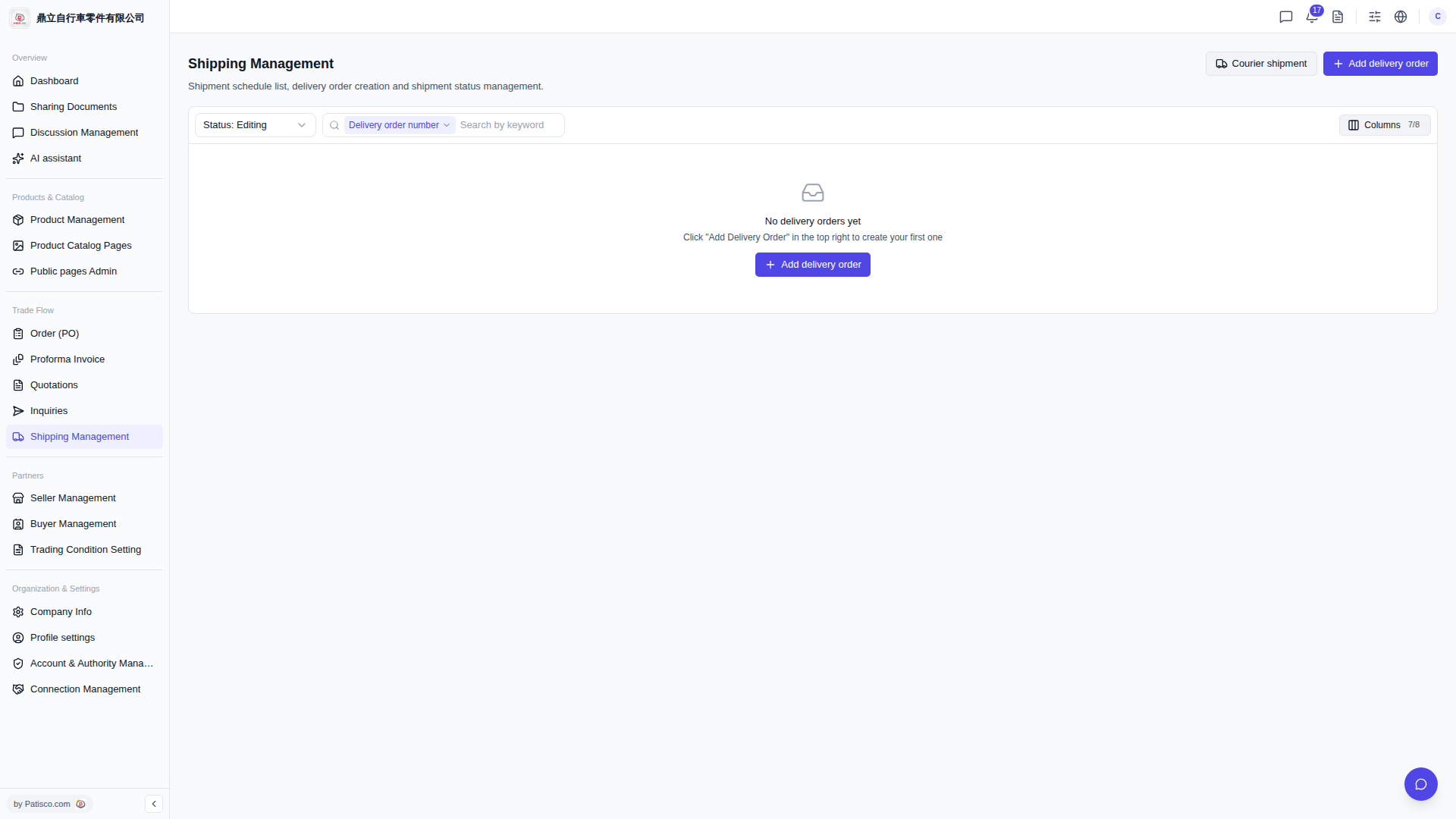 V5 新桌面版|ship.quick.entry
How do I know which documents need my attention on the V5 dashboard?
1. After logging in, go to the Dashboard page. 2. Find the "Documents needing action" section, which will list documents that are overdue or about to expire. 3. If the data appears to not be updated, click the "Refresh" button on the right side of the section to reload the latest data.
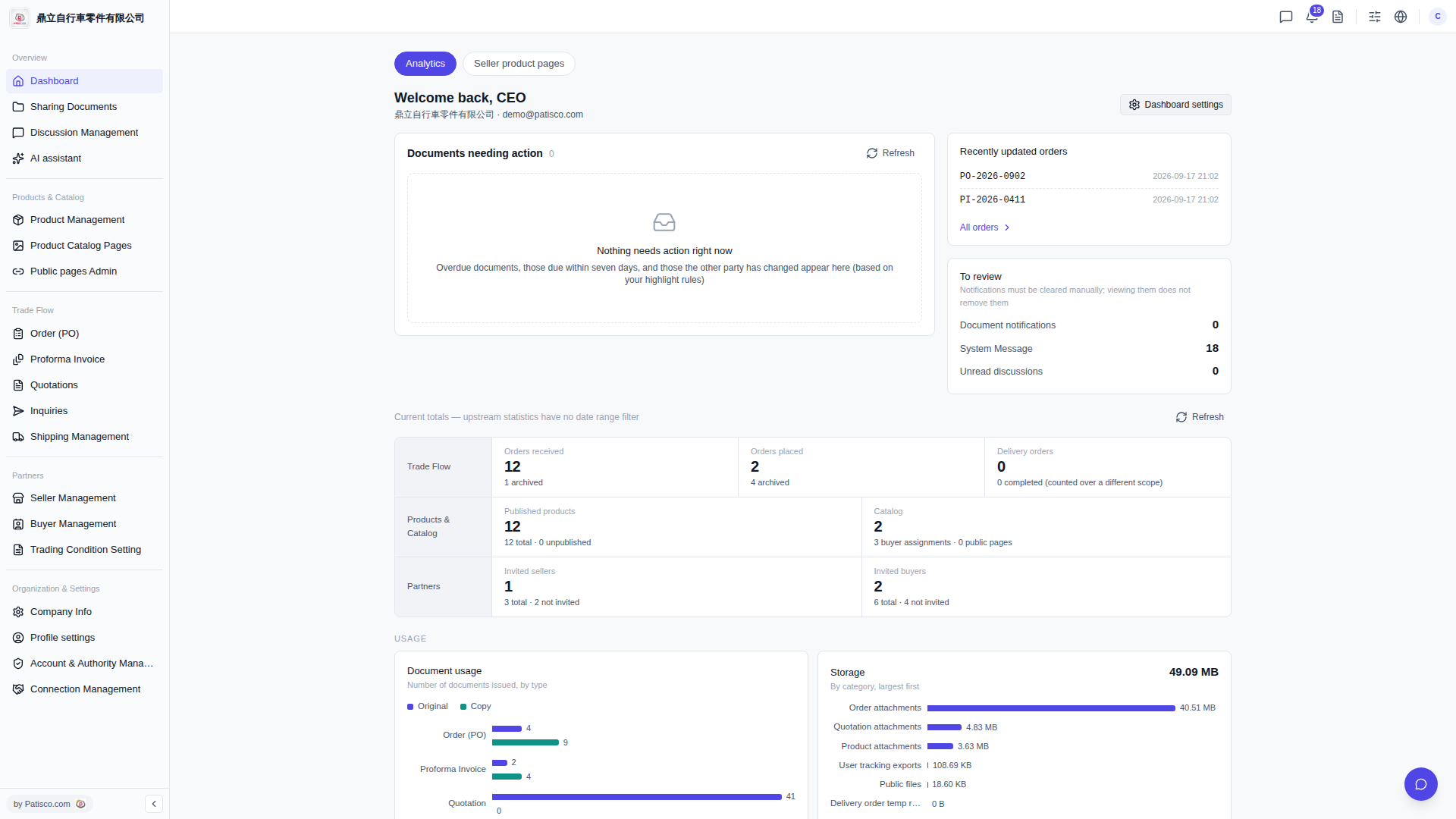 V5 新桌面版|Dashboard(儀表板)
How do I view the statistics on the V5 dashboard (number of orders, products, etc.), and can I adjust which items are displayed?
1. On the Dashboard page, scroll down to find the "Current totals" section, which displays overall summary data such as Orders received, Orders placed, Delivery orders, and Published products. 2. If the numbers are not updating in real time, click the "Refresh… Read the full answer →
V5 新桌面版|Dashboard(儀表板)I opened the catalog page using a buyer account, but I see "No permission for this module". What's going on?
Clicking a supplier's catalog from the [Seller Product Page] does not require [Seller Management] permission. After the system update on 2026-09-30, there was a period when buyer accounts without [Seller Management] enabled would be incorrectly blocked from vi… Read the full answer →
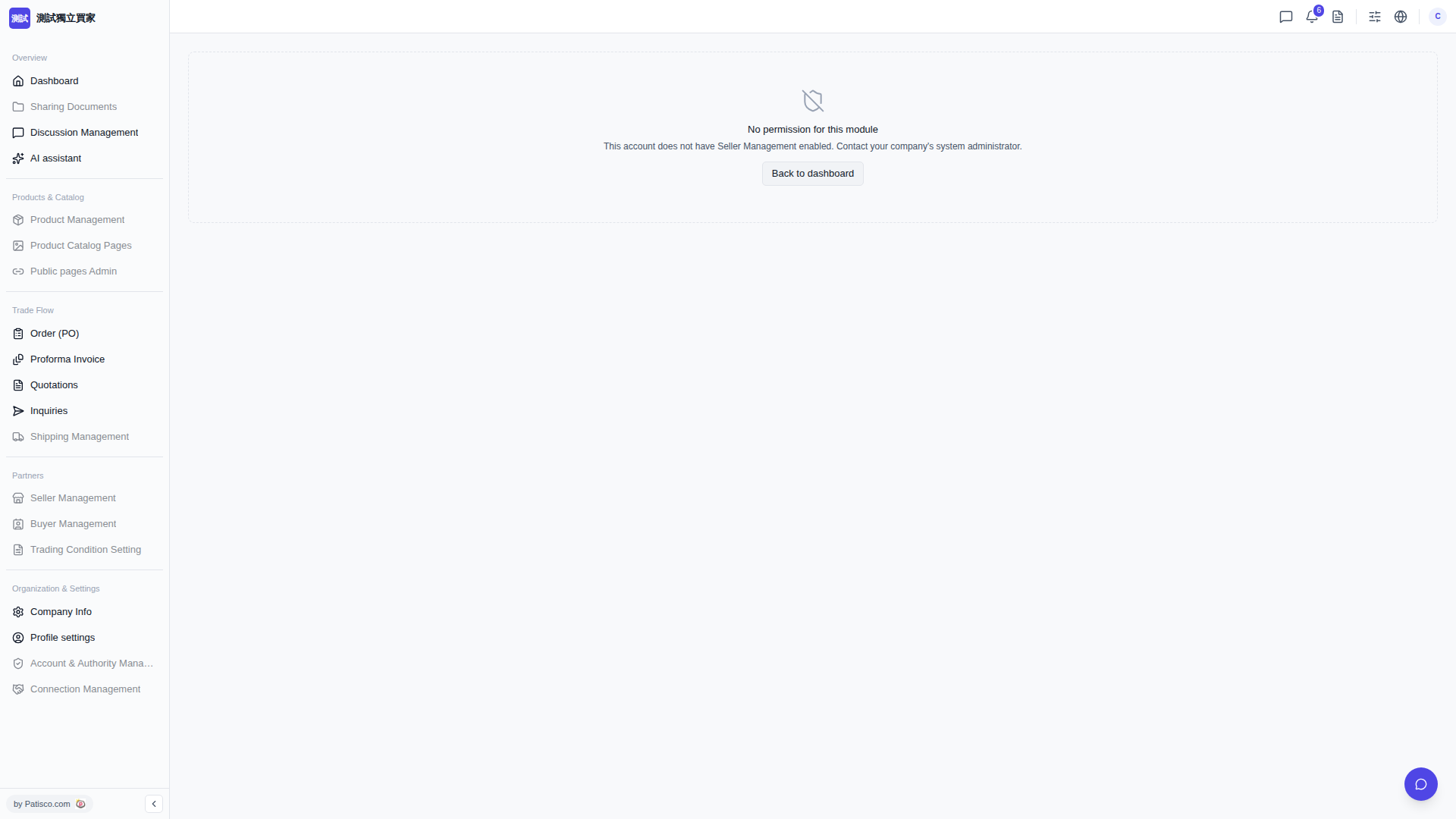 V5 新桌面版|No permission for this module
Where is the PO page in V5? What will I see after entering?
1. In the left sidebar, find the "Sales Process" section and click "PO" to enter the PO list page. 2. After entering, the page title is "PO". There are two tabs above the list: "Sent (PO)" shows the purchase orders you sent, and "Received (PO)" shows the purch… Read the full answer →
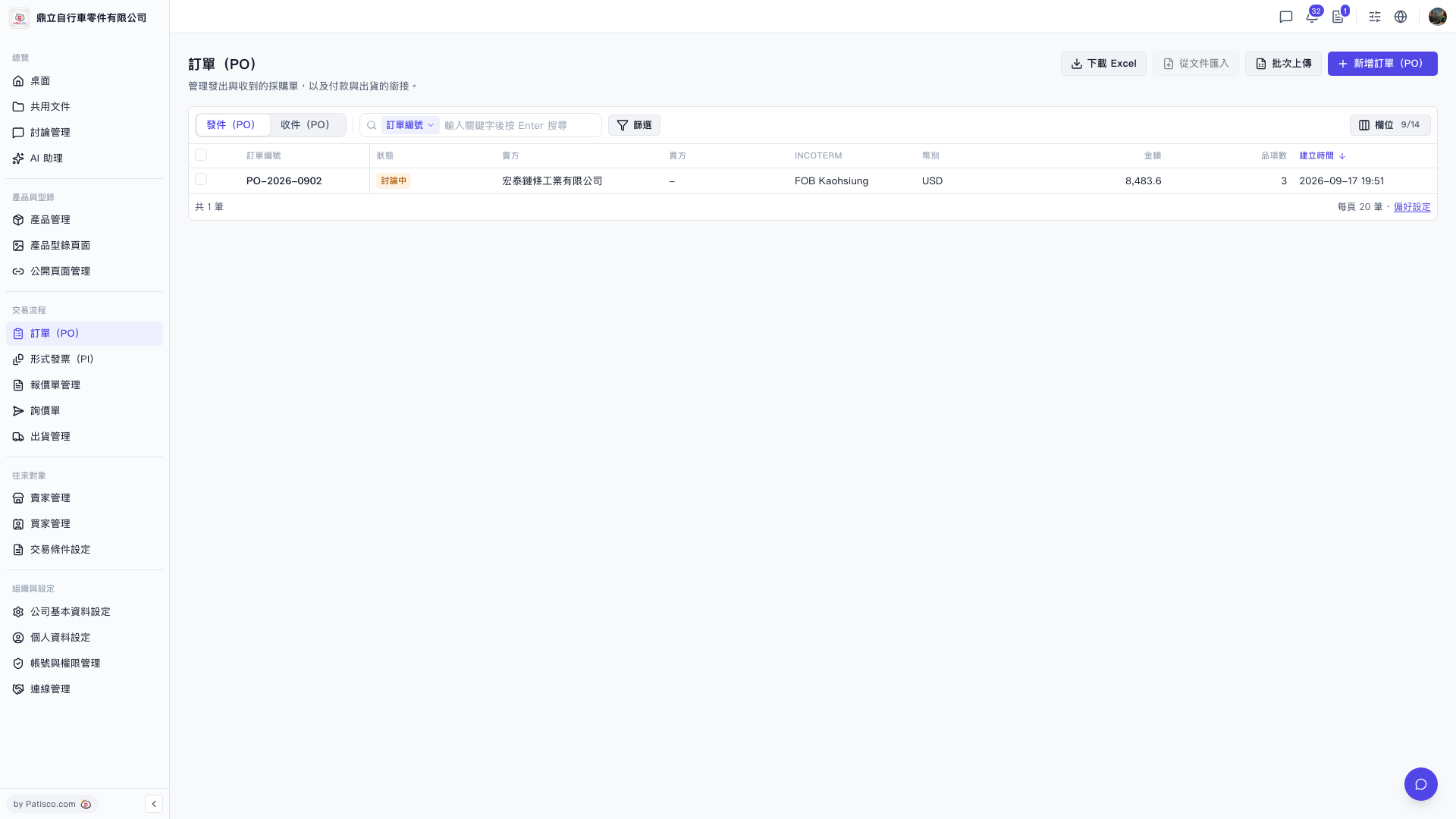 V5 新桌面版|訂單(PO)
The PO list has too many entries. How can I quickly find the one I need?
1. Enter the "PO number" in the search field above the list and press Enter to search for that specific PO. 2. To narrow down the results using multiple conditions, click the "Filter" button to the right of the search field, set your filter criteria, and apply… Read the full answer →
V5 新桌面版|訂單(PO)How do I log in to the Patisco system in V5?
1. Open your browser and go to https://v5.patisco.com/login. You will see the login page. 2. Enter your login account or email address in the "Account / Email" field. 3. Enter your password in the "Password" field. You can click the eye icon on the right side… Read the full answer →
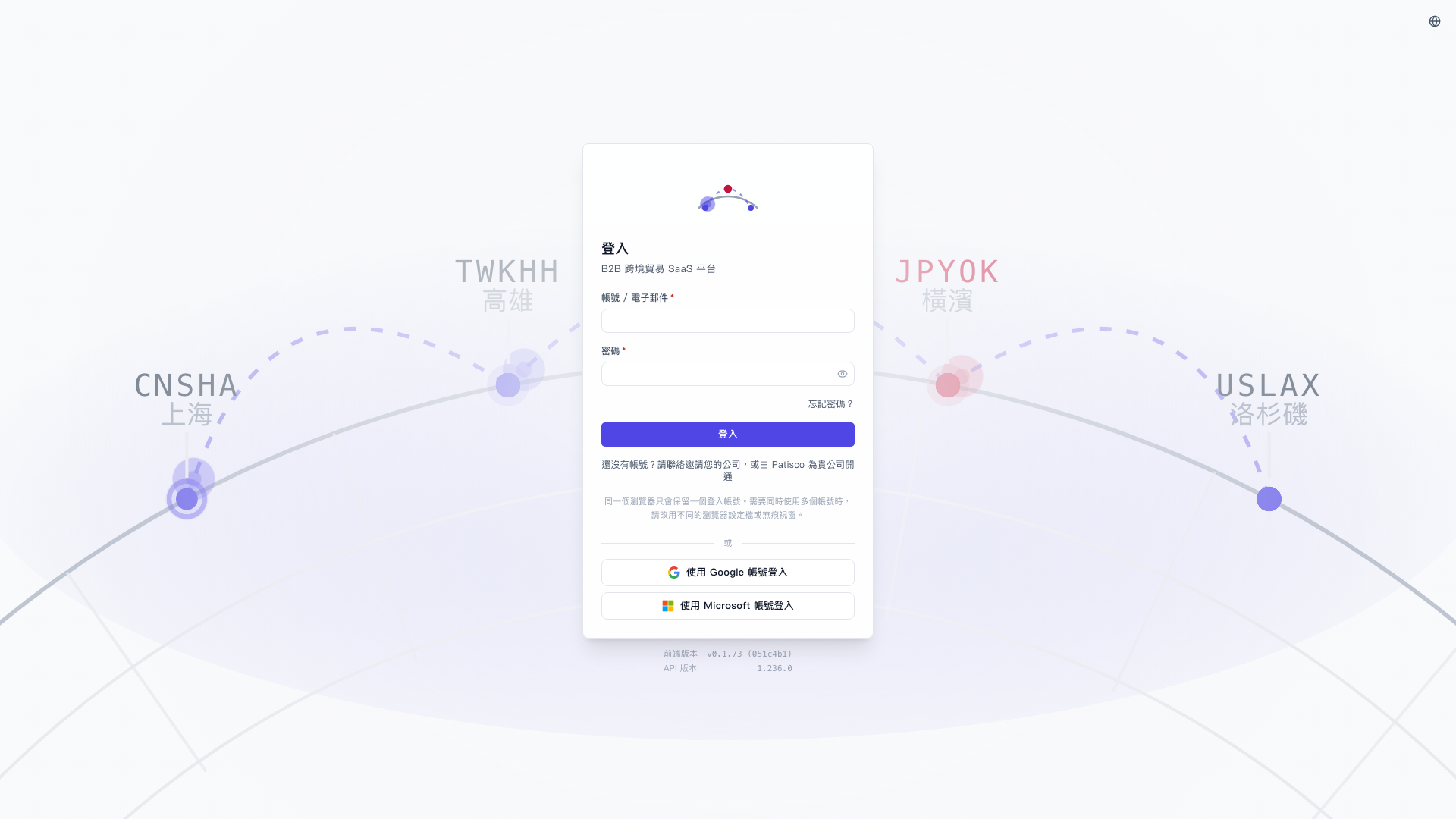 V5 新桌面版|登入
Can I log in to V5 using a Google or Microsoft account? How do I do it?
Yes, provided your company has SSO (Single Sign-On) enabled. Here is how to do it: 1. Open the login page at https://v5.patisco.com/login. 2. Below the divider line, look for the "Sign in with Google" or "Sign in with Microsoft" button. 3. Click the correspond… Read the full answer →
V5 新桌面版|登入How do I set up an AI provider and model in V5?
1. Go to the "Company Basic Settings" page (URL: v5.patisco.com/company-basic). 2. Locate the "AI Settings" section and verify whether the status shows "Enabled". 3. In the "AI Provider" field, select the provider you want to use. Currently, you can choose bet… Read the full answer →
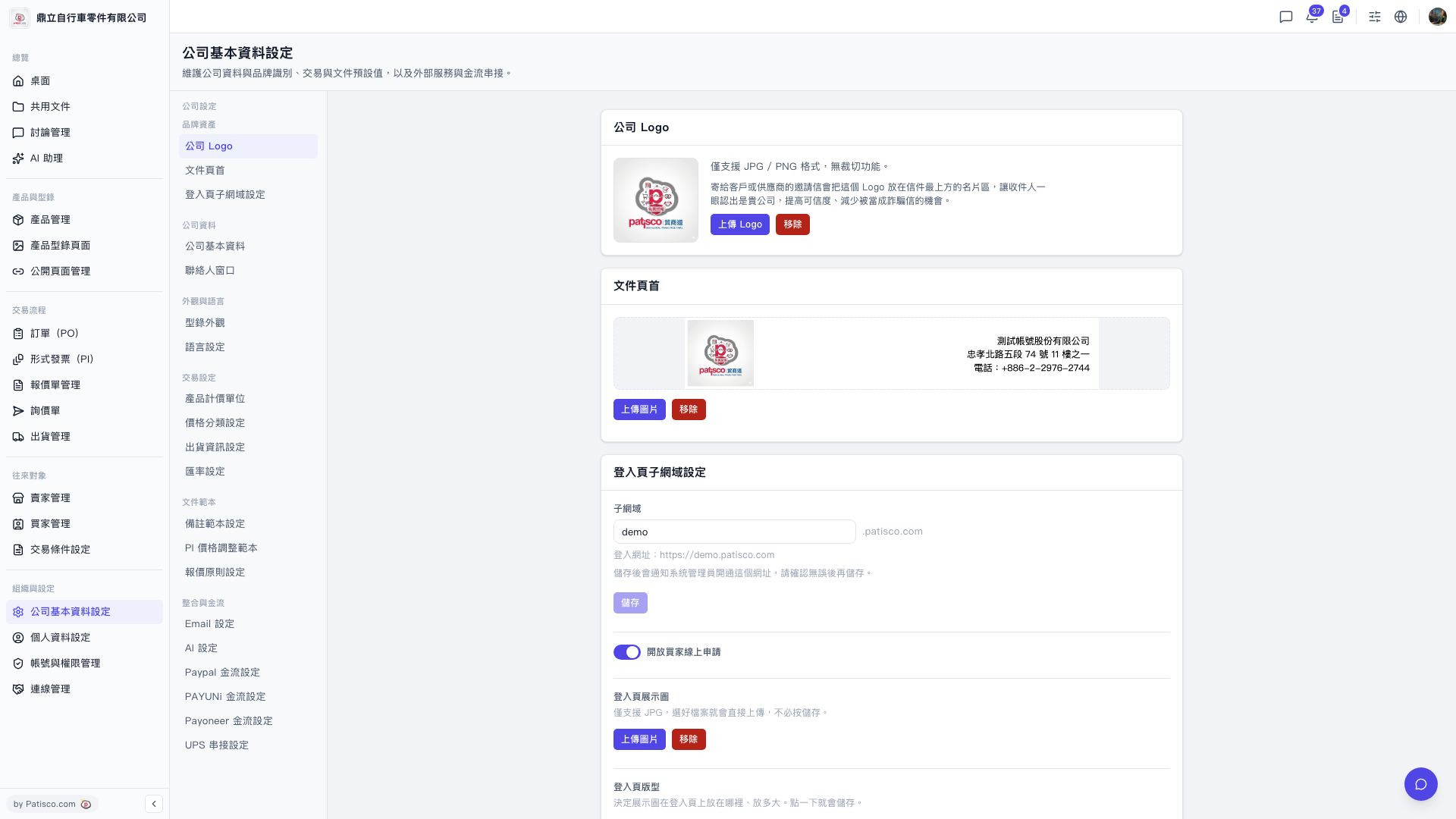 V5 新桌面版|ai.config
What is the "Test Connection" feature for in V5? How do I use it?
1. After completing AI settings and clicking "Update Settings", confirm that the settings have been saved to the upstream server, then click the "Test Connection" button. 2. The system will use the settings saved to the upstream server to actually call the AI… Read the full answer →
V5 新桌面版|ai.configWhere is the quotation management page in V5? What will I see when I open it?
1. Open https://v5.patisco.com/quo in your browser, or click "Quotation Management" from the main menu. 2. The page will display the "Sent" tab by default, which shows the list of quotations sent by us. 3. The list columns include quotation number, buyer, curr… Read the full answer →
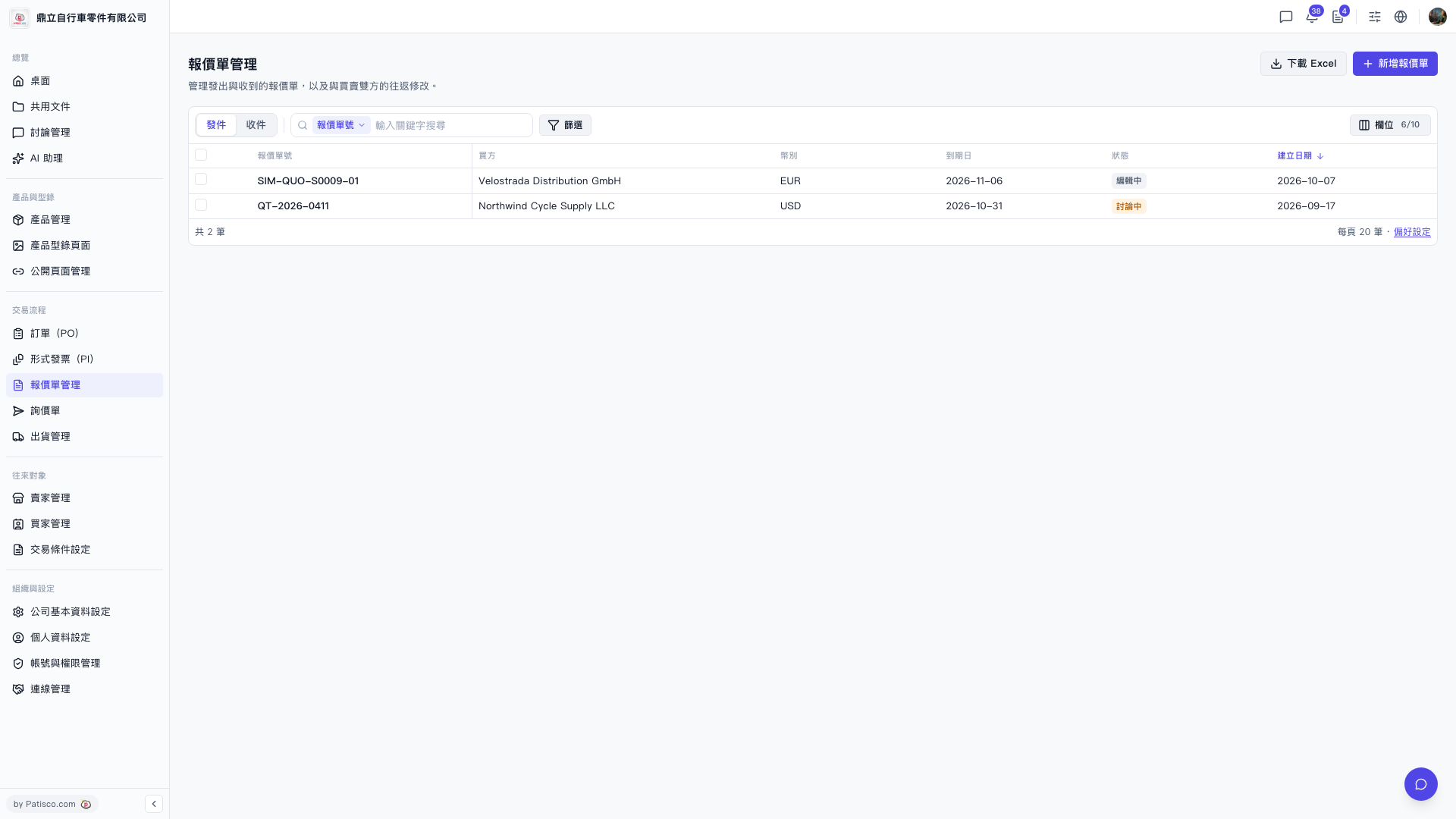 V5 新桌面版|報價單管理
How do I view quotations I received, or quickly find a specific quotation?
1. To view received quotations, click the "Received" tab on the left side of the filter bar at the top of the list. To switch back, click "Sent" again. 2. To search for a specific quotation, enter a keyword in the search box (such as quotation number or buyer… Read the full answer →
V5 新桌面版|報價單管理How can a buyer find the products they want on the product catalog page?
1. After opening the product catalog page, you can click "Category" or "Brand" in the left filter panel (for example, PATISCO Trading Solutions, Sales System) to narrow down the product range. 2. For further filtering, you can check options such as "Public Dis… Read the full answer →
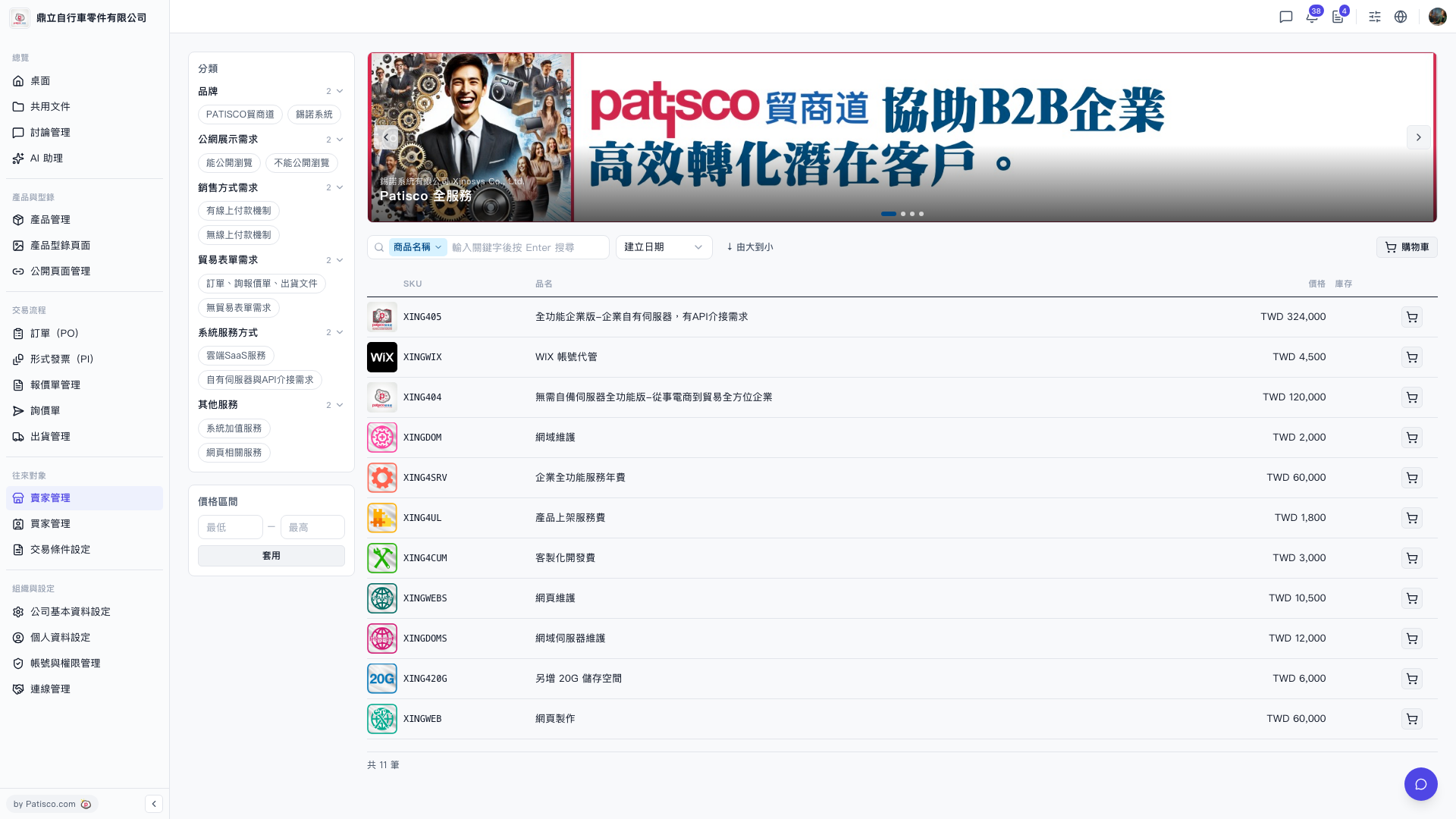 V5 新桌面版|貿家管理 - 產品目錄(公開買家頁面)
After finding a product on the product catalog page, how do I add it to the shopping cart?
1. Find the target product in the product list, then click the "Add to Cart" icon on the right side of that row to add the single product to your cart. 2. To verify which products you have selected, click the "Shopping Cart" icon in the top right corner to vie… Read the full answer →
V5 新桌面版|貿家管理 - 產品目錄(公開買家頁面)How do I open the AI assistant in V5 to ask a question?
1. Go to https://v5.patisco.com/ai-assist in your browser, or open the "AI assistant" page from the menu. 2. After the page loads, directly enter your question in the "Message Input Box" at the bottom of the screen. 3. Press Enter to send your question. If you… Read the full answer →
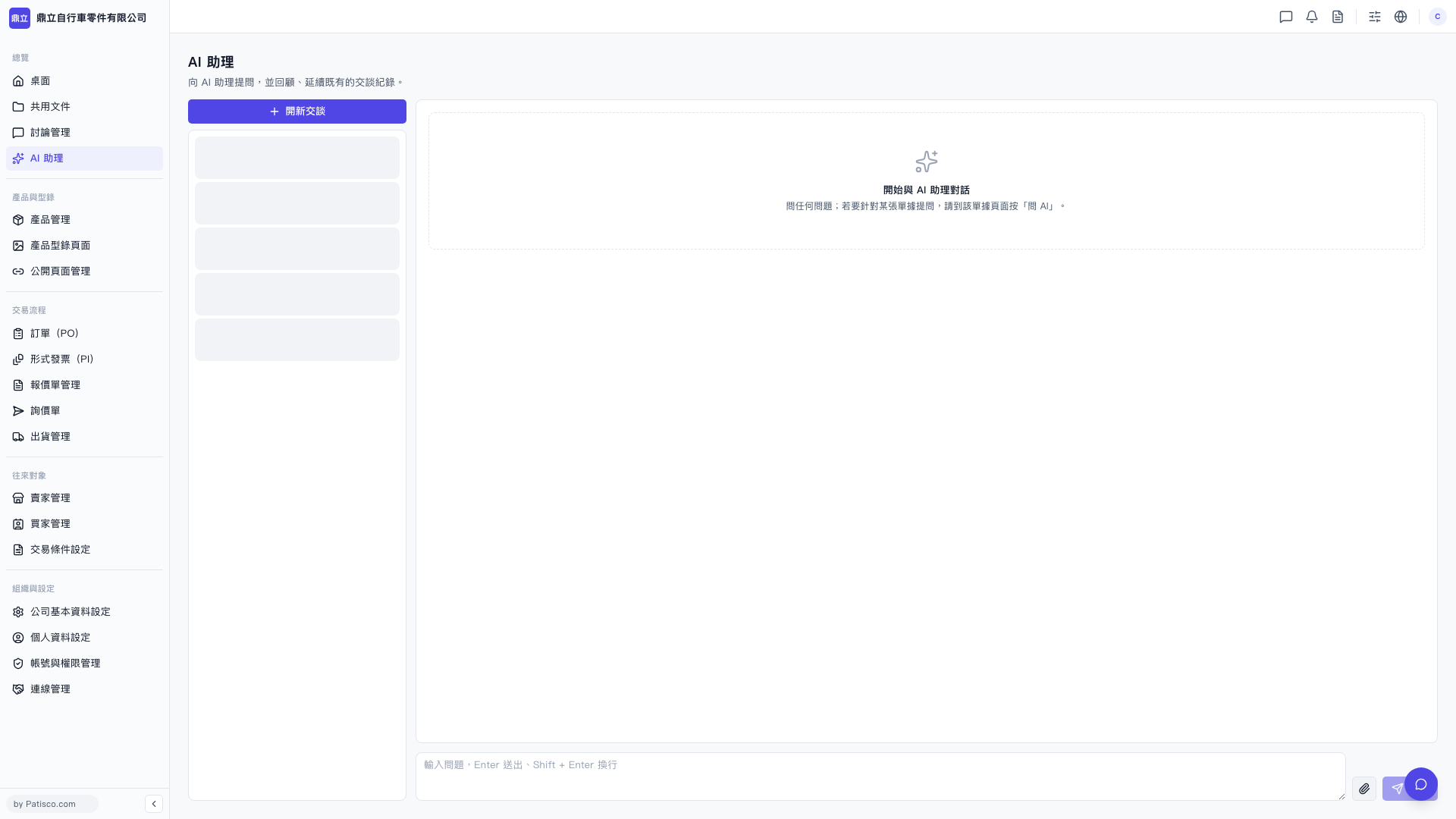 V5 新桌面版|AI 助理
How do I ask the AI assistant a question about a specific order or product? Also, how do I retrieve historical conversations?
Asking about a specific page: 1. First, navigate to the page you want to ask about (for example, an order page or product page). 2. Click the "Ask AI" button on that page. The system will automatically incorporate the context of that page, allowing the AI assi… Read the full answer →
V5 新桌面版|AI 助理How do I open the AI assistant in V5 to ask a question?
1. After logging in, go to the "AI assistant" page (the URL bar will display /ai-assist). 2. Click "+ New Conversation" at the top of the conversation list on the left side to create a new conversation session. 3. Enter your question in the message input box a… Read the full answer →
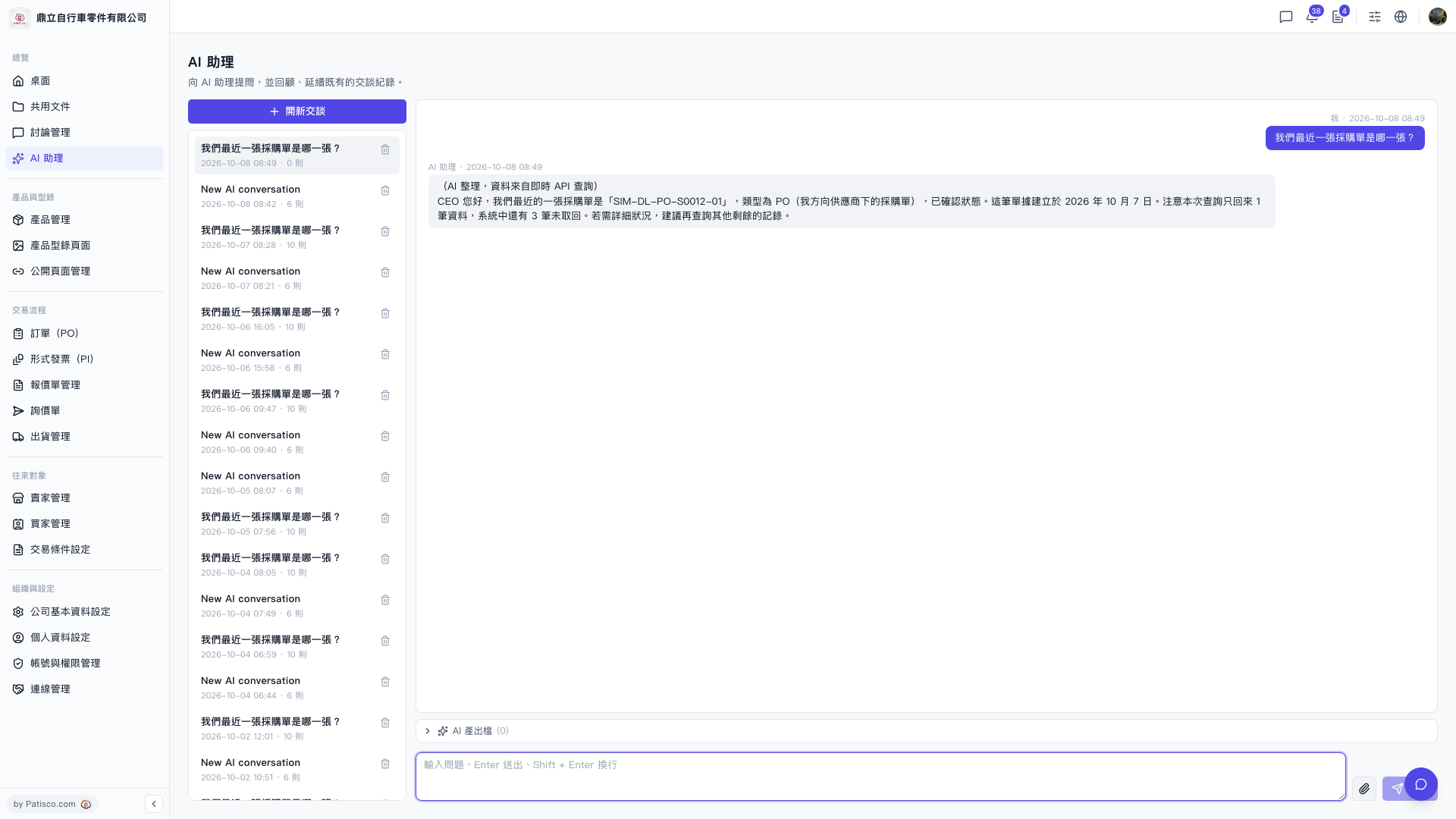 V5 新桌面版|AI 助理
How do I manage the AI assistant's historical conversations? Can I see files generated by AI?
1. To continue a previous conversation, simply click on the corresponding conversation record in the list on the left side to switch to it. 2. To delete unwanted historical conversations, click the "Trash" icon on the right side of that conversation record. 3.… Read the full answer →
V5 新桌面版|AI 助理How do I upload an attachment to the V5 AI assistant for analysis?
1. Go to the "AI assistant" page, then click the "Attachment upload (paperclip icon)" in the bottom right corner of the message input box. 2. Select the file you want to analyze from your computer and upload it. 3. Type your question in the input box, for exam… Read the full answer →
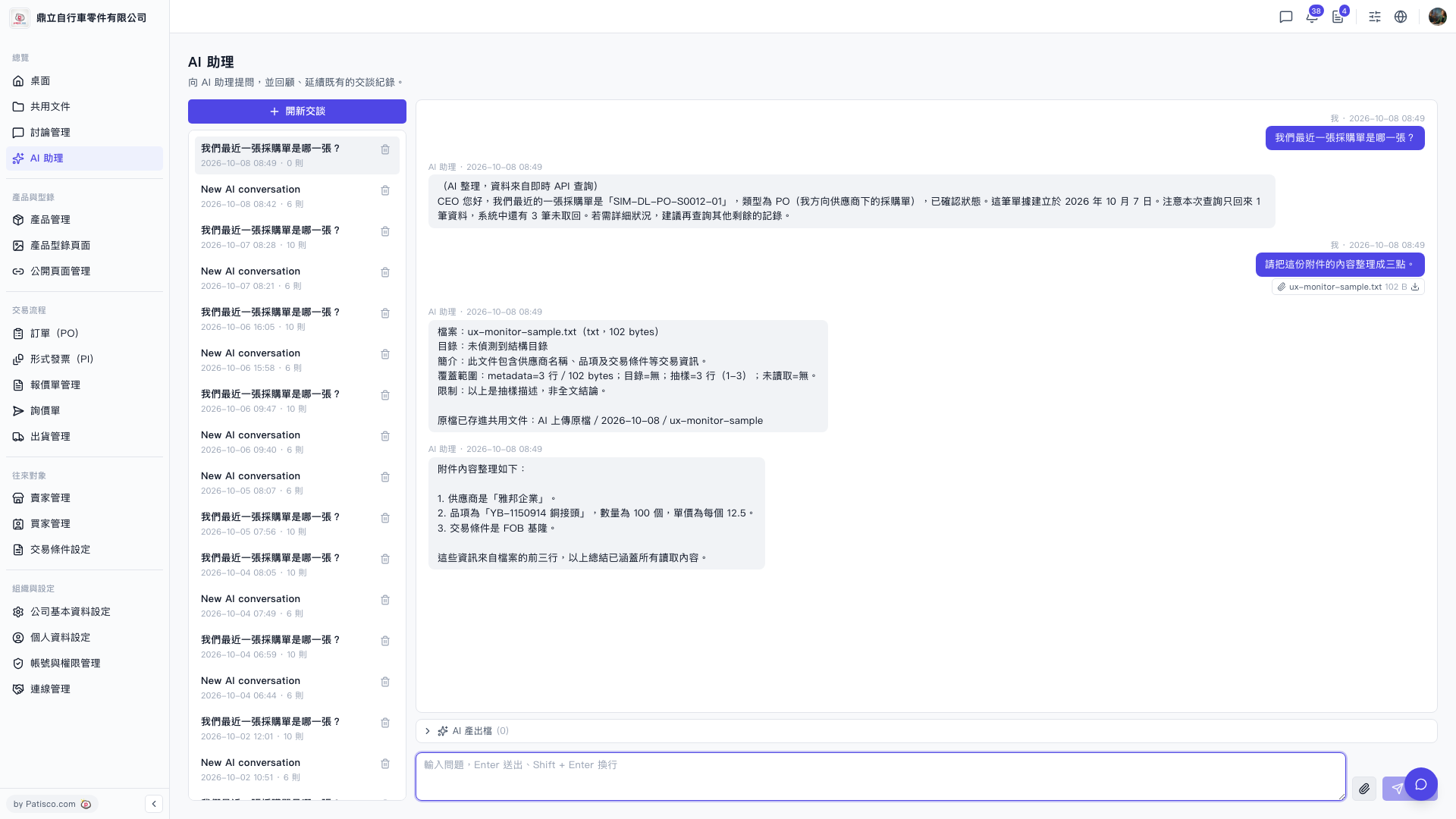 V5 新桌面版|AI 助理
Can I find the original attachment uploaded to the V5 AI assistant later?
Yes, you can. After the AI assistant analyzes an attachment, it automatically stores the original file in the shared documents. The path format is "AI 上傳原檔/upload date/filename", for example "AI 上傳原檔/2026-10-08/ux-monitor-sample". You can retrieve it from the… Read the full answer →
V5 新桌面版|AI 助理How do I use the V5 AI assistant to import supplier CSV?
1. Click "AI assistant" on the left sidebar to open the AI chat page. 2. Click "New Chat" in the top left corner to start a new conversation. 3. Click the "Attachment (paperclip icon)" on the left side of the input box and upload your supplier CSV file. 4. Typ… Read the full answer →
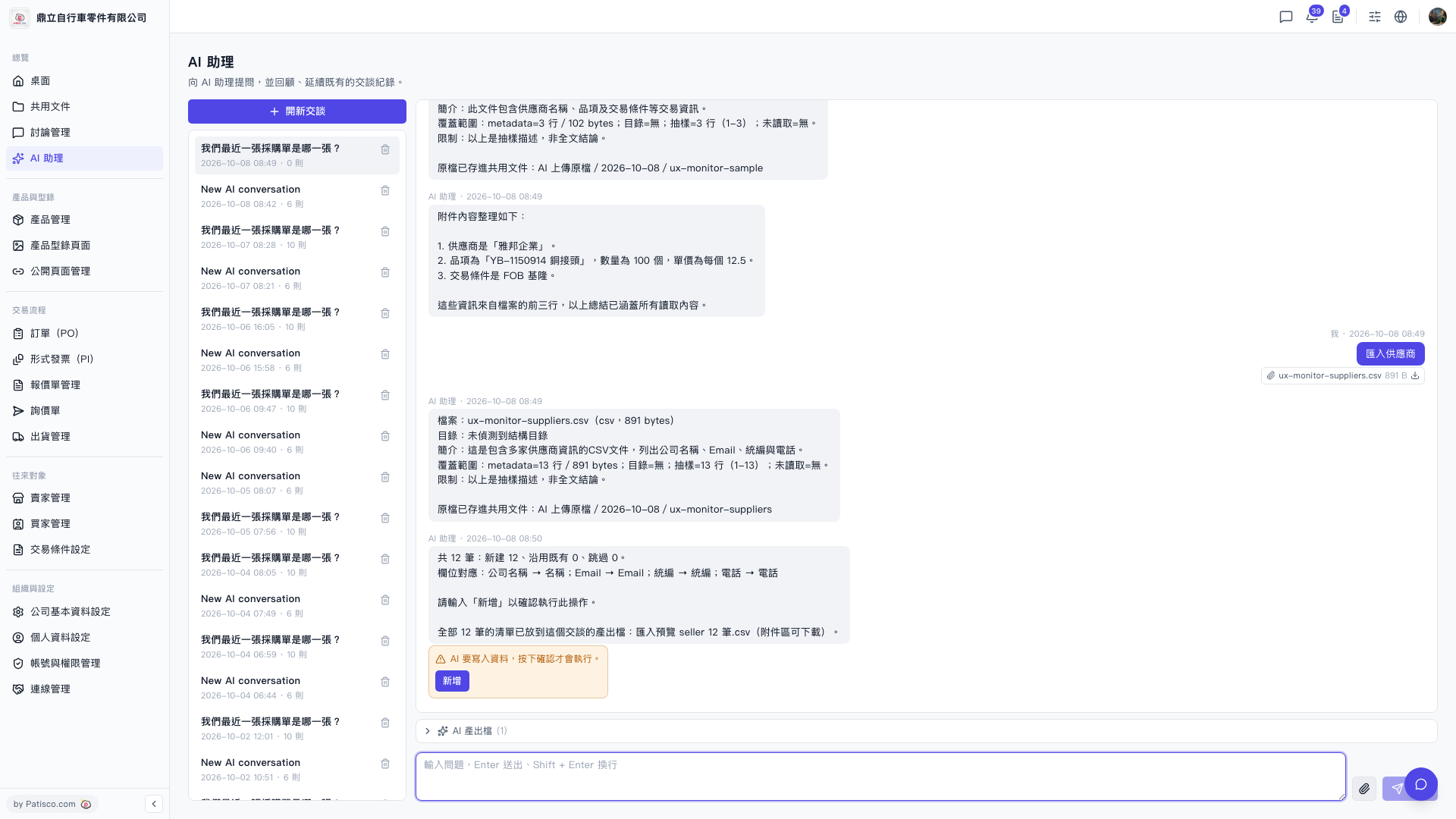 V5 新桌面版|AI 助理
How do I download the CSV result file after importing with the AI assistant?
1. On the AI assistant chat page, wait for the AI to complete analysis and display the import preview. Then the output CSV file will appear in the attachment field in the conversation area (for example, "Import Preview seller 12 records.csv"). 2. Click the "Do… Read the full answer →
V5 新桌面版|AI 助理How do I filter products I want on the V5 buyer catalog page?
On the "Catalog layout" page, there are several filtering methods: 1. Category filtering: Click a category name in the left "Category" section (for example, "Transmission and Wheel Group") to display only products in that category. 2. Price range filtering: In… Read the full answer →
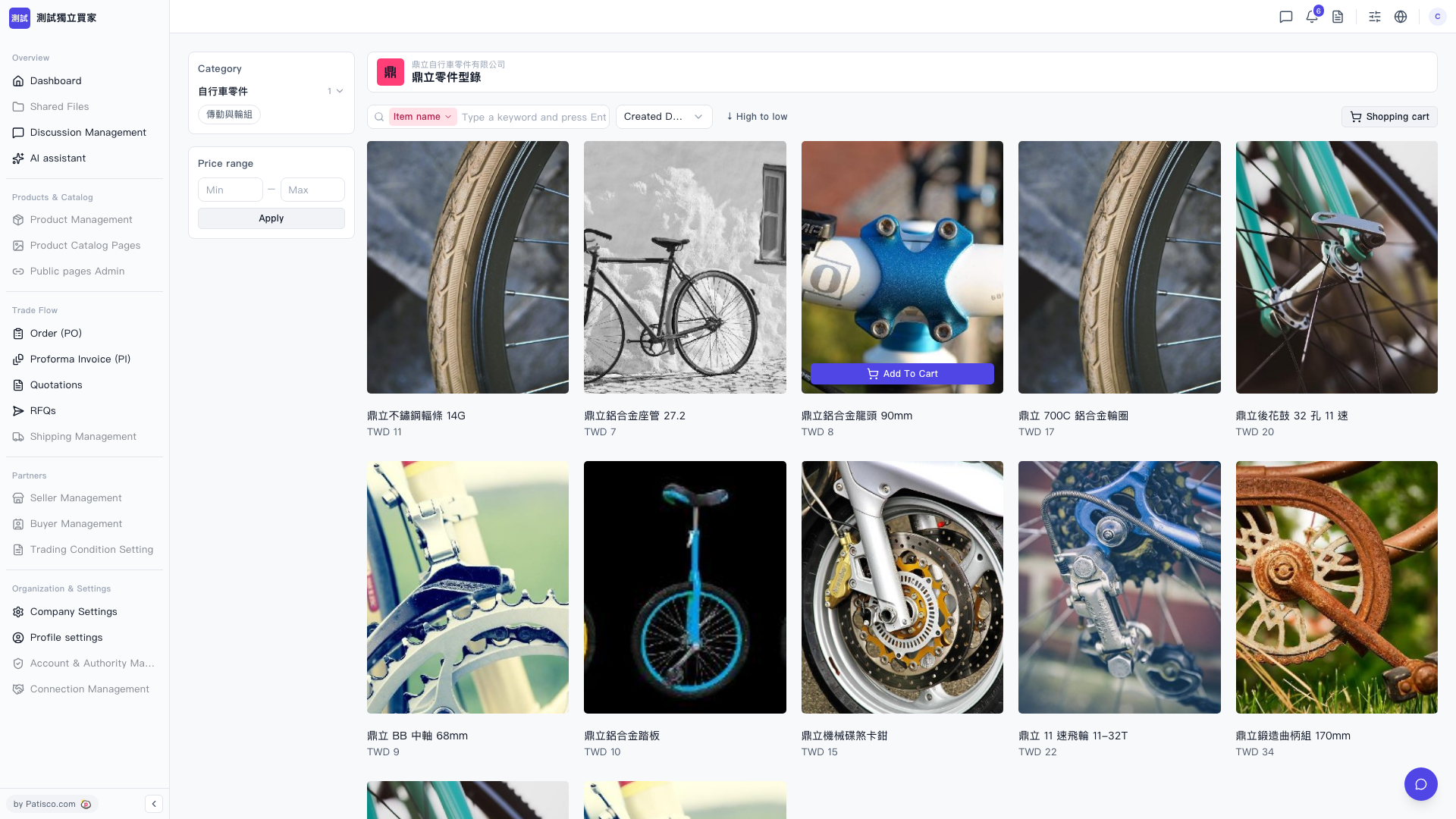 V5 新桌面版|鼎立零件型錄
How do I add a favorite product to the cart as a buyer on V5?
On the "Catalog layout" page, follow these steps: 1. Hover your mouse over the target product card. The "Add To Cart" button will appear on the card. 2. Click "Add To Cart" and the product will be added to your shopping cart. 3. To view the products you have a… Read the full answer →
V5 新桌面版|鼎立零件型錄How do I set up a UPS authorization link on V5?
1. After logging into the V5 new desktop version, navigate to https://v5.patisco.com/company-basic#ups-setting (or scroll down on the company basic settings page to find the UPS setting section). 2. Find the "UPS Authorization" field. The current status will s… Read the full answer →
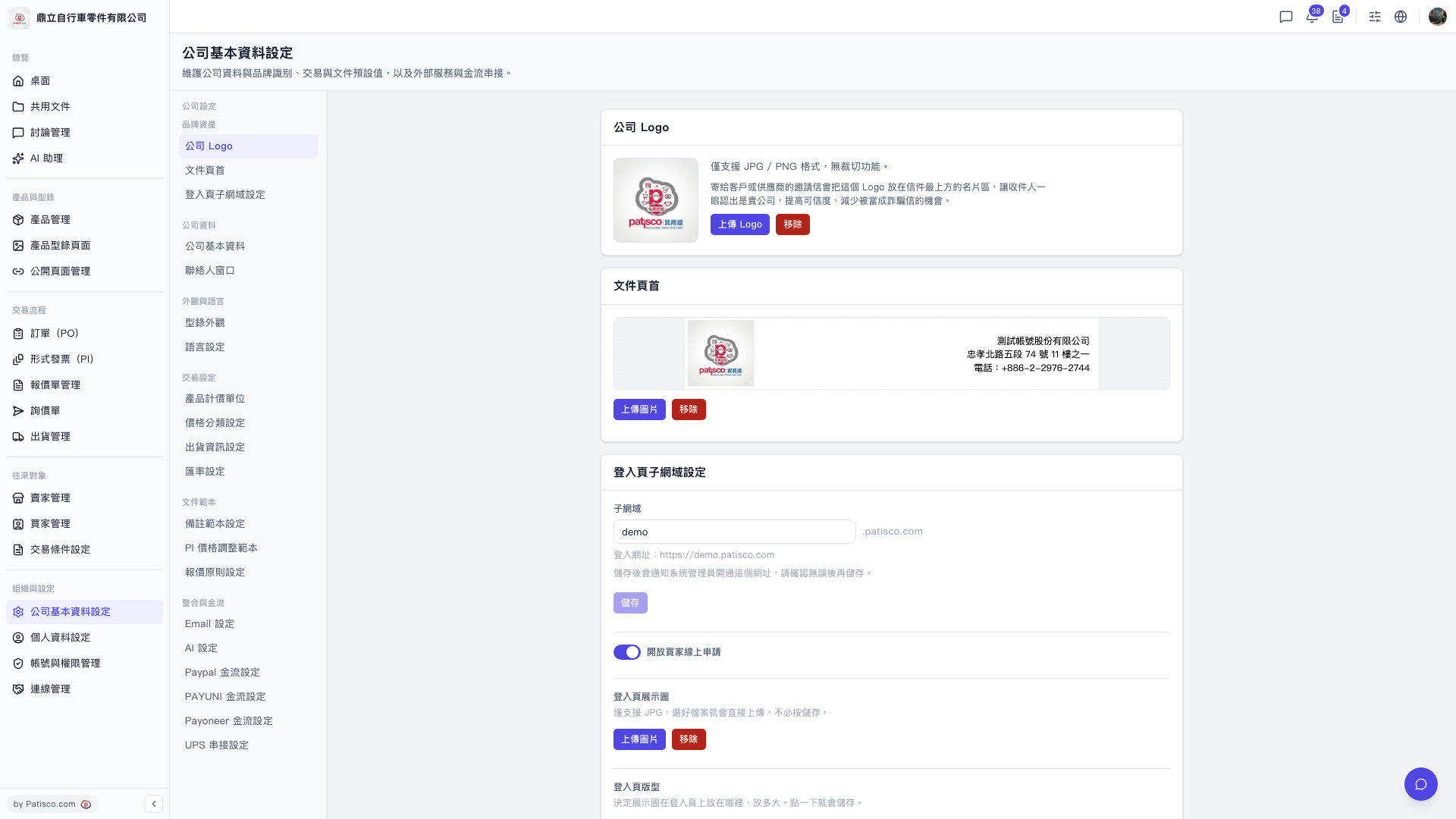 V5 新桌面版|ups.setting
How do I get the payment link for this PI on V5?
1. Open the PI page (URL format such as v5.patisco.com/pi/…). 2. Find the "Get Payment Link" button on the page and click it to obtain the link. 3. Copy the link and send it to your customer for payment. You can ask the AI assistant like this: "How do I let m… Read the full answer →
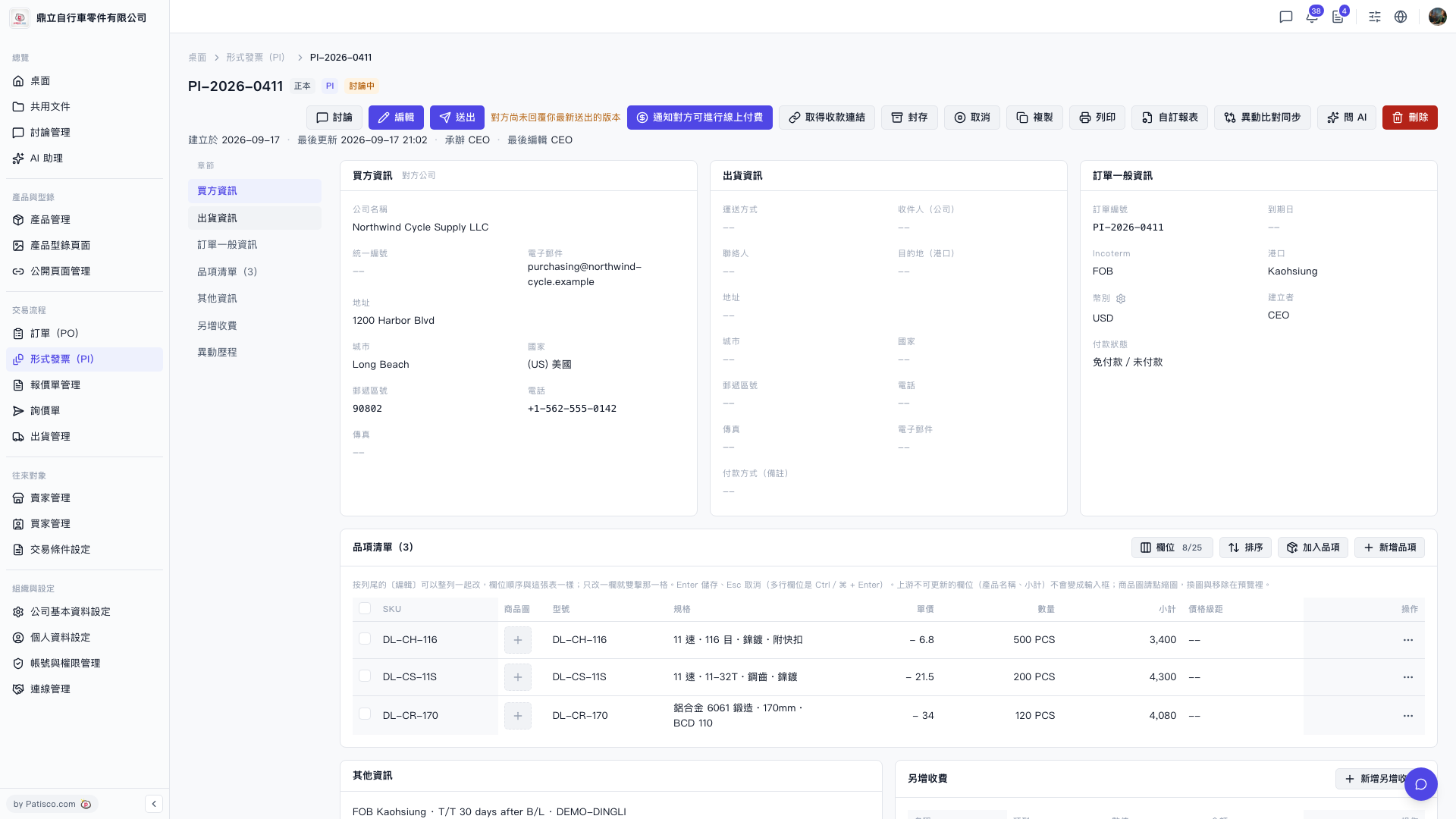 V5 新桌面版|pi.payment.entry
What information can I edit on the My Profile page in mobile version?
On the My Profile page, you can edit the following: 1. Avatar: Tap the pencil icon in the bottom-right corner of your avatar to upload or change your profile picture. 2. ACCOUNT section: Tap "Login Email" to view or modify your login email; tap "Password" to c… Read the full answer →
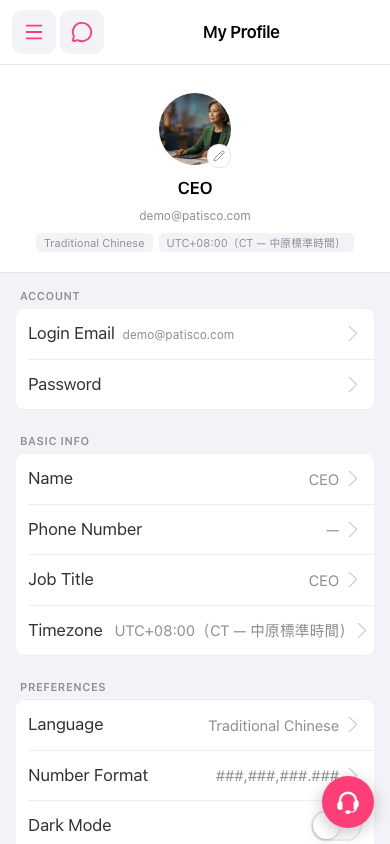 手機版|My Profile
How do I switch to dark mode on the mobile version?
1. Go to the "My Profile" page (https://mobile.patisco.com/main/userbasic). 2. Scroll down to the "PREFERENCES" section. 3. Find the "Dark Mode" option and toggle the switch on the right to change between dark and light themes. No need to save separately.
手機版|My ProfileHow do I log in to Patisco on mobile?
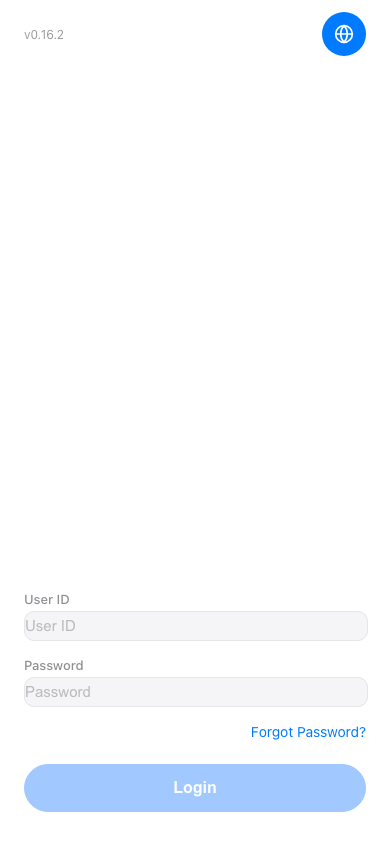
1. Open https://mobile.patisco.com/logon in your mobile browser. 2. Enter your account in the "User ID" field. 3. Enter your password in the "Password" field. 4. Click the "Login" button at the bottom center. Once verified, you will enter the system.
 手機版|登入
I forgot my password on the mobile login page. Can I change the language?
Forgot password: On the login page, click the "Forgot Password?" link at the bottom right of the password field and follow the on-screen instructions to complete the password reset process. Change language: Click the globe icon in the top right corner and select your preferred display language.
手機版|登入What does the mobile Dashboard display by default? How do I view a seller's product catalog?
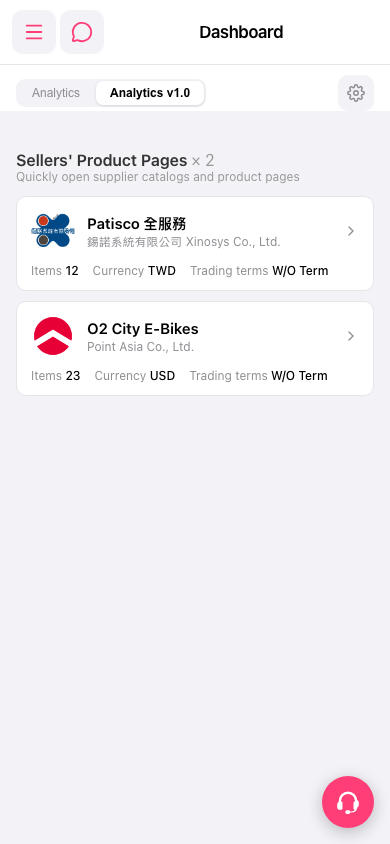
1. When you open the mobile version of Patisco, the system defaults to the Dashboard and displays the "Analytics v1.0" tab. 2. Scroll down to see the "Sellers' Product Pages" section, which lists all created seller product pages. 3. Click on any seller card (f… Read the full answer →
 手機版|Dashboard
What do the gear icon in the top right and the pink button in the bottom right of the mobile Dashboard do?
1. Top right "Settings gear": Click to open Analytics display settings, which you can use to adjust Analytics-related view options. 2. Bottom right "Customer service floating button" (pink): Click to open customer support chat. If you have any operational ques… Read the full answer →
手機版|DashboardHow do I view a seller's product page on the mobile Dashboard?
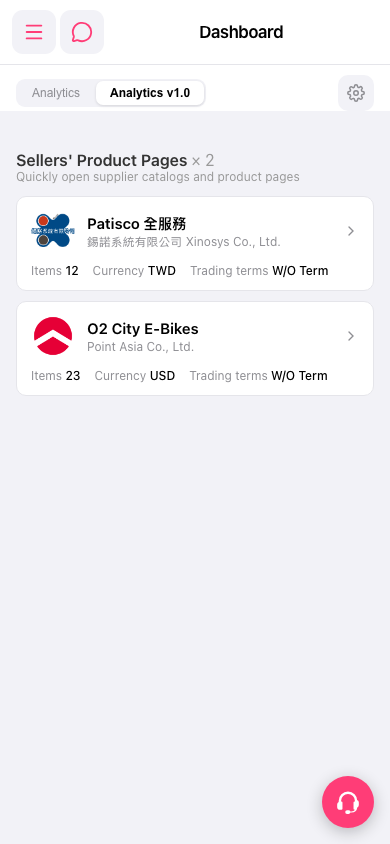
1. Open the mobile version of Patisco and enter the Dashboard page, which defaults to showing the "Analytics v1.0" tab content. 2. Scroll down to find the "Sellers' Product Pages" section, which lists the currently configured sellers (for example, "Patisco Ful… Read the full answer →
 手機版|Dashboard
Where do I adjust the Analytics display settings on the mobile Dashboard?
1. From the Dashboard page, click the "⚙️ Settings icon" in the top right. 2. This opens the Analytics-related settings for configuration. 3. If you want to switch back to the old version, click the "Analytics" tab at the top of the page (currently the "Analyt… Read the full answer →
手機版|DashboardHow do I access the PO page on mobile?
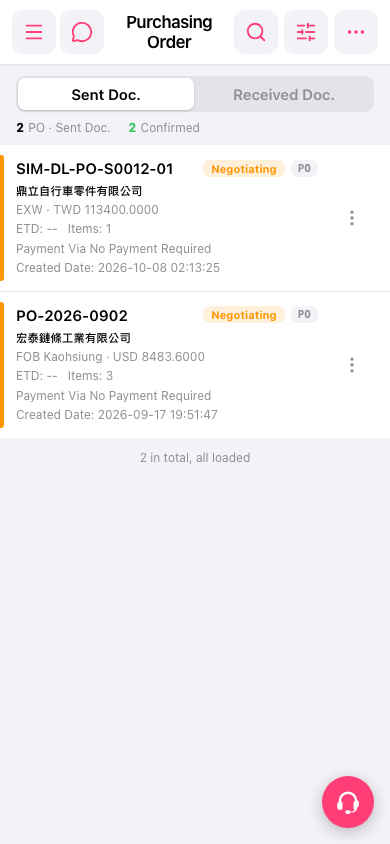
1. Open your mobile browser and go to https://mobile.patisco.com/main/po. 2. Once the page loads, you will see two tabs: "sent" and "received", corresponding to "sent PO" and "received PO" respectively. 3. Click on the corresponding tab to view the list of POs in that category.
 手機版|po.open
How do I view the quotations I sent on mobile?
1. Open the Patisco mobile version and click on the bottom menu to enter the "Quotation Management" page. 2. The page defaults to the "Sent Doc." tab, which directly shows the list of quotations you have sent. 3. The list displays information for each quotatio… Read the full answer →
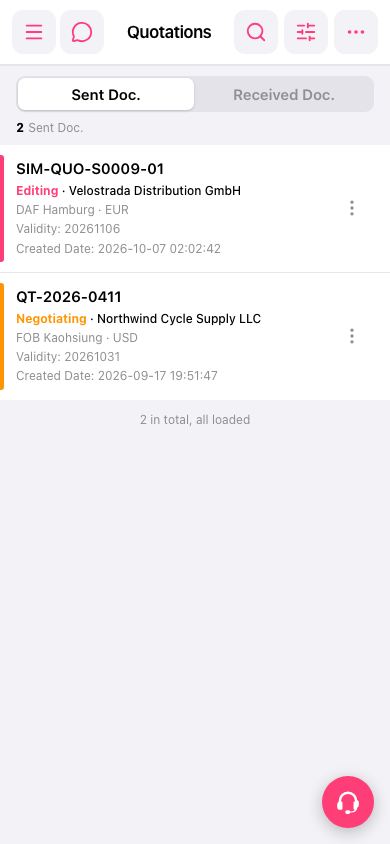 手機版|報價單管理
On the mobile Quotation Management page, how do I search for or filter a specific quotation?
1. After entering the "Quotation Management" page, click the "🔍" search icon in the top right corner, and enter the quotation number or customer name to quickly find it. 2. To filter by conditions, click the "⚙" filter icon in the top right corner to narrow d… Read the full answer →
手機版|報價單管理Where is the discussion area on mobile? What does the screen look like when I enter it?
1. After opening the mobile version of Patisco, enter the "Discussions" page (URL: mobile.patisco.com/main/topic). 2. The top of the screen has two tabs: "Discussion" on the left (general discussion list) and "AI Discussion" on the right (AI discussion mode),… Read the full answer →
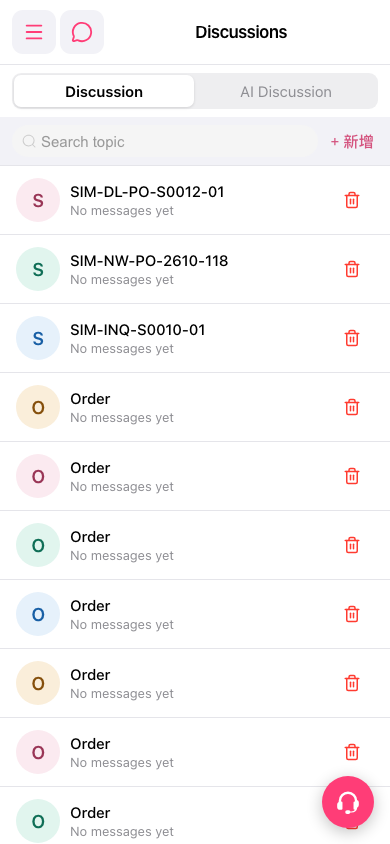 手機版|討論區(Discussions)
How do I add or search for discussion topics on mobile?
Add a discussion topic: 1. On the "Discussions" page, click the "+ Add" button to the right of the search bar. 2. Fill in the topic name and related information in the form that appears. 3. After completing the form, submit it. You will then see the newly adde… Read the full answer →
手機版|討論區(Discussions)On the mobile "Shared Files" page, how do I add a main folder?
1. After entering the "Shared Files" page, find the "+ Add Main Folder" button at the top center of the page. 2. Click "+ Add Main Folder". 3. Follow the on-screen prompts to enter the folder name and save.
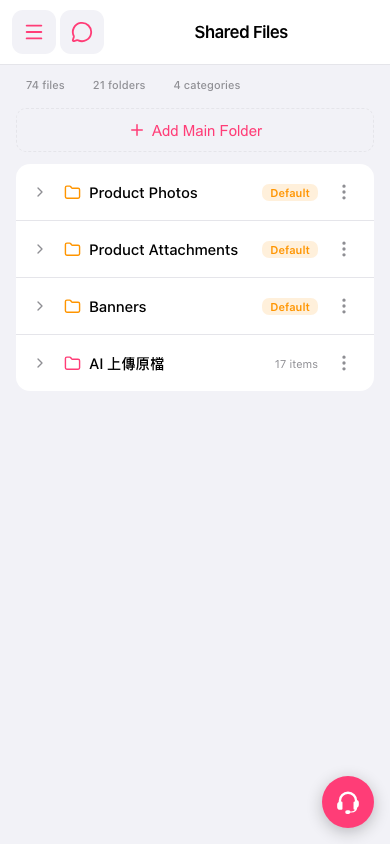 手機版|共享檔案(Shared Files)
How do I view folder contents or perform more operations on folders in the mobile version of 'Shared Files'?
To view folder contents: 1. Find the folder you want to view on the 'Shared Files' page. 2. Click the '>' arrow on the left side of the folder name to expand subfolders or file lists. 3. You can also click the folder name directly to view detailed contents. T… Read the full answer →
手機版|共享檔案(Shared Files)How do I open the AI assistant on the mobile version to ask questions?
1. After opening the mobile version of Patisco, open the 'New AI conversation' page (URL: mobile.patisco.com/main/topic). 2. The screen will display an empty conversation area with the prompt 'No messages yet'. 3. Click the input field at the bottom 'Ask AI a… Read the full answer →
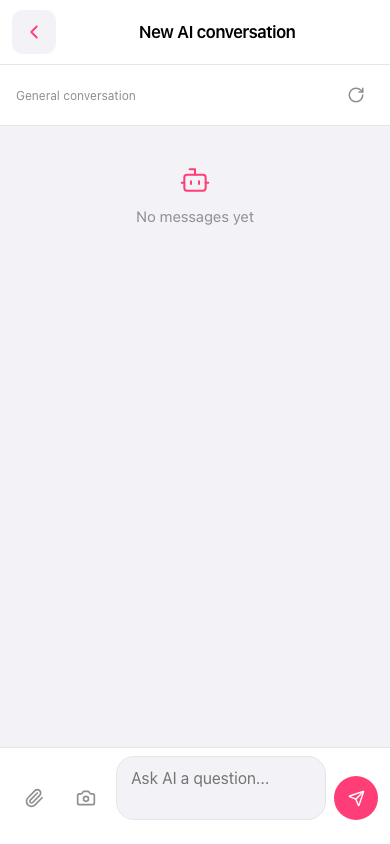 手機版|新 AI 對話(New AI conversation)
Can I upload files or photos in the mobile version of AI conversation? How do I do it?
Yes, there are two ways: 1. Upload a file: Click the 'Attachment' (paperclip icon) on the left side of the bottom input row and select the file you want to upload. 2. Upload a photo: Click the 'Camera' icon in the middle of the bottom input row and take a phot… Read the full answer →
手機版|新 AI 對話(New AI conversation)How do I use the AI assistant on the mobile version to look up trading data?
1. Open the 'AI conversation (New AI conversation)' page and confirm the page title shows 'New AI conversation'. 2. Click the input field at the bottom (showing the prompt text 'Ask AI a question...') and type your question. 3. Click the pink arrow button on t… Read the full answer →
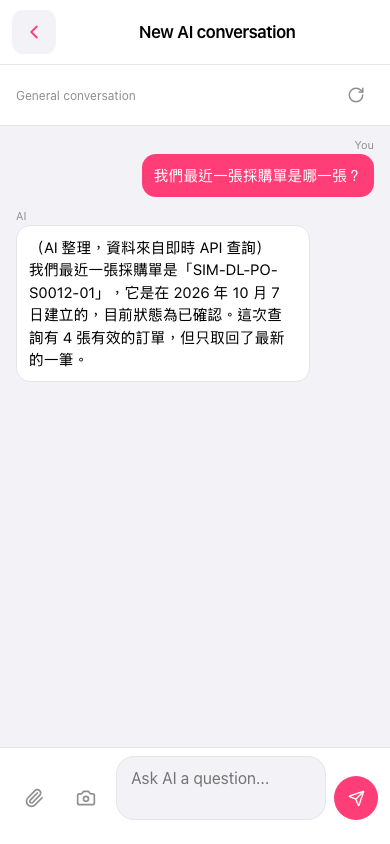 手機版|AI 對話(New AI conversation)
Can I attach files or photos together with my question on the AI conversation page?
Yes. At the bottom of the 'AI conversation (New AI conversation)' page, there are two icons on the left side of the input row: 1. Click the paperclip icon to attach a local file to the conversation. 2. Click the camera icon to take a photo or select an image f… Read the full answer →
手機版|AI 對話(New AI conversation)How do I use the AI assistant on the mobile version to import CSV supplier data into the system?
1. Open the 'AI conversation (New AI conversation)' page. 2. If you need to upload a CSV file, click the 'Attachment icon (paperclip)' at the bottom left to select the file. 3. Type 'Import suppliers' in the bottom input field, then click the 'Send button (pin… Read the full answer →
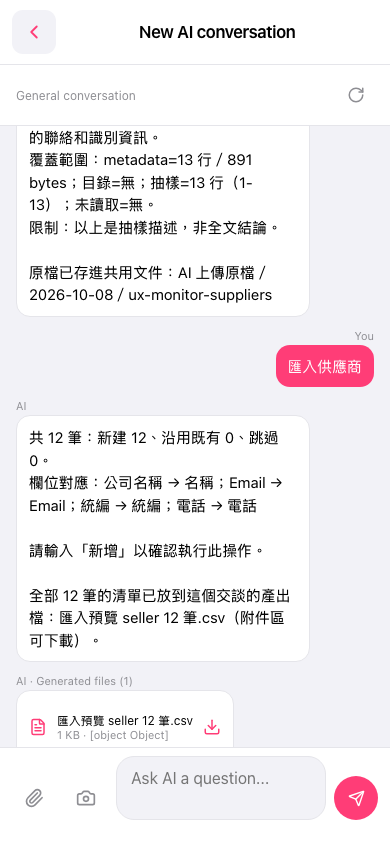 手機版|AI 對話(New AI conversation)
After the AI import is complete, how do I download the preview CSV file?
1. After the AI replies, find 'Import preview seller 12 records.csv' in the attachment area below the message. 2. Click the download icon on the right side of the file to save the preview CSV to your device. Known situation: Currently, although the reply indi… Read the full answer →
手機版|AI 對話(New AI conversation)Can I log in to Patisco with a Google or Microsoft account? What are the requirements?
Yes. The login page of the V5 new desktop version (https://v5.patisco.com/login) has two additional buttons besides username and password: "Sign in with Google" and "Sign in with Microsoft". There is only one requirement: the email address of that Google or Mi… Read the full answer →
After switching to Google or Microsoft login, can I still use my original password? Do I need to set it separately?
Your password remains usable. Both login methods coexist. SSO is just an additional login path and does not cancel or change your original password. If you cannot log in with your Google or Microsoft account one day, you can always go back to using your passwo… Read the full answer →
I received an invitation from a business partner. Can I join directly with a Google or Microsoft account?
Yes. After clicking the "Accept invitation" button in the invitation email, the acceptance page will show options to "Create account and accept invitation with Google account" and "Create account and accept invitation with Microsoft account". If you do not hav… Read the full answer →
I want to change my login email address. What is the process? Why do I need to enter my current password?
Go to "Account Settings" in the login account section and click "Change login email". After entering the new email address and your current password, submit the form. Three things will happen: 1. A confirmation email will be sent to the new mailbox. The change… Read the full answer →
I received a notification email at my old mailbox saying "Your login Email will be changed" with a cancel link in it. What is that link for?
That link is a safety brake for the original account owner. When someone requests to change your login Email to another mailbox, the system sends a confirmation email to the new mailbox and also notifies the old mailbox. If you requested this change yourself,… Read the full answer →
What is the difference between "Company Contact Email" and "Login Email"? Where can I change each one?
These are two different things, and changing one does not affect the other: • Login Email (login account): Individual to each user. Used for login, password reset emails, and system notifications. Change it in "Personal Settings". You need to enter your curren… Read the full answer →
Can an administrator change an employee's login Email? What will the employee receive?
Yes. An administrator can find the employee in "Account and Permission Management", change their login Email, and the system will send a confirmation email to the employee's new mailbox. The email will state "Your company administrator has requested to change… Read the full answer →
Can I customize the content of invitation emails sent to customers or suppliers? What parts cannot be changed?
Yes. When sending an invitation in "Account and Permission Management", both the "Invitation Email Subject" and "Invitation Email Content" can be edited. By default, it includes a description of what the recipient can do after joining (view your catalog and pr… Read the full answer →
I don't want the system to send emails. Can I just get the invitation link and share it with the other party via LINE or Email myself?
Yes, you can. The quickest way: go to Buyer Management or Seller Management under Trading Partners, open a contact you haven't invited yet, and click Generate Invitation Link next to Send Invitation. In the dialog box, the delivery method will default to "Gene… Read the full answer →
Where does the company logo and profile photo at the top of the invitation email come from? Why is it recommended to upload them first?
The invitation email has a business card-like section at the top showing your company's logo, the sender's profile photo and name. When the recipient replies, it goes directly to the sender's email address. • Company logo: uploaded by the administrator in "Com… Read the full answer →
When sending invitations, I see "Daily invitation limit reached". How many invitations can be sent per day? Why is the limit lower for new companies?
Each company can send a maximum of 50 invitations per day. New companies established less than 7 days ago that haven't completed any connection yet can send a maximum of 10 per day. The count resets the next day, and "link generation only" invitations count to… Read the full answer →
I received an email claiming to be from Patisco. How do I verify it's not a scam? Where should I report it if it's suspicious?
Genuine Patisco invitation emails have several fixed features you can verify: 1. At the top of the email is a business card section displaying the inviter's company logo, the sender's profile photo and name. It should be from a business contact you recognize.… Read the full answer →
Can I sign in to Patisco using Mac's Touch ID or iPhone's Face ID?
Yes, through your device's built-in password manager. V5's login page is marked as a standard username and password field, so Safari/Chrome's iCloud Keychain or Google Password Manager will recognize it: when you first log in with a password, the browser will… Read the full answer →
The invitation link has expired (the other party says they can't open it). Can I give them a working link directly without sending another email?
Yes. An invitation link is valid for 14 days from creation (or the last time it was resent). After expiration, when the other party opens it they will see "Invitation link has expired, please contact [Name] to refresh it"; the list and detail pages on our side… Read the full answer →
What does it mean when the invitation status shows red [Link Expired] on Connection Management or the buyer list?
It means the invitation was sent (or last refreshed) more than 14 days ago and the other party has not yet accepted it. The invitation link has now expired; when the other party clicks the link they will see "Invitation link has expired". How to handle it: Pre… Read the full answer →
I received an invitation link, but when I opened it, it says "Invitation link has expired". What should I do?
An invitation link is valid for 14 days from when the other party sent it (or the last time they refreshed it). If the screen shows "Invitation link has expired", it has passed the expiration date. The screen will also show which company invited you. Contact t… Read the full answer →
How do I re-invite a terminated invitation or reconnect?
It depends on whether the other party accepted the invitation before it was terminated: 1. The other party hasn't accepted yet, and the invitation was withdrawn by us (the last record in the invitation history is 「Withdrawn」): You can click 〔Resend invitation〕… Read the full answer →
Can Patisco directly arrange UPS shipments? What do I need to prepare first?
Yes. The new V5 desktop version allows you to use your company's own UPS account to check rates, create shipping labels, and schedule pickups. The rates are the prices your company negotiated with UPS, and UPS bills your company directly. Patisco does not hand… Read the full answer →
Why do I get redirected to the UPS website when linking my UPS account? Will Patisco store my UPS password?
No. Patisco uses UPS's official authorization method: when you click "Link UPS Account", the page redirects to the UPS website where you enter your credentials and click "Authorize". UPS then issues an authorization token to Patisco. Your UPS password is only… Read the full answer →
What do "List Price", "Discount", and "Negotiated Rate" mean on the UPS rate screen? What are the surcharges in the breakdown?
After clicking "Check Rate", each UPS service (Worldwide Express, Worldwide Saver, Expedited, etc.) shows three numbers: • List Price: UPS's published rate for customers without account discounts. • Discount: The negotiated discount your company has with UPS,… Read the full answer →
Does clicking "Create Shipping Label" immediately ship the package or charge my account? What is the correct UPS shipping workflow?
No. "Create Shipping Label" only registers the shipment with UPS and generates a tracking number and label PDF. Your package is still in your possession, and UPS has not yet charged you. The correct workflow is: 1. Check Rate: Only gets a price quote—no commi… Read the full answer →
I created a UPS shipping label by mistake (or just for testing). Can I cancel it?
Yes. After creating a shipping label, there is a "Void Label" button on the result screen. Click it and confirm. Patisco will submit a void request to UPS. When successful, the screen will show "This label has been voided and the tracking number is no longer v… Read the full answer →
I just need to send documents or samples without a Shipping Management record or packing list. Can I still arrange shipping?
Yes, use "Quick Ship". In the Shipping Management list, next to the "+ New Shipping Management" button in the top right corner, there is a "Quick Ship" button. Click it and you don't need to create a Shipping Management record first: • The sender is automatica… Read the full answer →
Where is the UPS shipping label stored? Where is the tracking number recorded?
The label PDF is automatically saved to the "UPS Labels" category in Shared Documents (the system automatically creates this category when you create your first label). The filename is "reference number_tracking number". Later, you can find it by searching Sha… Read the full answer →
After creating a UPS shipping label, I tried to check the status on the UPS website using the tracking number, but it says the tracking number cannot be found. Is the number incorrect?
No, this is normal. The UPS tracking number is generated when the label is created, but the UPS website will not show tracking status until after the driver picks up the package and scans it. Before that, the query will show "No record found" or "Information n… Read the full answer →
If other colleagues at the same company also need to ship via UPS, does each person need to link their own UPS account?
Currently, yes. Each colleague should go to their own "Company Settings → UPS Integration" and click "Link UPS Account", then log in and authorize using the company's UPS account once. After that, they can use it for shipments and courier shipping. The linked… Read the full answer →
The buyer says they didn't receive the payment notification email. Can I send them the payment link myself?
Yes. In the PI order details page (when the order is not archived and payment is pending), there's a "Get Payment Link" button. Click it to display a URL, and there's a "Copy Link" option next to it. You can send it to the buyer via LINE, email, or any other m… Read the full answer →
How should I name product photos in the shared documents folder so they automatically attach to products? Can I upload photos first and create the product later?
Upload photos to the "Product Photos" main category in the shared documents folder (subcategories won't trigger this). Name the files using the product's SKU, and the system will automatically attach them to that product's attachments: • ABC-001.jpg → Product… Read the full answer →
Can customers without a Patisco account inquire or place orders directly on our public page? Do they need to register first?
Yes, and no registration is required. After sellers create a public page in Product Management → Catalog layout, they can share the link on their website, email signature, or social media. Anyone who opens the link can view the catalog, add items to cart, send… Read the full answer →
What is the difference between the three modes "Display Only", "Inquiry Only", and "Order Enabled" on the public page? How are they determined?
The three modes determine how far visitors can proceed: • Display Only: Visitors can only view products. There is no shopping cart, and "Add to Cart" is disabled for all items. • Inquiry Only: Prices are hidden. Visitors can add items to cart and submit an in… Read the full answer →
When visitors click submit, they see "This page is currently not open for orders. Please contact the seller." What is not set up?
The most common reason is that this public page does not have an assigned Trading Condition Setting. A public page must be linked to a Trading Condition Setting for visitors to place orders or submit inquiries. When not linked, the public page list and detail… Read the full answer →
A visitor says items cannot be added to cart and the button is grayed out. What could be the reasons?
Check three things in order: 1. Is the mode set to "Display Only"? In Display Only mode, there is no shopping cart and all "Add to Cart" buttons are disabled. 2. Is the item out of stock? When the Trading Condition Setting has "Show inventory quantity" enable… Read the full answer →
A product in my cart is highlighted in red saying "quantity is below minimum order quantity", and the cart becomes empty when I switch to a different catalog. Is this normal?
Both behaviors are normal rules. Minimum order quantity: Each row in the cart displays the minimum order quantity for that product (the smallest one from the price tiers). When the quantity is below it, that row shows a red border, and the bottom displays "N i… Read the full answer →
A visitor says they didn't receive the email verification code during checkout, or gets the message "verification code has been sent too many times". How do I handle this?
Before checkout is submitted, the system sends a 6-digit verification code to the email address the visitor entered. The sender is the Patisco platform mailbox (service@patisco.com), not the seller's own domain, so it often gets filtered into the spam folder.… Read the full answer →
Can visitors choose their own payment method? If they select online payment but don't complete the payment, does the order still exist?
Payment methods are configured by the seller in Trading Condition Setting. Visitors cannot choose—a public page has only the one payment method set: PayPal, PAYUNi, or offline payment (which doesn't require an online payment mechanism). Online payment also fol… Read the full answer →
How is the "estimated shipping cost" calculated when a visitor checks out? Why does it sometimes show "shipping cost to be confirmed"?
When the seller enables "online direct order and shipment" on the public page, after the visitor fills in the delivery address (address, city, postal code, country), the system automatically estimates the shipping cost after approximately 0.6 seconds. It also… Read the full answer →
Will the estimated shipping cost that visitors see at checkout automatically be added to the PI amount?
No. The estimated shipping cost shown at checkout on the public page is for reference only and will not be written into the PI; the total amount on the PI does not include this shipping cost. Additional fees on the PI come from "Order Amount Adjustment" in Tra… Read the full answer →
After a visitor places an order on the public page, what new items appear on the seller's side? If the same customer places two orders, will two buyer records be created?
When a visitor submits an order, several things happen simultaneously on the seller's side: • One original PI is created with a number in the format PI plus date and time (year-month-day-hour-minute-second), and its status is "In Discussion". Since the visitor… Read the full answer →
What emails will visitors receive after placing an order? Will they receive another confirmation email after payment is completed?
Visitors will receive two emails immediately upon placing an order, both in the language set for the public page: 1. "Order Details" email: attached with a PDF of the PI, sent by the Patisco system on behalf of the seller. The email content includes payment an… Read the full answer →
After the visitor closes the window, how can they check their order again? Why does the order status page keep showing "Submitted, waiting for seller confirmation"?
Use the order tracking link. After placing an order, the result screen has the tracking link and a "Copy" button; the tracking link email also contains it. When opened, no account is required to view the order status, payment status, shipping information, deli… Read the full answer →
A visitor sends an inquiry from a public page. How should the seller reply? After the customer agrees to the quotation, how do we convert it to an order?
After a visitor submits an inquiry, a quotation will appear on the seller's side (under Trading Process → Quotation Management → Sent). At the top there is a notification banner stating "This is a new customer from a public page." To reply, open that quotation… Read the full answer →
How do I turn on "Online Direct Fulfillment" on the public page? The toggle is grayed out and I cannot open it.
The location is under Product & Catalog → Public Page Management → click a public page → Online Fulfillment. Below the toggle, four prerequisites are listed one by one. The toggle can only be turned on when all of them show "Yes": (1) UPS account is available:… Read the full answer →
Can the link to a public page be paused, revoked, or regenerated? How is the language that visitors see determined?
Currently, you cannot pause, revoke, or regenerate the link. Anyone who has the link can access it. To close a public page, you can only delete it or remove the catalog from the visible objects. Public pages are not indexed by search engines. The language is… Read the full answer →
Why does every document have both 'Sent' and 'Received'? What's the difference between an original and a copy?
Each document exists as one copy with each party: an original is the document you send out, which appears in the 'Sent' page of the list. A copy is the document the other party sent to you, which the system automatically generates on your side and appears in t… Read the full answer →
I modified the document, but why can't the other party see my changes?
Because you haven't pressed 'Send' yet. Each document has two negotiation statuses: 'Editing' (draft) and 'In Discussion' (sent). Any changes you make and save on your copy will keep it in the Editing status. Only by pressing 'Send' at the top of the details p… Read the full answer →
I only changed one quantity, but the document status changed from 'In Discussion' back to 'Editing'. Is this normal?
Yes, this is normal. In Patisco, both parties can modify their own copy at any time. Once you make a change, it returns to 'Editing', which means "this version hasn't been sent to the other party yet". Documents won't be locked just because both sides have rev… Read the full answer →
When does the 'Confirm Sync' button appear? Why can't I see it?
'Confirm Sync' only appears when three conditions are met simultaneously: (1) your copy is 'In Discussion' (sent with no unsent changes), (2) the other party sent you a new version (marked 'Update Notification' in the list, marked 'Changes Pending Sync' in the… Read the full answer →
The other party doesn't have a Patisco account (e.g., a customer from a public page or a manually created buyer). How do we confirm the document?
When the other party doesn't have a system account, the 'Send' button won't appear on the details page because there's no one to receive it. Instead, 'Confirm' is displayed when the document is 'Editing'. Click it to mark your copy as confirmed—this purely rec… Read the full answer →
The other party modified and sent back the document. How do I decide which changes to accept item by item?
Use 'Diff View & Sync' (called 'Diff View' on quotations and inquiries). When there are pending changes to sync on an order details page, it opens automatically upon entering the page. For quotations and inquiries, a button appears when the other party has new… Read the full answer →
I don't agree with the other party's modifications. How do I respond?
Open 'Diff View & Sync' and don't adopt any items. Click 'Send' directly. Sending 0 changes is valid and means "send my original version back unchanged". The other party will receive your version and see the differences on their end. If you agree with only som… Read the full answer →
What do the status labels "Update Notification", "Both Sides Confirmed", "Confirmed", and "Counterparty Cancelled This PO" mean on the document list?
Beyond the basic statuses "Editing", "In Discussion", "Archived", and "Cancelled", the list status column shows several additional labels: • Update Notification: The counterparty sent a new version that you haven't processed yet (usually requires opening diff… Read the full answer →
What can the "AI Suggestion" in the diff view do for me? Will it automatically change or send out my document?
AI Suggestion summarizes what the counterparty changed and proposes 3–4 response strategies. You select one (or write your own thoughts in "Custom Instruction", such as "I accept the quantity but need to reduce the unit price to 50"), click "Generate Field Sug… Read the full answer →
What is the "Change History" section below the document? Why does the PDF inside differ from the content on screen?
Change History is the timeline of this document with the latest entries at the top. Each entry shows whether it was "My Side" or "Counterparty", what action was taken (Print, Send, Confirm, Archive), who did it, and the time down to the second. The entries tha… Read the full answer →
The customer sent us a Purchase Order (PO) copy. How do we convert it to our Proforma Invoice (PI)?
Go to "Trading Process → PO", switch to "Incoming (PO)", open the PO copy from the customer, and click "Convert to Proforma Invoice" at the top. The system will create our PI using this PO, and upon completion, you'll be taken directly to the new PI. The PI he… Read the full answer →
What is the difference between 'Delete', 'Archive', and 'Permanently Delete' for documents? Can a mistakenly deleted quotation be recovered?
Delete happens in two stages: 1. Click 'Delete': the document moves to 'Archived' and does not actually disappear. 2. Filter 'Archived' in the list, select it, then click 'Permanently Delete': the document is truly removed from the system and cannot be recover… Read the full answer →
Why are the 'Cancel' and 'Restore' buttons for orders not clickable and show 'Feature not yet supported'?
The order service in the system currently does not provide a 'Cancel Order' function, so the 'Cancel' and 'Restore' buttons on both the detail page and list batch row are disabled and display 'Feature not yet supported' when hovered over. For unwanted orders,… Read the full answer →
What is the "Shino System Discounted Shipping Account"? How is it different from linking our own UPS account?
Shino Soft Co., Ltd. has a UPS account with negotiated rates at approximately one-third of UPS standard rates. After Patisco users activate this service, all UPS rate inquiries, bill of lading creation, and pickup scheduling use this account—you do not need to… Read the full answer →
When shipping with the Shino System Discounted Shipping Account, how is the shipping fee calculated? Who issues the invoice and how do we pay?
The shipping fee displayed on screen, which is what you will be charged, equals: UPS negotiated rate × (1 + Shino System's announced markup percentage). The amount shown when checking rates and creating bills of lading is this calculated figure, labeled "Shipp… Read the full answer →
How do we activate the Shino System Discounted Shipping Account? Who can activate it?
Go to "Organization & Settings → Company Profile Settings → Integrations & Payment → UPS Connection Settings" and click the button under "Use Shino System Discounted Shipping Account (approximately one-third of standard rates)". A service terms dialog will ope… Read the full answer →
After activating the Discounted Shipping Account, why can't I see standard rates, discounts, and fee details when checking rates?
When using the Shino System Discounted Shipping Account, the rate screen displays only the final amount after markup—what you actually pay—sorted from lowest to highest amount. The explanatory text reads: "The following are shipping fees for the Shino System D… Read the full answer →
How do I disable the Xinuo system discounted shipping account? What happens after disabling?
Click "Disable Discounted Shipping Account" in the Discounted Shipping Account section under "UPS Integration Settings", then confirm. Shipping fees generated before disabling will still be included in your bill. After disabling, the UPS rate inquiry, bill cr… Read the full answer →
When checking rates, I see "The Xinuo system discounted shipping account is currently suspended" or "Temporarily unavailable". What should I do?
Xinuo system can suspend or discontinue this service. During suspension, rate inquiry, bill creation, cancellation, and pickup scheduling for activated accounts will be blocked, displaying "The Xinuo system discounted shipping account is currently suspended. T… Read the full answer →
If goods shipped using the Xinuo system discounted shipping account are lost or damaged, who should I claim from? Who bears the related costs?
The actual carrier is UPS. Xinuo system only provides the UPS account and negotiated rates; it is not the carrier and does not assume carrier responsibility. All shipment handling, charges, claims, liability limitations, and dispute resolution are governed by… Read the full answer →
We don't have our own UPS account. Can we enable "Online Direct Order Fulfillment" on the public page and let visitors see shipping fees?
Yes. The first prerequisite for "Online Direct Order Fulfillment" is "UPS account available", which refers to the account your company actually uses: if you have activated the Xinuo system discounted shipping account and the platform is functioning normally, t… Read the full answer →
Can I customize the login page to match my company's branding when customers access our subdomain? What layout options are available?
Yes. Go to Organization & Settings → Company Profile → Brand Assets → Login Page Subdomain Settings, and click a card under Login Page Layout to save it. The preview below will update in real time. There are nine layouts in total, divided into two groups: • Cl… Read the full answer →
I already uploaded my company logo, but the image on the login page hasn't changed, or it's too small?
The login page uses a "Login Page Showcase Image", not the "Company Logo". These are two separate uploads: • Company Logo (Brand Assets → Company Logo): Used in invitation card signature area, system header, and catalog appearance "Extract Color from Company L… Read the full answer →
How can I let customers without accounts apply to become buyers directly from our login page? And what is the application entry point on the mobile version of the login page?
Go to Organization & Settings → Company Profile → Brand Assets → Login Page Subdomain Settings and turn on "Open Buyer Online Application" (toggle saves automatically). When enabled, your subdomain's login page will display "Want to become a buyer for this com… Read the full answer →
I changed my company's subdomain, but the new URL won't open. Why?
Configure your subdomain in Organization & Settings → Company Profile → Brand Assets → Login Page Subdomain Setting, then click Save. The system will notify the administrator to activate the URL. For the first-time setup, it takes effect immediately. For subse… Read the full answer →
How many catalog layout styles are there? How do I choose the right one?
There are seven styles in total. The company default is set in Organization & Settings → Company Profile → Appearance & Language → Catalog Appearance. Each catalog can also be changed individually on the catalog editing page: • Card (default): Suitable for tra… Read the full answer →
How do I set the brand color for my catalog? Can I extract colors directly from my company logo? Can I also change the colors of the backend system interface?
Set your brand color in Organization & Settings → Company Profile → Appearance & Language → Catalog Appearance. You can enter a #RRGGBB hex code, use the color picker, use an eyedropper tool (available in some browsers), or click "Extract Color from Company Lo… Read the full answer →
I changed the company's default layout style, but why hasn't one of my catalogs updated? Why is the layout still the old style?
That catalog has its own layout style setting. The rule is: if the catalog has its own setting, use that; otherwise, use the company default. Brand color always uses the company color regardless. To change that specific catalog, go to Product & Catalog → Produ… Read the full answer →
When I open a Patisco link on my phone, why does it redirect to mobile.patisco.com? How can I use the desktop version on my phone?
When you open any Patisco URL on a phone (company subdomain or v5.patisco.com), it automatically redirects to the mobile version at mobile.patisco.com. The mobile version and desktop version share the same account and data—the mobile version is intentionally s… Read the full answer →
Can I receive notifications for new messages and orders even when Patisco is not open on my desktop? How do I set this up?
Yes, you can use browser push notifications. Go to "Organization & Settings → Personal Profile → Notifications," or click "Preferences → Notifications" in the top right: 1. Turn on "Push notifications." When the browser asks, select "Allow." 2. Click "Send a… Read the full answer →
How do I receive Patisco push notifications on iPhone?
On iPhone, set up push notifications using the mobile version, and you must first add the mobile version to your home screen: 1. Open mobile.patisco.com in Safari and tap the Share button, then select "Add to Home Screen" (requires iOS 16.4 or later). 2. Afte… Read the full answer →
On the quotation and PO list, some rows have red, orange, or other background colors. What do they mean? Can I adjust them?
This is "conditional highlighting" applied to quotation, PO, and inquiry lists. Rules are prioritized from top to bottom: • Past due date: red. • Due within 7 days: orange. • Needs sync (the other party sent a new version that hasn't been handled): orange. •… Read the full answer →
The system notifications and form notifications in the top right keep piling up the more I clear, or I can't find the latest notifications. What's going on?
Notification rules work differently from regular "read" status: • Notifications do not have a read status; if they appear in the list, it means they haven't been handled yet. Simply viewing them won't make them disappear automatically; you must click "Clear th… Read the full answer →
The screen shows "Website has a new version" or "Please reload the page". How do I handle this? Customer service asked where to find the version number.
After Patisco updates, the system checks the version when you enter or switch back to the window. When there is a new version, "System Notification" will show a message "Website has a new version". Click "Reload" to proceed. If a tab has been open for a long t… Read the full answer →
What languages is the interface available in? Why do some contents still appear in English after I select Korean? Will the language of sent documents follow the interface language?
The interface supports nine languages: Traditional Chinese (default), Simplified Chinese, English, 日本語, 한국어, ไทย, Deutsch, Français, and Español. You can switch languages from the globe icon in the top right, the top right of the login page, or "Personal Setti… Read the full answer →
Will preference settings (theme, font size, rows per page, etc.) follow me to a different computer?
Most of them will. Starting from 2026-09, preference settings are stored on your account. When you log in from a different computer, the following will carry over: theme (follow system, light, dark), font and font size, interface density, rows per page, column… Read the full answer →
Can I still open old links from bookmarks or emails in the previous version of Patisco (/main/...)?
Most of them still work. Old /main/... URLs automatically redirect to the corresponding pages in V5. For example, /main/dashBoard redirects to Dashboard, /main/userbasic redirects to Personal Profile Settings, /main/companybasic redirects to Company Profile Se… Read the full answer →
I'm a buyer. How do I open the catalog shared by my supplier?
In V5 new desktop version: 1. After logging in, go to [Desktop] and click the [Seller product pages] tab at the top. 2. All supplier catalogs shared with you are listed here. Each card represents one catalog, showing the seller name, catalog name, and number o… Read the full answer →
I get "No permission for this module" when clicking on a supplier's catalog. What should I do?
Clicking on a supplier's catalog from [Seller product pages] doesn't require [Seller Management] permission in the first place. After the system update on 2026-09-30, there was a period when buyer accounts without [Seller Management] enabled were incorrectly b… Read the full answer →
The [Seller product pages] is empty or I can't find a supplier's catalog. What's the reason?
[Seller product pages] only displays catalogs that "the seller has shared with your company." When the screen is blank, it will show "Catalogs will appear here once sellers share their product pages with you." Common reasons and solutions: 1. You haven't accep… Read the full answer →
How do I place an order or send an inquiry from a supplier's catalog?
After entering a supplier's catalog: 1. Click [Add to cart] on the product you want (adding 1 unit at a time; you can adjust the quantity later in the shopping cart). 2. After selecting, open [Shopping cart] and confirm the items and quantities. 3. Click [Crea… Read the full answer →
How do I set up Price Tier in Trading Condition Setting? Where do the options come from?
The Price Tier options come from Organization & Settings → Company Profile → Price Classification Setting: however many price classifications you create there (for example, distributor price, wholesale price, suggested retail price), that many options will app… Read the full answer →
A buyer says they cannot see a certain price tier on the catalog (for example, suggested retail price), or they see prices they shouldn't see. How do I check this?
Which price tiers a buyer sees on the catalog is determined by the Trading Condition applied to that buyer. Please confirm in this order: 1. In Business Partners → Buyer Management, open the buyer and check which Trading Condition is applied in the Trading Con… Read the full answer →
How do I create a new product in Patisco?
Select Product Management from the left menu and click New Product in the top right. The system will create an "Unnamed Product" and open the Edit Product window: 1. Fill in Product Name (required), SKU, Model, Specifications, etc. 2. In the Price & Trading Co… Read the full answer →
Can a product be set up with prices in multiple currencies?
Each product has only one "Currency" field. To show different currencies to different customers, use Trading Conditions to convert prices: 1. Go to Company Settings > Exchange Rate Setting and add an exchange rate. Fill in the source currency, target currency,… Read the full answer →
How do I delist a product that is no longer sold while keeping the historical data?
Use Delist, not Delete. In Product Management, select the products you want to stop selling and click Batch Delist, then confirm. After delisting, the status changes to "Unlisted." Product data, price tiers, and attachments are all retained, but the product wi… Read the full answer →
Can product data be imported in bulk? What scenarios is it suitable for?
Yes. There are two methods in the top right of Product Management. Batch Add/Update (Excel): 1. Click Download Excel without filling conditions to get a blank template, or filter by name, SKU, model, status, creation date, or classification to download a file… Read the full answer →
What do PO, PI, QT, and IQ represent in Patisco? What are the differences?
All four are trading documents with differences in who issues them and which stage they are used in: - IQ Inquiry: Buyer inquires pricing from seller. Located in left sidebar [Inquiry]. - QT Quotation: Seller's quotation to buyer. Located in left sidebar [Quot… Read the full answer →
How do I create a new quotation (QT) in Patisco?
1. In the left sidebar [Quotation Management], under [Sent], click [New Quotation]. The system creates a blank draft and enters the details page. 2. Click [Edit], fill in buyer information (can select from buyer management), quotation details (quotation number… Read the full answer →
The customer has feedback on the quotation and needs to make several revisions back and forth. How does Patisco manage versions?
Patisco does not require saving as a new file. Each time you [Send], a version is saved: 1. After modifying the quotation, click [Send] so the customer receives the new version. If you only save without sending, the other party cannot see it. 2. When the custo… Read the full answer →
After receiving a customer's inquiry (IQ), can I directly convert it to a quotation?
Currently there is no function to directly convert an inquiry to a quotation, and we do not plan to create a separate module for this. In the future, this will be handled by the [AI Assistant]. For now, you can do the following: 1. Reply directly: Go to [Inqui… Read the full answer →
Can I still edit a trading document after it is confirmed? What if the order details need to be changed?
Yes, you can edit. Documents are not locked after confirmation; both parties can still make changes: 1. Open the document, click [Edit], modify and save. Any save will revert your copy to "Editing". You must click [Send] again for the other party to receive th… Read the full answer →
How do I create a Shipping Management document? What prerequisite steps are required?
A Shipping Management document can only be created from a Proforma Invoice (PI), so you need buyer information and a PI with unshipped items. Your account must also have Shipping Management permissions. If the customer provided a PO, first open that document i… Read the full answer →
Can a PI be shipped in multiple batches? How do I do it?
Yes, it can. When creating a Shipping Management document, if you fill in [Shipping Quantity] with less than the remaining quantity, it's a partial shipment. The remaining quantity will appear when you create the next document. 1. [Shipping Management] → [New… Read the full answer →
Why do the Packing List and Commercial Invoice have a different number of item lines?
In Patisco, the Packing List and Commercial Invoice are two tabs of the same Shipping Management document, using the same shipped items: quantities and carton counts follow the Packing List, and the Commercial Invoice only adds unit price and amount. They look… Read the full answer →
What is "tail carton"? When do I need to use it?
Tail carton combines quantities that don't fill a whole carton with another carton for calculation. A common case is when there's a small remainder after filling whole cartons. Patisco's Packing List handles this with "tail cartons," which you operate on at th… Read the full answer →
Can Patisco handle documentary credit negotiation? How do I change the currency on shipping documents?
Patisco does not have documentary credit negotiation features. Documentary credit negotiation is a process that happens outside the system—after shipping documents are sent to a customs broker, customs clearance is completed, and documents are complete, then y… Read the full answer →
If a Shipping Management document has items from multiple PIs, how do I tell which item comes from which PI?
Open the [Packing List] tab of the Shipping Management document. There are two places where you can see this: 1. "Associated PI Orders" lists every PI used in this Shipping Management document. Click [Locate Items] for a PI, and the screen will scroll directly… Read the full answer →
How do I add shipping or other fees to a Shipping Management document?
Add shipping, handling fees, etc. to "Additional Charges" on the Commercial Invoice: 1. In [Shipping Management], open the Shipping Management document and go to the [Commercial Invoice] tab. 2. Under "Additional Charges," click [Add Additional Charge], which… Read the full answer →
How do I invite a new buyer to join my platform?
1. In the left sidebar, click Buyer Management, then click Add Buyer. Fill in the company name and Email (required) and save. 2. Click the company name to open the details page and click Send Invitation. 3. Select the Invitation Email Language (nine options av… Read the full answer →
The buyer says they didn't receive the invitation email. What should I do?
Invitation emails are sent by default from the Patisco platform mailbox (service@patisco.com). If your company has selected Resend Custom Domain in Company Basic Settings > Email Settings and the domain is verified, it will be sent using your own domain instea… Read the full answer →
How do I set different prices and products for different buyers?
Prices are controlled through "Trading Condition Settings" and products through "Catalogs": 1. In Company Basic Settings, go to Price Classification Settings and create price classifications (for example, Standard, VIP, Distributor). For each product, fill in… Read the full answer →
What is a public page? Can visitors without a login see my products?
Yes. A public page is a catalog entry point for people without a Patisco account. Share the link on your website, email signature, or social media—anyone can open it and browse without logging in. 1. In the left sidebar, click Public Page Management, then clic… Read the full answer →
What is the "Accept Customization Requests" function in the buyer's Trading Condition Setting?
The corresponding screen option is the Accept Customization Requests toggle in the Trading Condition Setting details page, under the "Collaboration Terms" card. In Patisco, negotiation and customization are the same thing: customization can mean changing speci… Read the full answer →
How do I set up letting buyers see product inventory quantities?
Enable it in the Trading Condition Setting: 1. In the left sidebar, go to Trading Condition Setting and open the condition set that this buyer (or public page) uses. 2. In the "Collaboration Terms" section, turn on Show Inventory Quantity. The change takes eff… Read the full answer →
I am both a buyer (purchasing from suppliers) and a seller (selling to my customers). How do I manage this?
You can be both a buyer and seller under the same company account. Buyer and seller are relative roles managed separately: - Put suppliers in Seller Management and customers in Buyer Management. The same company can be both your buyer and seller at the same ti… Read the full answer →
How do I upload a company logo and document header image?
Both images are in "Brand Assets" at the top of Company Basic Settings: 1. Company Logo: Go to Company Logo and click Upload Logo to select a file. Once selected, it uploads automatically. The logo appears in the business card area at the top of invitation ema… Read the full answer →
Can I change the system interface theme color?
This has two separate parts: - Branding color for the backend interface (changing system buttons and menus to company colors): V5 does not currently support this setting. It is planned for a future release. - Light/Dark theme: Yes, you can. Click the Preferenc… Read the full answer →
How do I add employee accounts? Can I restrict employees to viewing data for specific buyers only?
Adding employees: 1. Go to Account and Permission Management > Employee tab on the left, then click New. 2. Fill in Name, Phone, User ID/E-Mail (also used for login), Department, Job Title, Permission Type, Language, and Password, then save. The system does no… Read the full answer →
How do I make the system send invitation emails from my company's own email? Do I need to set up SMTP?
The system does not have SMTP settings. System emails like invitation letters are sent by default from the Patisco platform mailbox service@patisco.com. To use your own domain, switch to Resend: 1. Set up DNS verification for your domain in Resend. 2. Go to Co… Read the full answer →
How do I set up the AI assistant so the system uses our own AI API key?
Patisco's AI features always use your company's own key. If not configured, AI functions are unavailable—there is no backup key. Please have an admin follow these steps: 1. Go to 〔Company Settings〕 → 〔AI Settings〕, and select ChatGPT or Claude for 〔AI Provider… Read the full answer →
An employee has left. How do I deactivate their account without deleting historical data?
Use deactivation, not deletion: 1. Go to Account and Permission Management > Employee tab, select the employee and open their record for editing. 2. Change Status to "Inactive" and save. Once deactivated, this account loses access to all function modules. Empl… Read the full answer →
How do I view the history and status of buyer invitations sent?
1. Connection Management > Invitation History on the left shows all invitations (buyers and sellers) sent by the company. You can filter by "All," "Pending," "Accepted," or "Terminated/Rejected" to see the invitation recipient, email, language, invitation date… Read the full answer →
How do I set my personal interface language to Traditional Chinese?
You can change this in two places with the same result: 1. Go to Personal Settings on the left, select Traditional Chinese in Interface Language under "Interface and Format," and save. The change applies immediately. 2. Or click the globe icon in the top-right… Read the full answer →
How do I start a new discussion topic?
1. Click [New Discussion] in [Discussion Management] on the left side, enter the [Discussion Title] (up to 200 characters), and click [Confirm New]. 2. Click [Add Participants] in the right information panel, and select people from the [Internal Staff], [Buyer… Read the full answer →
Can I add a buyer to the discussion? How do I invite a buyer to participate?
Yes, but you can only add buyers who are already connected (the other party has accepted your invitation and their status is "Accepted"): 1. Open the discussion and click [Add Participants] in the right information panel. 2. Go to the [Buyer] tab, select the c… Read the full answer →
How do I know which messages I haven't read yet?
1. The [Discussion] icon in the top-right system tray shows the number of unread messages in the badge. Click it to see the 10 most recent discussion threads (not just unread ones). Click a thread to go to it, or click [View All Discussions]. 2. When you open… Read the full answer →
Can a discussion be linked to a specific order or product?
You can link to documents. There are two ways: 1. Start discussion from a document: Click [Discussion] on the details page of an order (PO), Proforma Invoice (PI), quotation, or inquiry. The discussion for that document will open on the right side, allowing yo… Read the full answer →
Do discussion messages support file attachments? How do I send them?
Yes. In the discussion input box, there are three ways: 1. Click [Attach Files] in the toolbar and select a file. 2. Drag a file directly into the input box. 3. Copy a file or take a screenshot, then paste it in the input box. A single file can be up to 100MB… Read the full answer →
How do I find a specific discussion topic in the Discussion Management page?
1. Type a keyword in the search box at the top of the left list in [Discussion Management]. It searches the discussion title. The list is always sorted with the newest first. 2. Switch to the [Table] view in the top-right to see all discussion threads listed w… Read the full answer →
What types of companies is Patisco suitable for?
Patisco is a B2B trading collaboration platform designed for companies that have inquiries, quotations, POs, and shipping exchanges with fixed buyers or suppliers, and want to consolidate their scattered Excel and PDF workflows into one unified system. Example… Read the full answer →
What is the difference between "inquiry" and "quotation" in the Patisco system?
The difference lies in who creates the document: - Inquiry (IQ): Created by the buyer and sent to the seller to request prices and terms. Found under [Inquiry] on the left sidebar. - Quotation (QT): Created by the seller and sent to the buyer. Found under [Quo… Read the full answer →
What export documents can I generate directly on Patisco?
1. Quotation, Proforma Invoice (PI), PO, and Inquiry: On the detail page, click [Print], select [File Format] (PDF/Excel) and [Document Language] (Traditional Chinese, Simplified Chinese, Japanese, English), check the fields you want to print, and download. 2.… Read the full answer →
How is Patisco's "Buyer Management" different from a typical CRM?
Patisco's buyer management—found under [Buyer Management] on the left sidebar (suppliers use [Seller Management])—is directly connected to transactions, functioning as more than just a contact list: - Connection: Send invitations; once the other party accepts,… Read the full answer →
Where should new users start when beginning to use Patisco?
It depends on whether you are primarily a seller or a buyer. For sellers, the recommended sequence is: 1. [Company Basic Settings]: Upload your company logo and document header, and fill in your basic company information. 2. [Account and Permission Management… Read the full answer →
Some pages in Patisco display abnormally or the layout is broken. Is this a device issue or a system issue?
You can first rule out these common situations: 1. Using a mobile phone: The mobile version automatically switches to mobile.patisco.com; if you force the desktop version on mobile, the layout is not guaranteed to work well. For iPad and Android tablets, use t… Read the full answer →
The export document generation feature keeps spinning and cannot complete. Is the system stuck?
Most likely not stuck. Packing lists and commercial invoices for shipments are generated in the background, and large documents or during peak times may take a while: 1. You can do other things while waiting. When the report is ready, you'll usually see "Shipm… Read the full answer →
How do I report a bug or abnormality in Patisco system operations so the technical team can fix it quickly?
Simply describe the issue in the [Customer Service] dialog box at the bottom right of the system. We receive every question, and if customer service can't answer, we'll handle it. To help us find the problem quickly, please try to write clearly in the dialog:… Read the full answer →
A quotation or inquiry form I was filling out suddenly switched pages or the data disappeared. How can I prevent data loss?
First, understand when data is saved: - Items: Adding, editing, or deleting items in a quotation or inquiry saves immediately. - Header, counterparty information, other information: After editing, you must click [Save] to write the data. - Dialog boxes: If you… Read the full answer →
Trade know-how 421
When a buyer says 'not buying for now' or 'let's wait and see', how do I tell if it's a genuine lack of demand or just a shift in priority?
'Not buying for now' and 'no demand' are two different things. The key is in the details of the buyer's response. If the buyer is still asking about specifications, delivery time, or payment terms, it means the purchasing intent is still there—the evaluation c… Read the full answer →
A buyer's payment terms or order quantity requirements are very different from before. How do we quickly adapt our quotation process?
When buyer expectations shift, common changes include: requesting smaller minimum orders, wanting longer payment periods, or asking for split shipments to reduce upfront capital. To respond to this, your quotation process needs to handle different conditions f… Read the full answer →
If our current product catalog is shared with buyers via PDF or Excel, how do we start making it easier to update quickly as the market changes?
The biggest problem with maintaining a catalog via PDF or Excel is: whenever prices, MOQ, or inventory changes, you have to remake the file and resend it to every buyer—it's time-consuming and easily leads to version confusion. To improve this process, the fir… Read the full answer →
How is this overseas channel subsidy different from the previous digital transformation subsidy? What can it be used for?
This subsidy differs from the digital transformation subsidy that general enterprises are familiar with. The core is not purchasing equipment or implementing systems, but helping enterprises establish actual overseas market channels. The subsidy covers: overse… Read the full answer →
After finally finding overseas agents or distributors, subsequent management becomes chaotic. Is this a common problem? Where do issues typically arise?
This is a shared challenge faced by many Taiwanese export enterprises and often the most overlooked hidden cost of overseas expansion. Common situations include: different product information versions being provided to different markets and customers; quotatio… Read the full answer →
To manage multiple agents or distributors where each has different pricing and payment terms, is there a more systematic approach?
The most critical step is moving 'each customer's trading conditions' from manual tracking and spreadsheets into a centralized system. In practice, you can set fixed quotation conditions, price tiers, and payment methods for each agent or distributor separatel… Read the full answer →
After the government subsidy is approved and an overseas location is actually established, what internal coordination does the enterprise need to prepare to ensure efforts are not wasted?
The subsidy addresses the initial funding for establishing a location, but enterprises still need to build several supporting capabilities afterward, otherwise the effort can become superficial. First is unified product data management: all markets, customers,… Read the full answer →
Are there government subsidies that can be used for implementing trade management systems or related digital tools?
The current Ministry of Economic Affairs '2026 Subsidy Program for Enterprises Establishing Overseas Channels' focuses on subsidizing the establishment of overseas channel locations themselves (such as agents, distributors, fulfillment warehouses, etc.), not d… Read the full answer →
We want to test our new product in the Southeast Asian market but don't know where to start. What should we do first?
The first step is to define clearly "what question does this test aim to answer?" Many companies try to test everything at once, resulting in messy data and unclear conclusions. It's better to focus on one or two core questions first, such as: "What price rang… Read the full answer →
After market testing, how do I know which pricing option is most attractive to customers?
You can launch two or three different pricing options paired with different packaging sizes simultaneously, and observe actual customer inquiry and transaction responses rather than just looking at survey checkboxes. The gap between "willing to tick a survey b… Read the full answer →
Currently our business relies on a few major customers, with the largest accounting for nearly half of our revenue. We want to diversify risk but don't know how to enter new markets.
High customer concentration is a common risk—if a major customer reduces orders or switches suppliers, the entire business suffers. You don't need to wait for a completely new product or distribution channel to begin diversifying. Instead, you can use a "marke… Read the full answer →
Our company currently manages orders using Excel and LINE. What problems will this record-keeping method create during market testing?
Using Excel and LINE for record-keeping causes errors even in daily operations, and the problems become more pronounced during market testing. The essence of testing is to "collect data, compare results, and make decisions." But if data is scattered across dif… Read the full answer →
After market testing, the data suggests we need to adjust pricing or packaging, but internally people disagree. How should we handle this?
This is the most common real challenge with market testing: you complete the test, but the conclusions aren't accepted. The root cause is usually that "the data isn't convincing enough" or "decision-makers don't have sufficient confidence in the data." There a… Read the full answer →
Taiwan's export numbers look so strong, so why are our company's orders declining?
This isn't a false impression on your part. Taiwan's export growth is highly concentrated in its structure. In 2025, electronic components and information and communication products combined account for 74% of Taiwan's total exports—meaning more than 7 out of… Read the full answer →
How exactly does Chinese overcapacity impact Taiwan's traditional industries?
China's overcapacity impact is transmitted primarily through price mechanisms. When China exports large volumes of steel, plastics, rubber, and other bulk products, international market prices for similar products get depressed. Taiwanese manufacturers can mai… Read the full answer →
B2B purchasing behavior has changed. Is the traditional model of salespeople building relationships still effective?
According to Gartner research, 75% of B2B buyers now prefer a purchasing experience without sales involvement. This doesn't mean sales have lost all value—rather, the first half of the purchasing decision process—searching, comparing, initial screening—is now… Read the full answer →
How can traditional machinery manufacturers tell if they're facing temporary downturn or a market positioning problem?
The article provides a useful observation framework: machine tools have declined for three consecutive years, but during the same period high-end equipment and AI-related demand have still grown. If your orders are declining, you can start by asking a few ques… Read the full answer →
Where should traditional industries start to build the capability to be 'seen by the market'?
The article points out that the first screening round of current B2B purchases happens through Google search, website content, digital catalogs, and online comparison tools. The starting point is making your product information clear, accurate, and findable in… Read the full answer →
I already have stable inquiries on Alibaba or other B2B platforms. Do I need to do anything else on my own?
Platforms do lower the barrier to being found, and that value is real. But there's one thing you need to pay attention to: all behavioral data on the platform—where buyers come from, what they viewed, how long they stayed on your page, why they didn't place an… Read the full answer →
Taiwan manufacturers have always communicated overseas with Email plus Excel. What's the problem with this approach?
This combination can work for a single order, but it has a structural problem: nothing accumulates from each transaction. Customer preferences on specifications, concessions made during negotiation, how many versions the quotation went through, which MOQ thres… Read the full answer →
Can I offer different quotation terms to different levels of buyers? Can platforms do this?
Third-party platforms are designed so buyers can easily compare, so you basically present the same set of terms to all visitors. The differentiation space you have is very limited. If you want to set different price tiers, MOQ thresholds, payment terms for dif… Read the full answer →
Our products have many advantages in craftsmanship and certifications, but buyers only seem to ask about price. What should we do?
This phenomenon is partly caused by platform structure. When you're listed alongside competitors on the same interface, buyers naturally enter comparison mode because that's the platform's browsing logic. Your Taiwan manufacturing, German certifications, 28 ye… Read the full answer →
How should the company's internal ERP and external customer communication system divide their responsibilities?
These handle different problems and shouldn't be forced into one tool. ERP handles the internal side: inventory, production, finance, purchase-to-sales-to-inventory—your company's own books. The part facing overseas buyers—inquiries come in, quotations go out,… Read the full answer →
After a senior sales representative leaves, customer relationships and pricing experience go with them. What can we do to keep this knowledge in the company?
The root problem is that knowledge exists only in people's heads, not in the system. The solution is to convert "what you're already doing" into searchable records in real time: customer preferences, historical quotations, key contact points, and special reque… Read the full answer →
Order data is scattered across Excel, Email, and LINE. How do we integrate them, and where do we start?
The root cause of scattering is that each tool operates independently. Integration starts by giving documents a single home. I recommend first centralizing quotations and POs in one place, keeping a version record each time you send them. When you need to conf… Read the full answer →
We want to enter new markets, but don't know which product line or region to focus on. What methods can help us make more informed decisions?
The risk of choosing markets by intuition is that you spend money before discovering your direction was wrong. A more practical approach is to find clues in your existing order data: which product lines have repeat orders, which customers are showing growing i… Read the full answer →
To build a digital transformation culture, what resistance do employees commonly face, and how can we reduce it?
There are two common types of resistance: first, "the current way is inconvenient, but I'm used to it—I'm not sure the new system will be better"; second, "I'm already busy enough, I don't have time to learn something new." The key to reducing resistance isn't… Read the full answer →
More and more overseas customers are unwilling to meet first or discuss before viewing the catalog. Is there a problem with my development approach?
It's not a problem with your development approach, but rather a fundamental shift in buyer behavior. According to Gartner research, as many as 75% of B2B buyers prefer a "no-sales-involvement" experience during the exploration phase — they want to search speci… Read the full answer →
Can large-value B2B orders really be completed online without any sales involvement?
According to Forrester Research forecasts, more than 50% of large cross-border transactions will be completed directly through manufacturers' own websites or self-service portals by 2025—this trend is already happening. The key is not whether buyers have someo… Read the full answer →
To expand into overseas markets, should we list on major B2B marketplaces like Alibaba or Amazon B2B first?
Major B2B marketplaces do have traffic, but they also have clear structural limitations: intense price competition, homogeneous information, making it hard for buyers to differentiate you from competitors, and most importantly—transaction data remains outside… Read the full answer →
How exactly is "first-hand data" useful for export businesses? Does it really matter if we don't collect it?
When all business transactions happen through salespeople's private messages, scattered emails, or public platforms, you never know: which products customers view most, which price tiers they hesitate on, which quotations stall longest—these are the critical i… Read the full answer →
How do we set different prices for different customer types (importers, distributors, retail) in a digital environment while preventing them from seeing each other's prices?
The traditional approach is individual quotations each time, but this is time-consuming, error-prone, and makes it hard for customers to "self-serve." The digitalized approach is to pre-configure price tiers, MOQ ladders, and quotation terms for each customer… Read the full answer →
Information is scattered across LINE for operations, Email for trade, and Excel for finance. How can we integrate this?
The root problem is that data for the same transaction is dispersed across different tools. Any missed sync creates version inconsistencies or missed actions. The solution is to select one platform where all roles work together: order status, payment progress,… Read the full answer →
Document versions never match, and we don't know who changed what. Is there a way to fix this?
Version confusion usually stems from documents being passed through Email attachments, where each message may contain a different version with no unified 'latest version' concept. The solution is to store quotations, POs, and other documents in a system with v… Read the full answer →
When senior sales staff leave, customer relationships and pricing logic go with them. What can we do?
This is a classic case of 'capability resides in individuals' rather than 'capability resides in the organization.' The core strategy is to record information in the system as each transaction progresses: customer preferences, historical quotation terms, and c… Read the full answer →
We want to test new markets but worry about investing too much in something that fails. What is a practical approach?
The core logic of market testing is 'acquire actionable information at minimum cost.' In practice, start by defining a clear validation question—for example, 'Does this market have basic demand for this specification?'—then test with small quantities or limite… Read the full answer →
Order decisions are based on experience and intuition. Where do we start to shift toward data-driven decision-making?
Start with 'having records'—you don't need a complex analytics system from day one. First, consolidate order, quotation, and shipping data in one place so historical data can accumulate. With this foundation, you can then ask: which products have high conversi… Read the full answer →
Our performance relies on just a few major clients, and we want to develop new markets but don't know where to start. What should we do?
Client concentration is one of the most common risks for Taiwan's small and medium manufacturers. Entering new markets doesn't have to happen all at once—start with "small-scale testing." Pick a few willing partners from your existing overseas clients or coope… Read the full answer →
Our quotations keep getting pushed down by clients. How can we use market testing to identify a reasonable pricing range?
Price pressure usually stems from two causes: clients are genuinely comparing prices, or you don't fully understand the price elasticity of your market. Market testing directly answers the second question. The approach is to design three price tiers—high, mid,… Read the full answer →
Our order processes are scattered across Excel, email, and LINE. When senior staff leave, client relationships disappear. What's a systematic solution?
The root cause is that "processes depend on people's memory and information flows through individuals." Once they leave, everything goes with them. The solution isn't to make staff record better—it's to move the process itself into a system where every quotati… Read the full answer →
When doing market testing, data collection often becomes messy. How can we keep this process going consistently?
Messy data collection usually happens because there's no standardized process—everyone records in different formats, making it painful to consolidate later. Solutions come in layers. First, define which fields need to be collected before testing begins—order v… Read the full answer →
The news says Taiwan's exports hit a record high, so why do orders keep dropping at our factory?
This gap is real. Export growth is highly concentrated in a few product categories. Taiwan's total export value did rebound to $47.5 billion in 2024, but information and audiovisual products alone jumped from $61.3 billion in 2021 to $132.5 billion—a gain of o… Read the full answer →
What are the main factors simultaneously compressing the export share of traditional manufacturing?
The article identifies at least three structural factors simultaneously narrowing the space for traditional product categories. First, global supply chain reorganization: purchasing decisions are becoming more dispersed, undermining the old model of stable ord… Read the full answer →
What kind of misjudgment do traditional Taiwanese exporters most often make right now?
The most common error is interpreting structural problems as short-term cyclical downturns. Fewer orders? "Business will pick up." Pressure on price? "It's all China dumping." Clients not responding? "The market is being cautious." Individually, none of these… Read the full answer →
How is the logic of export competition fundamentally different from ten years ago?
In the past, many traditional Taiwanese exporters built long-term customer relationships on stable quality, reliable delivery, and flexibility. The market wasn't booming, but operations were orderly. Today's competitive logic has shifted: information transpare… Read the full answer →
Machinery exports bounced back in H1 2025—does that mean traditional manufacturing is staging a comeback?
Don't read it that way. The Ministry of Finance's figures show machinery overall grew 4.3% year-on-year in H1, but the same report clearly notes that machine tools still declined 6.0% year-on-year. This reveals severe internal divergence within the machinery c… Read the full answer →
Our company relies on a few major customers. We want to develop new markets in Southeast Asia but don't know where to start. What are some practical entry strategies?
We recommend starting with a "small-scale pilot" rather than full-scale distribution from the beginning. The concrete approach is: first select a target region or a small group of potential customers, launch a new product or trial package, and set clear, quant… Read the full answer →
After a salesperson leaves, customer relationships break down. Customer data, quotations and records are scattered across their personal computer or LINE messages. How can we solve this?
This is a typical risk of "knowledge concentrated in individuals rather than the enterprise." The fundamental solution is to digitize all customer data, order records, quotation terms, and communication history and centralize them in a system controlled by the… Read the full answer →
We want to run price A/B testing, but we don't know how to design it meaningfully, and after the test, we're unsure how to determine which pricing option is better.
Meaningful price A/B testing requires three prerequisites: controlling variables, establishing judgment criteria, and accumulating sufficient sample size. First, change only one condition per test (for example, adjust unit price only while keeping other condit… Read the full answer →
For SMEs conducting market tests, which specific numbers should we track to make the effort meaningful?
Which metrics to track during a market test depends on the test objective, but for export-oriented manufacturing businesses, the following categories of numbers are typically most valuable: First, funnel metrics—number of potential customers reached, actual in… Read the full answer →
When a single customer accounts for over 40% of revenue, how dangerous is this level of customer concentration? How should it be assessed?
Excessive customer concentration is one of the most common hidden risks in small and medium-sized manufacturing businesses. When a single customer represents over 40% of revenue, any reduction in orders due to the customer's strategic shift, market decline, or… Read the full answer →
Is there a real problem with managing orders through Excel and Email?
Using Excel, Email, and LINE to handle orders separately typically creates three categories of problems. First, version confusion occurs when both buyer and seller modify quotations or POs independently, leading to mismatches in quantity or unit price that are… Read the full answer →
How can the four principles of risk management—identification, assessment, countermeasures, and continuous monitoring—be applied in manufacturing practice?
The key to implementing these four principles is converting abstract steps into concrete regular actions. "Risk identification" can be achieved by periodically reviewing customer concentration, revenue share of main products, number of key personnel, and other… Read the full answer →
When developing a new market with limited resources, how can small-scale trial orders reduce risk?
The core logic of small-scale trial orders is "using low cost to gain real market information," making this approach ideal for resource-constrained small and medium-sized manufacturers. The practical approach is to introduce one or two representative products… Read the full answer →
When employees resign, they take customer relationships and business experience with them. What methods can retain this knowledge within the company?
The essence of this issue is "transferring capability from individuals to the organization." To achieve this, you must work simultaneously on two levels. First, data retention: customer contact information, historical orders, negotiation records, and special t… Read the full answer →
Orders are scattered across Excel, Email, and LINE, and versions are often out of sync. What is a more fundamental solution?
The root cause is data fragmentation across multiple tools, and each change risks creating confusion about which version is current. The fundamental solution is to centralize inquiries, quotations, and orders in a single system, creating a version snapshot eac… Read the full answer →
Our largest customer accounts for over 40% of revenue. Customer concentration risk is very high. How can digitalization help?
The risk of customer concentration is that a single large customer cutting orders or switching suppliers creates significant revenue volatility. Digitalization itself won't directly find new customers for you, but it enables you to "actively test the market at… Read the full answer →
When senior employees leave, customer relationships and pricing experience leave with them. How do we solve this problem?
This is the most common pain point in traditional manufacturing: critical knowledge exists only in people's heads, and when they leave, the company has to start from scratch. The solution is to "structure" this knowledge into the system during day-to-day opera… Read the full answer →
I know something is wrong with the company, but I can't pinpoint the exact problem. Can a business diagnosis help me figure it out?
Yes, it can. The core of a business diagnosis is to transform 'something feels wrong' into 'concrete problems we can address'. The approach involves systematically examining several dimensions: Are there bottlenecks or redundant steps in order processing, quot… Read the full answer →
Our quotations are often pressured down by customers, but I don't know how to adjust. Is this a pricing issue or a process issue?
It could be both, and they often affect each other. Being pressured on quotations sometimes stems from unclear cost structures—not knowing your bottom line, so you lack confidence in negotiations. Sometimes it's because your market positioning isn't clear enou… Read the full answer →
Many things in our company are only in our experienced employees' heads. What happens if they leave?
This is an extremely common risk in Taiwan's small and medium manufacturing enterprises, and it's frequently identified during business diagnosis. When customer relationships, negotiation experience, and specific operational habits exist only in a few people's… Read the full answer →
After a business diagnosis, how do we ensure the improvement plan is actually executed and not just shelved after the report?
This is indeed the biggest challenge many enterprises face after diagnosis. The report sits unused and problems remain unchanged. To make diagnosis truly effective, several things matter: First, prioritize the improvement list—don't try to change everything at… Read the full answer →
What's the practical difference between an online business diagnosis and on-site consultant coaching?
Both serve the same purpose but suit different situations. Online diagnosis works through questionnaires, video calls, and document sharing. Its advantages are flexible scheduling—no need to coordinate on-site visit schedules—and relatively lower costs, making… Read the full answer →
My product quality is clearly good, so why won't customers buy?
Quality is the entry threshold—it determines whether you qualify to compete. But it's not the reason customers open their wallets. Customers buy "a solution that solves their current problem," not the product with the highest specs. If you're selling an indust… Read the full answer →
From waiting for orders to actively testing the market—what are the concrete steps?
Waiting for orders means: expect large clients, traders, or trade shows to bring opportunities, then you quote. Testing the market means: use low cost and fast speed to first verify whether a product line has demand in a certain market, then decide whether to… Read the full answer →
Staff leave and take customer knowledge with them. How do we prevent this?
This is one of the most common operational risks in Taiwan's small and medium enterprises. When knowledge stays in people's heads, it can't be passed on, retrieved, or scaled. The core action to solve this is to turn scattered knowledge into "structured data r… Read the full answer →
Each quality tier has a corresponding market. How do we judge which market fits our product?
The starting point for judgment is not your product specs, but what pressure the buyers you're targeting face in that market. High-quality products suit buyers with strict reliability requirements, high switching costs, or certification needs—for example, medi… Read the full answer →
What impact does an incomplete product page have when overseas buyers are looking for suppliers?
The first step in modern B2B procurement almost always happens online: buyers search, compare specifications and images, and confirm whether the supplier has what they need before deciding whether to send an inquiry. If product page data is incomplete—missing… Read the full answer →
Is it really possible for a team of just two or three sales staff to manage over a hundred customers simultaneously?
Having limited staff is not inherently a problem; the question is whether you have a system to eliminate repetitive work. If every quotation requires manual entry, every purchase order needs manual file assembly, and customers asking about conditions means sea… Read the full answer →
Is 'worried about increased inquiries and being overwhelmed' a valid reason to avoid opening up product information?
This concern is genuine, but the solution is not to 'reduce exposure' but to 'establish a process capable of handling volume.' If every additional inquiry requires manual sales response, custom quotation creation, and document distribution, then you will indee… Read the full answer →
What has digital transformation really changed for foreign trade professionals?
For foreign trade professionals, the most direct change from digital transformation is that the 'market entry point' has shifted from a trade show booth to an online product page. Previously, buyers encountered you at trade shows and received catalogs before b… Read the full answer →
Major customers are becoming increasingly vague about direction and requirements. Is this a problem on our end?
It's not your problem—this is the new normal in global markets. Product cycles are shrinking, consumer preferences shift rapidly, and large enterprises often misjudge their own R&D budgets. That's why they monitor their supply chain instead: observing who has… Read the full answer →
What does it mean that "a quotation is a proposal"? How do you actually do this?
Traditional quotations follow a "customer asks, you reply" model—it's passive cost calculation. A proposal-based quotation, by contrast, proactively tells the buyer: why this item deserves consideration, what MOQ and terms you recommend, and where this specifi… Read the full answer →
What strategic value does a trial order have? Is it just offering a discount?
The core value of a trial order isn't discounting—it's trading minimal cost for market feedback and an entry ticket to the working relationship. For major customers, trial orders reduce their decision risk, making them willing to take a step in an uncertain ma… Read the full answer →
How do you begin building a market that is "understandable, trackable, and comparable"?
The article points out: if your product information is scattered across Excel sheets and quotations are exchanged via fax or email, your company appears like an office with the lights off to the outside world. The first step to establishing "visible presence"… Read the full answer →
How can SMEs shift from "order takers" to "market designers"?
The article presents three new roles: market observer, market designer, and market-observed entity. The starting point of transformation is changing how you process information—treating each inquiry, each rejection, each customer complaint as a market signal t… Read the full answer →
Is it sufficient to rely only on import statistics to assess the US dependence on Taiwan semiconductors?
Looking at import statistics alone will severely underestimate actual dependence. Many semiconductors undergo assembly, testing, and packaging (ATP) in third countries before export, so the documented country of origin does not represent the actual manufacturi… Read the full answer →
What negotiating leverage do Taiwan semiconductor manufacturers have under the US onshoring trend?
Taiwan's leverage comes from three dimensions. First is "irreplaceability"—Taiwan has accumulated decades of advantages in advanced process nodes, yield management, and a complete industrial ecosystem that cannot be easily replicated overseas, even with US sub… Read the full answer →
If the US enforces higher onshoring production percentages, what potential negative impacts could affect the supply chain?
Pushing onshoring ratios excessively could produce three countereffects. First is technological isolation risk: over-restricting access will cause US companies to become disconnected from international equipment, materials, and downstream application technolog… Read the full answer →
What is driving the "50-50 policy" and how should Taiwan understand this policy direction?
The core driver of the 50-50 policy is US domestic political and security anxiety, not pure economic logic. Washington is attempting to mitigate domestic voter concerns about strategic dependence by "making supply chains visible," rather than basing decisions… Read the full answer →
What should Taiwan manufacturers exporting to the US pay special attention to when evaluating country of origin and regulatory compliance?
There are several aspects worth noting. First is 'country of origin determination standards.' US Customs has strict requirements for 'Made in USA' certification or eligibility for preferential tariff treatment, requiring substantial transformation or a certain… Read the full answer →
Customs data shows our imported chips come from Malaysia or Vietnam. Why is there still talk of deep dependence on Taiwan?
Many chips undergo wafer fabrication in Taiwan, then are sent to Southeast Asia for assembly, testing, and back-end packaging (ATP), before being reported to the U.S. customs as exports from Malaysia or Vietnam. Customs statistics record the last exporting cou… Read the full answer →
The U.S. is pushing hard for chip localization. What negotiating leverage does Taiwan have?
Taiwan's core leverage lies in technological irreplaceability and market structure. First, advanced process node (most cutting-edge N) yield management and ecosystem integration require years of accumulation, making it difficult for the U.S. to replicate in th… Read the full answer →
What are the negative effects of excessive forced localization on the U.S. itself?
The article identifies three main risks. First, technological isolation: restricting cross-border collaboration too heavily may disconnect the U.S. from global innovation flows—including equipment, materials, and downstream integration—actually slowing technol… Read the full answer →
Based on this analysis, what should foreign trade practitioners pay attention to when assessing a customer's country 'localization policy'?
The article provides an important analytical framework: the true motivation of localization policies is often political anxiety rather than pure economic or security rationality, so the actual implementation strength may not match the announced stance. Foreign… Read the full answer →
How deep is the U.S. dependence on Taiwan's semiconductors? Is looking at import statistics alone enough?
Looking at customs import statistics alone is insufficient because many chips undergo testing, assembly, or transshipment through third countries before reaching the U.S., making the source appear diversified on the surface when actual manufacturing may be con… Read the full answer →
Is the 55-45 policy a threat or an opportunity for Taiwan's industry players?
The core argument of the article is that the 55-45 policy is more of an anxiety boundary for the U.S. rather than a constraint on Taiwan. Taiwan possesses high irreplaceability in advanced logic chip manufacturing. If the U.S. mandates that half of chips be pr… Read the full answer →
What are the major backlash risks if the U.S. aggressively pushes for semiconductor localization?
The article identifies three primary counterproductive risks. First, technological isolation: excessive closure of manufacturing and imports may cause the U.S. to gradually fall behind global progress in semiconductor equipment, materials, and downstream innov… Read the full answer →
How does supply chain "exposure" analysis differ from conventional import-export statistics, and do trade professionals need to understand it?
Traditional import-export statistics record only the last exporting country of a shipment, but modern supply chains involve multiple layers of transshipment: a chip may be manufactured in Taiwan, sent to Vietnam for testing, then exported to the U.S. from Viet… Read the full answer →
Has Taiwan's screw exports been declining or recovering over the past two years? How should the numbers be read?
Both are true, just at different time points. From 2022 to 2023 was the downward phase, with export volume dropping from 1.66 million tons to 1.27 million tons, a decline of nearly 23%. In 2024, the decline halted with a slight recovery to 1.292 million tons.… Read the full answer →
How should export documentation be handled to address PO, PI, and invoices simultaneously without audit risk?
The core principle is "leave a traceable record at every step," not wait until an audit comes to organize records afterward. In practice, there are several common problem areas: first, inconsistency between the quotation and the actual PI conditions issued, wi… Read the full answer →
What practical impact does EU CBAM have on screw exporters, and what should be prepared now?
CBAM (Carbon Border Adjustment Mechanism) currently targets high carbon-emission product categories such as steel, aluminum, and cement. Since the primary raw material for screws is steel, screw manufacturers exporting to the EU are within the scope of impact.… Read the full answer →
Before formally accepting large orders, what low-risk methods can be used to test a particular overseas market?
The most common approach is "small-quantity express trial orders" combined with public product pages. The principle is: first establish a product entry point that can be browsed without login, allowing overseas visitors without formal buyer-seller relationship… Read the full answer →
Has Taiwan's screw exports been declining or recovering over the past two years? How should the numbers be read?
Both are true, just at different time points. From 2022 to 2023 was the downward phase, with export volume dropping from 1.66 million tons to 1.27 million tons, a decline of nearly 23%. In 2024, the decline halted with a slight recovery to 1.292 million tons.… Read the full answer →
Most of our customers are long-term clients. When we try to develop new markets, our sales team often discusses collaboration terms directly but gets no response. What's the problem?
The problem is likely that trust has not been established. With long-term clients, direct business discussions work because years of dealings have built a foundation of trust—they know your quality, delivery reliability, and service level. But for strangers, a… Read the full answer →
How do you determine whether a product catalog or website page is suitable to show to new prospects?
The most direct way is to find someone who has never heard of your products, let them browse your current catalog or page, then ask: "Do you know what problem this product solves for you? Do you know the minimum order quantity and approximate price?" If they c… Read the full answer →
What are the common bottlenecks in trial order and sample shipment processes in practice?
There are several common bottlenecks in trial and sample processes: First, internal workflows are not optimized for small-quantity trial orders, so sales spend a lot of time coordinating to ship even a single batch, and prospects lose interest while waiting. S… Read the full answer →
How should you think about resource allocation in sales between new prospect development and existing client retention?
This is a common structural problem. Existing clients already have established trust, so retention is efficient—sales can discuss opportunities directly and close quickly. In contrast, new prospects require multiple steps from initial contact to first purchase… Read the full answer →
If you want to use digital tools to support new prospects' product exposure, which steps are most worth prioritizing?
The three steps most worth prioritizing are usually: First, let new visitors see key product specifications and use cases without logging in or contacting sales first—a public product page is the core of this step, with clear inquiry or sample request entry po… Read the full answer →
How do I determine whether my company's scale or current situation is suitable for adopting a trade management system?
The key is not the size of your business, but whether your current pain points are truly slowing you down. Here are some practical self-assessment directions: Do quotations frequently need to be redone manually yet still contain errors? Are different customer… Read the full answer →
How can I handle differentiated quotations for different markets or customers without making mistakes?
The two most common sources of error in differentiated quotations are: first, "changed this customer's terms but forgot about that one," and second, "verbally agreed conditions were never documented in the official quotation." A more robust approach is to set… Read the full answer →
Shipping documents are constantly incorrect or don't match the purchase order. What is usually the root cause?
When shipping documents and purchase orders don't align, there are usually several root causes: First, the order was modified verbally after confirmation, but the documents were not updated accordingly. Second, the exchange rate and additional charges on the c… Read the full answer →
As a new brand without distribution channels, how do I get distributors to reach out to me proactively?
The key is to establish track record of "proven market demand" first, rather than approaching distributors directly. The concrete approach is to target a few retail stores or online platforms willing to try new products, then ship in small quantities via prepa… Read the full answer →
How should I structure a quotation for retail merchants to encourage them to place trial orders?
Your quotation structure should make retailers see three things at a glance: the price they can sell at (MSRP suggested retail price), the margin they make (the gap between your shipping price and suggested retail price), and how low their procurement risk is… Read the full answer →
From retail trial orders to proactive distributor inquiries, how much time or how many stores' repeat orders do I roughly need?
The article doesn't specify a fixed timeframe or quantity threshold, but Lawyer's Treasure's case shows a direction: they accumulated over 200 retail merchants in a short period, with each averaging 3 to 5 repeat purchases per year—this scale showed distributo… Read the full answer →
For the same brand, some products suit channel bulk sales and some only suit specialty retail—how do I distinguish?
This judgment typically comes from actual retail trial feedback. Zeno's case illustrates one approach: by letting a few specialty stores test-sell first, you observe which products truly have word-of-mouth and fast reorders, and which appeal only to specific c… Read the full answer →
Small-quantity courier shipping costs more—is the margin still worth it?
Lawyer's Treasure's case in the article shows a gross margin exceeding 20%, indicating that even with small-quantity courier, if your quotation structure is designed properly, margin space still exists. The core logic is: small-quantity courier costs should be… Read the full answer →
I want to enter European and American markets, but buyers are unwilling to place trial orders due to high MOQs. What should I do?
High entry barriers are the most common obstacle to trial orders in new markets. Consider adjusting your quotation structure: offer a small-quantity express delivery option with taxes and shipping included, so buyers don't have to deal with the uncertainty of… Read the full answer →
Should I include shipping and taxes directly in the quotation? What are the risks?
The advantage of including taxes and shipping (typically corresponding to DDP or DAP terms) is that buyers see the final landed cost, making decisions simpler with lower barriers to trial orders. However, the risk is that you bear the burden of currency fluctu… Read the full answer →
After a successful trial order, the distributor suddenly wants a large quantity shipment. Are we prepared? What should we pay attention to in scaling from trial to mass production?
Scaling from trial to large-volume procurement typically encounters several checkpoints: First, can your supply side keep up? The inventory logic for small-quantity express delivery and large-batch ocean freight are completely different—lead times, packaging s… Read the full answer →
How do I design quotations to attract both retail merchants and large distributors simultaneously?
For different types of buyers, quotation logic should be designed separately, not with the same price list for everyone. Retail merchants care about low trial risk and sufficient profit margins, so tax-and-shipping-included small-batch express delivery options… Read the full answer →
Market response is poor, and I want to adjust quotations or product combinations, but recreating documents each time is time-consuming. Is there a better approach?
The prerequisite for flexible quotation adjustments is to separate "condition setting" from "document generation." If you have to recreate catalogs or PDFs every time you change prices, it's not only time-consuming but also prone to version confusion—buyers' o… Read the full answer →
Our production team often doesn't know how much inventory to prepare. How can we use sales data to improve inventory planning accuracy?
The core issue is that sales and production data are separated. The first step to improvement is making sales data systematically organized and reviewable: which products, in which seasons, to which markets, and in what quantities. With this historical context… Read the full answer →
How can product development find direction from order data instead of relying on the boss's decision?
Order data actually contains many market signals: which specifications are repeatedly inquired but not converted to orders (possibly due to pricing or MOQ issues), which products are growing fastest, and which markets only place orders during specific seasons.… Read the full answer →
How should brand positioning and pricing strategy be adjusted based on market data? Where do we actually start?
Brand positioning adjustments are typically not a one-time overhaul but a continuous fine-tuning process. Starting from sales data, you can first clarify: which price ranges our deals concentrate in, which markets deliver better margins, and which customer gro… Read the full answer →
Partners in the supply chain each use their own tools, and quotations and documents often don't match. What can we do to keep data consistent?
The core issue is "everyone maintains their own copy": manufacturers have their own Excel, importers have their own quotation, and distributors re-enter the data from scratch when they receive it. If one step gets a number wrong, everyone downstream is working… Read the full answer →
Trade documents (quotation, PO, PI) are revised back and forth between buyers and sellers. How can we ensure that the version shipped is confirmed by both parties?
The biggest risk in document revisions is not "what was changed," but "which version did the other party actually confirm." The common problem is: the seller ships according to revision 3, while the buyer thinks they're still on revision 2, and only realizes t… Read the full answer →
If customers and suppliers need to collaborate in the system, do they have to pay an additional fee? Will they be willing to cooperate?
This is the most practical barrier when introducing external collaboration: asking partners to switch tools requires something in return. From a cost perspective, customers or suppliers invited to join Patisco are free of charge and don't need to purchase add… Read the full answer →
We want to integrate Patisco with our existing ERP. How complex is this? What should we evaluate?
The complexity of ERP integration varies significantly, depending on several dimensions: First, data scope: do you want to sync customer data, product master data, orders, or all three? The larger the scope, the higher the implementation effort. Second, sync… Read the full answer →
How can I show different prices or terms to different customers for the same product?
The most straightforward solution is to set up quotation conditions, price tiers, and payment terms for each customer individually. You can define the product display status, applicable price levels, and trading conditions—including payment method and terms—th… Read the full answer →
Trade documents like quotations, POs, and PIs get revised back and forth—how can I ensure both parties are working with the same version?
Document version inconsistency is a very common risk in foreign trade operations, especially when quotations, POs, and proforma invoices (PIs) need to go through several rounds of revision before confirmation. An effective approach is to preserve a PDF snapsho… Read the full answer →
One customer PO involves multiple suppliers—how do I efficiently split and track the purchase orders?
When items from a single customer PO come from different suppliers, manually splitting the order and sending separate purchase requests to each supplier is the most common—and most error-prone—approach. Problems like missing line items, mismatched quantities,… Read the full answer →
What should I watch out for when quoting in multiple currencies? How can the system help?
The two most common issues with multi-currency quotations are: first, exchange rates don't update in time, and the quoted price has already incurred a loss by settlement; second, when invoicing at shipment, you need to convert to your home currency for account… Read the full answer →
My product quality is clearly better than competitors, but quotations keep being called too expensive. Where's the problem?
The issue usually isn't the cost itself, but whether the quality advantage is clearly communicated. When the market complains about price, it's often because buyers can't see what makes your product worth more than cheaper alternatives or what concrete benefit… Read the full answer →
What's the practical purpose of setting MSRP for B2B export? Don't channel partners decide retail prices themselves?
MSRP's main role for export brands is to maintain brand positioning and protect channel margins. Without a clear MSRP, different distributors can undercut each other, gradually eroding your brand's perceived value across the market and demotivating partners wh… Read the full answer →
Should shipping and tariffs be included in the quotation? What's the difference between itemizing them separately and bundling them?
Both approaches work in different scenarios, but for high-cost products, embedding shipping and taxes directly into the quotation (closer to DDP or CIF concepts) often lowers the buyer's trial threshold. The reason: buyers fear uncertain landed costs. If they… Read the full answer →
When developing channels in Europe and North America, what else should you prepare besides samples to get serious consideration?
Samples let partners evaluate the product itself, but what they ultimately consider is whether the brand sells, how much profit it generates, and what promotion investment it requires. To get serious evaluation, you typically need: First, a clear MSRP and prof… Read the full answer →
A major channel partner has already approached us about agency. How do we avoid letting them take control?
A major partner's interest is an opportunity, but also the beginning of a power shift in negotiation. Here's how to keep control: First, before entering negotiations, establish your own clear MSRP, minimum selling price floor, and exclusive agency conditions—d… Read the full answer →
After a trade show, inquiry records are scattered everywhere—salespeople have notes and emails all over the place. How do we avoid losing business opportunities?
The most common problem at trade shows is: customer information comes from handwritten notes or business cards, and when you get back to the office, you realize the data is incomplete or you've forgotten what each customer asked about. The fundamental solution… Read the full answer →
Salespeople tend to focus only on existing customers and respond slowly to new inquiries. How can we fix this at the root?
This behavior isn't really an attitude problem—it's a structural one: "handling new customers has hidden costs that are too high." With new customers, you have to re-explain the product, re-confirm trading conditions, re-write a quotation, and every step takes… Read the full answer →
The company wants to hire more salespeople to handle more inquiries, but we're concerned about personnel costs and turnover. Is there another way to think about this?
The cost of adding headcount isn't just salaries—it's that every new hire has to learn the process all over again, takes personal customer data when they leave, and then you have to start from scratch with the next person. The deeper problem is this: if the pr… Read the full answer →
Customers often send inquiries with incomplete information, and salespeople have to go back and forth confirming details many times. Is there a way to collect more complete data at the inquiry stage?
Incomplete inquiry data usually happens because customers fill out inquiries freely via email or messaging apps with no standard format to guide them. The solution is to have customers initiate inquiries through a structured entry point: predefined required fi… Read the full answer →
All company data lives in individual salespeople's heads or in their own Excel files. If someone leaves, customer information and negotiation terms just disappear. How do we handle this risk?
The root of this risk is "knowledge exists only in people." To solve it, the first step is to centralize all customer data, quotation history, trading terms, and communication records into a company-wide system, not scattered across personal inboxes or Excel f… Read the full answer →
Why won't channel partners cooperate even when the price is low enough?
Low price does not equal profit for channel partners. Besides earning the buy-sell margin, channel partners must bear actual costs such as warehousing, logistics, customer service, and returns handling. If the manufacturer's factory price is too compressed, it… Read the full answer →
What are the long-term risks of selling factory prices directly on e-commerce platforms?
Listing factory prices directly on platforms like Amazon appears highly competitive in the short term, but creates several structural problems. First, channels have no profit margin, so no distributors or retailers will help stock your product or maintain bran… Read the full answer →
How do you design a tiered quotation system that encourages cooperation across all channel levels?
The core logic of tiered quotation is: first understand the risks and service responsibilities each channel role bears, then work backward from the end-retail price to calculate the profit margin each tier should have, and finally confirm whether factory costs… Read the full answer →
How do you manage differentiated quotations for different buyer tiers in practice?
The challenge with differentiated quotations is execution: the same product must have different prices and terms for importers, distributors, and retailers, yet you cannot let each party know the others' terms—otherwise channel conflict easily arises. In pract… Read the full answer →
When entering a new market, how do you determine if your pricing structure is reasonable?
Before entering a new market, you can do an initial validation by working backward from end-retail prices. First, research the retail price range for similar products in the target market. Then estimate the importers' and distributors' landed costs based on th… Read the full answer →
My product quality is competitive, but quotations keep getting squeezed. What's the real problem?
Price compression usually isn't about the product itself—it's about how you position and communicate value in the market. When buyers can't clearly see the difference between your product and competitors', the only thing left to compare is price. Another commo… Read the full answer →
I've spent a lot on trade shows, travel, and printing catalogs, but orders are minimal. What can I do?
Traditional channel development has three cost-driving characteristics: high upfront investment (booth fees, travel, sample printing), low flexibility (printed catalogs are hard to change), and slow market feedback (inventory sits with distributors before reac… Read the full answer →
How can I set different prices for different customer levels (importers, distributors, retailers) without each feeling cheated?
The key to tiered pricing is giving each level clear profit margin and keeping prices non-transparent across levels. In practice, you can set different tiered prices based on purchase volume, purchase frequency, or partner role—importers get the lowest price f… Read the full answer →
Without distributors to help, how can I actively capture market feedback myself?
The prerequisite for not relying on distributors is having a way to get market feedback directly. There are several practical approaches: First, let potential buyers inquire with you directly without needing a middleman. Second, replace bulk inventory with sma… Read the full answer →
Market design sounds abstract. What exactly should a foreign trade business do?
The article breaks 'market design' into three concrete tasks. First is price structure—from factory to end-user, decide each layer's margin and purchase terms during product development, not after production. Second is testing logic—before mass production, val… Read the full answer →
When selling the same product to different types of distributors, importers, and retailers in different countries, how do you manage pricing so it doesn't get messy?
The core approach is to separate "who can see what price" from "who can place orders under what conditions" rather than using a single unified quotation for everyone. For each customer type (for example, importers, distributors, direct retailers), set up separ… Read the full answer →
When a brand is losing price control on e-commerce platforms, is there a systematic way to establish price standards?
Price loss of control usually happens after a distributor acquires your product and you can no longer control their selling price. To establish price standards, the first step is to specify a minimum advertised price (MAP) at the contract level, but this requi… Read the full answer →
When inquiries, quotations, orders, and shipments are currently being exchanged via email and Excel, what are the specific risks?
Using email plus Excel for transaction documents typically creates three types of problems. First is version confusion—once both buyer and seller make edits, it becomes hard to confirm "which version is currently in effect," especially after a quotation has be… Read the full answer →
When a Taiwanese manufacturer wants to develop European distributors but doesn't have local sales staff, what can they do in advance?
Without local sales staff, the main actions you can proactively take fall into three directions. First is making your product information visible and credible to European buyers—an English product page, clear specifications and MOQ, and an entry point where bu… Read the full answer →
What's wrong with keeping product data in Excel and sending quotations back and forth by email?
It may look fine in the short term, but this approach carries several hidden risks. First, when customers ask about the same product, different salespeople may give different information because each one has a different version of the Excel file. Second, quota… Read the full answer →
"Orders through systems" sounds great, but all our customers are used to email. How do we handle that?
Customers being comfortable with email doesn't mean your backend has to use email too. The most practical approach is: keep the front-end communication in the way customers prefer, but centralize all incoming inquiries, quotations, and POs in one system on the… Read the full answer →
Competitors on cross-border platforms are selling the same products at ultra-low prices. My customers think I'm just taking a margin. How do I break this deadlock?
When customers can buy the same product directly on platforms, their judgment of whether a distributor has value shifts from 'price' to 'what can this relationship give me'. The key to breaking through is making customers see clearly that you provide things th… Read the full answer →
A market I built over several years was destroyed in just a few months. Is it still worth continuing to invest?
Whether it's worth continuing to invest depends on whether you can build a 'relationship that cannot be replicated'. The core thesis is: capital-driven imitators can quickly replicate products, but they cannot replicate the trust you've accumulated with custom… Read the full answer →
The article says 'demand validation' is important, but how do I know which products are real demand and which are just following trends?
The most reliable basis for demand validation is your own historical order data, not platform bestseller lists or social media trends. A few practically actionable directions: First, look at which items your existing customers have reordered most frequently ov… Read the full answer →
'Sustainable pricing mechanism' sounds important. How do I design one in practice?
Sustainable pricing design has several core principles. First, your pricing should cover the actual cost of services you provide, not just match competitors' prices downward. If what you provide includes technical support, samples, and customized spec services… Read the full answer →
The article says 'grow together with channel partners', but how do I maintain this relationship in practice without making the other party feel dispensable?
The key to maintaining channel partner relationships is making them feel in each transaction that 'cooperating with you is more cost-effective than finding manufacturers directly'. This isn't just a price issue but an overall cooperation experience issue. A fe… Read the full answer →
Chinese manufacturers are selling at low prices directly on various platforms. How deep is the impact on us as distributors/resellers? How should we respond?
The impact goes beyond just price pressure. The article points out a more fundamental issue: when consumers or downstream buyers see low prices directly online, their perception of distributors shifts from "service provider" to "middleman adding markup." Once… Read the full answer →
Manufacturers are sustained by traffic and loans, producing regardless of whether there are real orders. What risks does this pose to the procurement side?
The model described in the article poses a direct risk to buyers: the supplier's survival depends not on your orders, but on capital and platform traffic. This means several things: First, product lifecycles become extremely short. A model selling today may b… Read the full answer →
How are "broken market signals" formed? As a serious manufacturer or exporter, how can you judge whether you're following false signals?
The article points out that many manufacturers base decisions not on real consumer demand, but on "what's trending on short-form video platforms, what platforms are promoting, what others are selling." These signals themselves aren't bad; the problem is treati… Read the full answer →
Brand value and product lifecycles are being destroyed by this price-cutting wave. Is it possible to build them up under current conditions?
The article's conclusion is pessimistic: in an environment where "rapid replication and aggressive price-cutting" have become the norm, good products struggle to survive, and conscientious manufacturers often choose to exit. But this describes manufacturers pa… Read the full answer →
This article discusses issues facing Chinese manufacturers, but what actual impact does it have on Taiwanese foreign trade operators?
The impact is comprehensive because Taiwanese foreign trade operators—whether manufacturers, traders, or distributors—face the same global buyers. Once buyers grow accustomed to ultra-low quotes from direct China sourcing, their perception of "reasonable prici… Read the full answer →
How should distributors respond to Chinese manufacturers selling directly on e-commerce platforms at ultra-low prices and taking away end customers?
The core of this issue is not just price, but redefining the value of distribution channels. Competing on price alone won't work, but distributors possess something Chinese manufacturers struggle to replicate: long-accumulated customer relationships, localized… Read the full answer →
Why claim that manufacturers relying on loans to produce and blindly copying products are 'unhealthy'? Haven't they managed to survive anyway?
Surviving in the short term doesn't mean being healthy—it's deferring problems. These manufacturers' survival logic depends on continuous financing rather than genuine market acceptance generating profit. As long as shipment volumes hold, they can report to le… Read the full answer →
How can Taiwan manufacturers doing B2B export avoid having their own pricing system get dragged along by this wave of competition?
The key to maintaining a pricing system is making buyers feel the product is 'irreplaceable,' rather than fighting a price war in the same arena. Here are several concrete directions. First, when quoting, clearly present service content, customization capabili… Read the full answer →
The article says 'fighting price wars is only because of lack of brand-building capability.' What specifically are manufacturers with brand-building capability doing?
Brand-building capability in the B2B export context doesn't mean fame or advertising. It means enabling buyers to have continuous trust and reliance on you. Specifically, here are several things manufacturers with brand-building capability are doing. First, th… Read the full answer →
As a distributor, how should you work with manufacturers to avoid having the market you've painstakingly developed get bypassed by the manufacturer's direct sales?
This is a structural risk distributors face long-term, with no one-size-fits-all solution. However, several approaches can mitigate this risk. First, make distribution protection clauses explicit in your agreement from the start of cooperation, including regio… Read the full answer →
Our products have good quality and stable existing customers. Do we still need to actively pursue international marketing?
Stable existing customers are an advantage, but that doesn't mean new sources of customers will appear automatically. The core issue is: if your current customers reduce orders, or larger market opportunities emerge, do you have a mechanism to let unfamiliar b… Read the full answer →
Without trade shows or overseas business trips, is there a way to develop new overseas customers?
Yes, but the prerequisite is that you have a digital mechanism to let unfamiliar buyers discover you proactively. Trade shows are a channel for building trust face-to-face, but they are not the only option—nor should they be. The article mentions that younger… Read the full answer →
What's the difference between Taiwan's "hidden champions" and Germany's?
The term "hidden champion" comes from German scholar Hermann Simon and refers to enterprises that hold a globally leading position in a specific niche market but are not widely known. The key is "globally leading position"—it's not just about strong technology… Read the full answer →
How do you tell whether your company's current practices are building future customer sources, or just maintaining the status quo?
The article proposes a direct test: is your current way of operating cultivating future customers, or just going through the motions? You can ask yourself several concrete questions: First, without relying on introductions from existing customers, can stranger… Read the full answer →
How can you explain your value to international buyers on your own without relying on distributors?
The core issue is: what does a buyer see when they first encounter you without a distributor or introduction? The article's key point is "if you don't speak for yourself, others will; if you don't show yourself, others will define you." The starting point for… Read the full answer →
My website traffic is low. Should I continue investing effort in building it, or just rely on platforms like Alibaba?
Orders from platforms mean customer relationships, data, and contact lists belong to the platform. Once they change rules or fees, you have little leverage. The core advantage of your own website is complete control over buyer experience and the ability to acc… Read the full answer →
Large overseas B2B enterprises have built their websites into transaction platforms. Can small and medium enterprises do the same? How many resources does it take?
Companies like Bosch and Honeywell embed product selection, condition settings, and auto-quote pages directly into their websites, which looks like a high barrier to entry, but the core logic applies equally to SMEs—just at a different scale. The key is to wor… Read the full answer →
How do I know if my website has real "transaction capability"? What are the concrete checkpoints?
You can self-assess using these questions: First, can visitors understand what you sell, what situations suit your products, and the approximate price range—without contacting you? Second, do you have clear action entry points—inquiry, spec sheet download, con… Read the full answer →
We have many product records and complex specs. How do I help overseas buyers self-select on the website instead of relying on sales explanations every time?
The core approach is to "structure" product data—taking specs scattered across PDFs or sales knowledge and organizing them into filterable, comparable fields. When visitors arrive, they can narrow down options by application, size, material, certification, and… Read the full answer →
After an inquiry comes in through the website, how do I respond quickly and convert it into a formal Quotation without keeping the customer waiting?
Response speed is critical in B2B conversion—research shows the first respondent wins the order far more often. To shorten response time: First, make your inquiry form collect sufficient information (items, quantity, target market, lead time) so sales can quot… Read the full answer →
I collected a lot of business cards at the trade show, but when I send quotations, I hardly get any responses. Is the problem really price or product?
In most cases, it's not. According to research by Google and Gartner, 70% of B2B buyers have already completed half to 70% of their decision-making process before they actively contact a supplier. This means buyers don't wait for your quotation to start evalua… Read the full answer →
How are today's international buyers different from before? Why doesn't the "quote only when asked" approach work anymore?
A Forrester report shows that 73% of millennial B2B buyers prefer a purchasing process that doesn't require contact with a sales person at all. This generation of buyers is used to doing their own research online, calculating prices, comparing conditions, and… Read the full answer →
Specifically, what information should a product page contain to "let customers find what they want on their own"?
A page that lets buyers self-evaluate needs to cover several layers of information. First, product specifications must be detailed—not just a one-sentence description. Include dimensions, materials, certifications, and applicable scenarios that can be directly… Read the full answer →
My website gets traffic, but visitors leave without submitting inquiries. What could be the reason?
Visitors don't inquire because they can't find enough information on the page to make their next decision. Common friction points include: pricing is completely unclear, customers must provide contact info to access the catalog, specs require a separate reques… Read the full answer →
How do I actually set up different quotation conditions for different customers or markets?
The core approach is to separate "who sees what" from "what conditions apply when creating orders" instead of relying on manual sales judgment each time. Specifically, you can configure each buyer with corresponding MOQ tiers, payment methods, applicable Incot… Read the full answer →
We've converted our quotations to PDF and moved our POs to the cloud. Does that count as digital transformation?
Converting paper processes to digital formats is just "tool replacement," not transformation. True digital transformation means you can now serve customer types and markets you couldn't reach before. The way to judge is simple: Can strangers understand your pr… Read the full answer →
For the same product, how do I prepare different versions of terms and quotations for buyers from different countries?
Buyers from different markets have very different expectations for the same product—packaging specs, payment methods, MOQ, preferred currency, even the language used to describe it. In practice, you can approach this from several angles: First, structure your… Read the full answer →
How can a trading company assess whether its product pages are only understandable to familiar customers?
Try a simple test: give your currently published product information to someone who doesn't know you at all—not a colleague, not an existing customer—and ask them to decide within five minutes whether the product suits them and whether they can try to calculat… Read the full answer →
How can trading companies that started in manufacturing shift from "waiting for customer inquiries" to actively making themselves visible to the market?
Companies that grew out of manufacturing typically compete on craftsmanship and quality, but if these strengths aren't presented in "ways that can be seen," you'll only ever rely on customer referrals or face-to-face trade show explanations. The first step in… Read the full answer →
For highly fragmented traditional industries like textiles, where should digitalization efforts be focused to avoid wasting resources?
The most common trap in highly fragmented traditional industries is pouring digital resources into "making existing processes run smoother," such as creating fancy quotation templates or moving order records to the cloud. These help, but the marginal gains are… Read the full answer →
We already have ERP and CRM in place. Why is the process from quotation to order placement still so messy?
ERP handles what comes "after the deal is closed"—inventory, finance, production. CRM handles "customer relationships"—contact records and follow-up reminders. But neither was designed to manage "the moment of closing" itself: adjusting prices and terms for di… Read the full answer →
When selling the same product to different buyers, we have to manually change prices and terms each time. Is there a way to avoid redoing this work every time?
Yes. The approach is to set up "quotation terms, price brackets, and payment methods specific to each customer" in advance. After that, these conditions are automatically applied when you create a quotation each time—no need to rewrite them. Specifically, you… Read the full answer →
After sending a quotation, the customer doesn't respond. How can we follow up effectively without relying on memory or sticky notes?
The problem with memory and sticky notes is that when business gets busy or staff transitions happen, follow-ups break down. A more reliable approach is to keep the quotation in the system itself, and record every action the buyer takes—whether they viewed it,… Read the full answer →
Can opening a PI be automated, or does the sales team always have to fill it in manually?
Most of the content in a PI (Proforma Invoice) comes from an already-confirmed quotation: line items, quantities, unit prices, payment terms, and shipping terms. If this information already exists in the system, you can generate the PI directly from the quotat… Read the full answer →
Our product catalog is large and specifications are complex. Will B2B buyers really be willing to place orders online on their own?
Looking at the GE Renewable Energy case, even for highly technical products like turbine components, buyers want to search, confirm inventory, find alternative part numbers, and then decide whether to place an order or send an inquiry. The key is having robust… Read the full answer →
Market demand suddenly surged 670%; the existing order process can't handle it. How can we rapidly increase order volume?
When AMMEX faced a 670% spike in disposable glove demand during COVID-19, they moved their order channel to a digital commerce platform—letting customers place orders directly on the website instead of through manual sales input. This change wasn't just "savin… Read the full answer →
After printed catalogs are distributed, product information becomes outdated. What's a way to let buyers always see current inventory and prices?
The McKesson case illustrates the problem directly: printed catalogs are obsolete the moment they leave the press—pharmacists receive lists that may be inaccurate weeks old. The solution is to move the catalog online so inventory status and product availabilit… Read the full answer →
When making cold calls at unfamiliar shops in Europe, how do you start a conversation and get the other party willing to share market insights?
Based on practical experience in the article, several approaches show clear results. First, bringing physical gifts (such as pineapple cakes) quickly builds rapport and makes the other party naturally treat you as a visitor rather than a salesperson. Second, b… Read the full answer →
When discussing new partnerships with European retailers, if the other party says "we will prioritize new products from existing suppliers," how do you break through this barrier?
The young employee at Westside Bike & Snow in the article put it very directly: when existing suppliers launch new products, they prioritize that existing partner over unknown brands. This statement reveals the core logic of B2B—the accumulation of trust is ha… Read the full answer →
Is there still opportunity in the E-Bike market in Europe? Do all retailers have a consistent view?
The shops interviewed in the article show significantly different attitudes toward E-Bikes, and it's worth understanding them separately. The Westside Bike & Snow case shows that the pandemic drove E-Bike demand to surge, with low-cost commuting needs making e… Read the full answer →
When engaging European retailers about new partnerships, how do you work with their preference for existing suppliers?
Understood from a practical standpoint: European retailers typically prioritize proven relationships and trust. Rather than competing directly, position yourself strategically. First, identify product gaps or categories where existing suppliers are underperfor… Read the full answer →
Do all European retailers have the same view on the E-Bike market?
No. The interviewed shops show quite different perspectives that deserve separate analysis. Westside Bike & Snow experienced E-Bike demand surge driven by pandemic and low-cost commuting needs, showing clear growth. Le fiets' store manager states E-Bikes have… Read the full answer →
What factors should be considered when selecting international partnership brands?
Partnership brands should have a stable supply chain, good brand protection policies, and appropriate inventory management, as seen in the No Limit Bicycles and Stevens collaboration. Patisco's quotation management feature helps enterprises evaluate terms and pricing from different suppliers.
More and more B2B buyers are using mobile devices to research products. What adjustments do we need to make to our product catalog and quotation process?
Data shows that over 80% of B2B buyers use mobile devices at work, and more than 60% say mobile played an important role in their most recent purchasing decision. This means your product information, inquiry entry points, and order confirmation processes need… Read the full answer →
We've collected quite a bit of customer order and transaction data, but we haven't really used it much. How do we start making data work for us?
Most companies don't lack data—they lack the ability to organize it into a form that enables decision-making. The first step is to confirm whether data is centralized and whether formats are consistent. Data scattered across emails, Excel files, and different… Read the full answer →
European customers are starting to ask about our sustainability practices. How do we respond to these types of inquiries concretely?
B2B buyers are increasingly explicit about their sustainability and ethical sourcing requirements. Simply saying "we care about the environment" is no longer enough—they need specific information they can submit to internal audits. When responding to such inqu… Read the full answer →
We currently rely on salespeople to contact customers one-on-one. We want to transform into a more digitalized omnichannel model. Where should we realistically start?
Omnichannel doesn't mean replacing salespeople—it means giving customers the ability to find information, send inquiries, and confirm orders on their own without waiting for a salesperson to respond every time. A practical starting point is to identify "what y… Read the full answer →
B2B buyers are asking about our sustainability practices more frequently. How should we prepare concrete responses?
B2B buyers' expectations regarding sustainability and ethical sourcing are becoming increasingly specific. Saying "we value the environment" is no longer sufficient—they need concrete information they can present to their own internal compliance teams. To resp… Read the full answer →
We've been using printed catalogs for years. Now we're moving into B2B e-commerce. How do we bridge the two?
The biggest problem with printed catalogs is that once they're printed, they're locked in place. Price changes, product discontinuations, and specification updates mean the information in your catalog becomes outdated instantly, and customers end up with stale… Read the full answer →
How can B2B e-commerce help when we're at a trade show?
Trade show time is extremely limited, and your sales team can't give a complete presentation to every visitor. The traditional approach is to hand out a catalog and hope they follow up, but that usually leads nowhere. A more effective approach is to demonstra… Read the full answer →
When we're in a solution discussion meeting with a client, how do we make our proposal more convincing and reach consensus faster?
The traditional approach is to prepare a few presentation slides or quotations beforehand, but when a customer raises a different concern during the meeting, your sales team often has to go back and reorganize everything, then present a new version at the next… Read the full answer →
Building a B2B e-commerce platform has a high one-time setup cost. Is it really worth it in the long run?
To compare costs fairly, you need to factor in all the hidden expenses, not just the initial implementation fee. Every time you update a printed catalog, you have to redesign, print, and ship it again, and the information is never current. Your sales team spen… Read the full answer →
How is SEO for B2B e-commerce different from B2C? Where should I start?
B2B buyers search very differently from consumers. They typically come with specific business problems and search for keywords like "material specifications suppliers" or "OEM minimum order quantities" rather than brand names. B2B SEO is not about competing fo… Read the full answer →
Is content marketing useful for B2B trading companies? Are white papers and case studies really worth the time investment?
For B2B trading, content marketing works differently than in B2C—it's not about driving impulse purchases, but establishing your expertise while buyers are still in the evaluation phase. Enterprise purchasing decisions have long cycles and involve multiple sta… Read the full answer →
What is ABM (Account-Based Marketing) in B2B marketing? Which company sizes is it suitable for?
ABM (Account-Based Marketing) concentrates marketing resources on a small number of high-value target customers rather than broadcasting to everyone. The approach is to identify the few companies or market segments you most want to win, then create customized… Read the full answer →
How should B2B e-commerce platforms collect customer reviews? What if buyers are unwilling to leave reviews?
B2B customers don't naturally leave reviews the way consumers do, mainly because they don't see reviews as part of their workflow, and enterprises are often cautious about public information. To increase review volume, the most effective method is requesting f… Read the full answer →
After investing in B2B marketing with content and budget, how do I know if it's working? What metrics should I track?
B2B marketing effectiveness is harder to measure than B2C with immediate conversion rates, because sales cycles are long and multiple decision makers are involved. Track results across three layers: First layer is reach and traffic—search rankings, website vis… Read the full answer →
B2B customers are already used to ordering via email and phone. Is it really necessary to have them switch to self-service online purchasing?
Habit doesn't mean highest efficiency. With email and phone orders, each order requires a sales team member to manually receive, confirm, and enter it into the system, and both parties end up waiting for responses from each other. Self-service online purchasi… Read the full answer →
Different customers have different prices and catalog conditions. How does a B2B online system handle this kind of variation?
This is exactly what sets B2B e-commerce apart from typical retail e-commerce. In B2B business relationships, almost every customer has different conditions: some have contract pricing, some have volume-based tiers, some can only view specific products. A sys… Read the full answer →
B2B e-commerce is said to reduce service costs. Where specifically are the savings?
Cost reduction comes from two directions: reallocation of labor and reduction of errors. On the labor side, in traditional processes sales staff spend significant time on "execution": receiving orders, entering orders, confirming inventory, responding to orde… Read the full answer →
What preparations should the company make before implementing B2B e-commerce?
The article emphasizes that the core is "standardizing and systematizing business execution processes," which means the processes themselves need to be clarified before implementing the system. Several questions worth reviewing: Do each customer's quotation t… Read the full answer →
What impact does B2B e-commerce have on the role of sales staff? Will they feel replaced?
This is common internal resistance when implementing. The article's perspective is: self-service online purchasing doesn't replace sales staff—it frees them from "tedious manual order entry tasks" so they have more time to do work that "builds deeper relations… Read the full answer →
What is the minimum standard for an early-stage B2B company's online purchasing experience?
Early-stage startups have limited resources, but customer expectations for experience don't shrink accordingly—research shows that 88% of customers consider the experience a company provides equally important as the product itself. Therefore, even at a small s… Read the full answer →
What bottlenecks commonly appear in order management during rapid growth?
The most common issue in the growth phase is when early processes pieced together through manual work or scattered tools fall apart as order volume doubles. Specific symptoms include: the same order data being re-entered across Email, Excel, and systems, raisi… Read the full answer →
When entering a new market, what data can help determine which regions or product categories to prioritize?
Expansion decisions shouldn't be based on gut feeling. There are actually several data dimensions worth examining: First, the geographic distribution of existing orders and inquiries—if a particular country or region already has customers reaching out, even if… Read the full answer →
Why does a B2B e-commerce platform still need replacement or upgrades when it reaches maturity? Isn't it already stable?
"Stability" is sometimes a warning sign rather than a reason to stop. Mature B2B enterprises face constantly shifting market dynamics: buyer purchasing habits are changing, competitors are adopting new tools, and new regulatory and compliance requirements keep… Read the full answer →
What does B2B personalized purchasing experience mean? How do you actually implement it?
B2B personalization differs from B2C. The focus is not on "recommended for you," but rather ensuring each customer sees terms that match the negotiated partnership between both parties. In practice, this means different buyers log in to see their own contract… Read the full answer →
What is the difference between B2B2C and general B2B? How does it impact my business process?
B2B2C is distinctive because your direct customers are businesses, but the end users are consumers. This means your product positioning, packaging methods, and even contract terms must consider the needs of both layers. General B2B only needs to align with the… Read the full answer →
What are the main pain points a wholesale business needs to solve in terms of systems?
Wholesale operations face three core challenges. First is "tiered account pricing"—different customers and purchase quantities should see different prices, and manual maintenance is error-prone. Second is "managing large and complex orders"—wholesale orders ha… Read the full answer →
Is it really worth it for manufacturers to do B2B e-commerce directly and bypass intermediaries? What should I prepare?
The biggest benefit of bypassing intermediaries is higher margins and the ability to build direct relationships with customers, gaining first-hand market insights. However, the cost is that you must take on the work previously shared by wholesalers or distribu… Read the full answer →
What is the role of distributors in the supply chain? Why is the system they use described as "critical"?
Distributors sit between manufacturers (or wholesalers) and retailers, primarily responsible for product warehousing, logistics coordination, and inventory management, ensuring goods arrive at the right place on time. Their operations typically involve large v… Read the full answer →
How should an enterprise determine which B2B e-commerce model is right for it?
Start by clarifying your position and role in the supply chain: Are you a producer (manufacturer), a volume distributor (wholesaler), a logistics provider (distributor), or do you play multiple roles? Next, identify your main customers—are they enterprise buye… Read the full answer →
What is the fundamental difference between B2B and B2C business models? How does it affect my system choice?
There are three core differences. First is transaction scale: a single B2B order may cover hundreds of product lines and reach hundreds of thousands of dollars, while B2C typically involves small quantities and one-time purchases. Second is pricing method: B2B… Read the full answer →
B2B customers have highly variable order quantities, from small to large. How should I design pricing so we don't have to renegotiate every time?
A common approach is to establish tiered pricing based on order quantity ranges. Set different unit prices for different volume brackets in advance—for example, 1–99 units, 100–499 units, 500+ units each have a different price. This way, when a buyer places an… Read the full answer →
B2B requires 'account-level pricing.' How do I implement this in practice?
Account-level pricing means each customer sees not a single public price, but trading conditions negotiated and confirmed between you and them. In practice, you typically set up independent trading conditions in your system for each customer, including their a… Read the full answer →
Why should a B2B e-commerce platform give each buyer a 'personalized storefront'? What concrete benefits does this bring to the business process?
A 'personalized storefront' means that when different buyers log into the same catalog portal, each sees different content, pricing, and available products tailored to them, rather than exposing all products and public prices to everyone. This approach offers… Read the full answer →
What is the difference between B2B e-commerce and regular online shopping?
Regular online shopping (B2C) targets individual consumers, while B2B e-commerce involves business-to-business transactions. This difference creates several practical distinctions: B2B purchases typically involve larger order values, more complex specification… Read the full answer →
How will the work of sales staff change after implementing B2B e-commerce?
The most direct change is: the time originally spent on 'repeated inquiries and confirmations' can be significantly reduced. Once basic specifications, pricing, and ordering conditions are established in the system, customers can place orders or reorder themse… Read the full answer →
B2B e-commerce claims to 'reduce service costs'—how exactly does it achieve this?
The reduction in service costs comes from two main directions. First is reducing the number of manual touchpoints: when customers can self-serve for ordering, check product specifications, and place repeat orders, sales and customer service staff no longer nee… Read the full answer →
How does B2B e-commerce help enterprises attract more customers?
Traditional B2B sales rely heavily on sales staff's personal networks and active outreach, limiting the number of customers that can be reached by available sales capacity. After implementing B2B e-commerce, an enterprise's product information, specifications,… Read the full answer →
What is the difference in B2B quotation logic between creative products and factory-standard items?
Factory-standard items are priced based on cost and volume conversion—buyers compare which supplier offers the lowest price for identical specifications. Creative handmade products, however, emphasize uniqueness and the story behind them. The same bag might co… Read the full answer →
During the pandemic when exhibitions were unavailable, how can overseas distributors remotely inspect product materials and details?
Video conference quality is often insufficient, especially for creative or material-detail-focused products—a standard laptop camera cannot convey the texture for proper buyer assessment. The approach mentioned in the article is to use a capture card with an H… Read the full answer →
What is the biggest pain point for trading intermediaries and how can it be fundamentally solved?
The most time-consuming phase for intermediaries is contacting each supplier one by one after receiving a buyer's PO to confirm the latest lead times and quotations, because the data in their hands is almost always outdated—suppliers may have discontinued a pr… Read the full answer →
What is the practical impact on closing sales when product data is organized before an online meeting?
If buyers can browse product quotations, specifications, and categories in advance before the formal video meeting starts, the meeting itself can skip large amounts of time spent introducing what each product is and can focus directly on discussing details for… Read the full answer →
Do B2B companies really need to run ads? Aren't trade shows the main customer acquisition channel?
Trade shows remain important, but more and more buyers search online and filter options before contacting suppliers. Even in highly B2B industries like chemical raw materials, leading companies can see over 2 million unique monthly visitors, with paid traffic… Read the full answer →
How comprehensive does a digital catalog need to be to truly reduce repetitive buyer inquiries?
The core purpose of a digital catalog is to let buyers find answers themselves, rather than sending inquiries every time. PDF catalogs allow searching only by product name; even after finding a product, buyers still need to email for confirmation, limiting eff… Read the full answer →
Why is conversion tracking so difficult for B2B advertising? What can be done to improve it?
The biggest challenge with B2B advertising is that after a buyer clicks to send an Inquiry email, the data trail ends—advertising platforms can only record views and inquiry clicks, not which products interested the buyer, what the quote outcome was, or whethe… Read the full answer →
Besides Google and Facebook, which other advertising platforms are worth considering for B2B?
LinkedIn is a platform particularly suited for B2B advertising. The reason is that LinkedIn users log in with their professional identity, and their profiles contain fields like job title, industry, and company size. The advertising platform can directly targe… Read the full answer →
Advertising brings more inquiries, but the sales team can't keep up. How do we solve this contradiction?
Ads drive traffic, traffic generates inquiries, and inquiries require manual responses—this is the dilemma many B2B companies face when increasing ad budgets: volume grows but headcount doesn't, and potential buyers wait long for replies, reducing satisfaction… Read the full answer →
I've spent a lot on keyword advertising, but why aren't I getting any inquiries?
The most common reason is that your advertising budget is being consumed by ineffective keywords. When you cram every keyword you can think of into your ad account without strategic categorization, your budget gets spent quickly in a short time and fails to re… Read the full answer →
My daily keyword advertising budget runs out very quickly, and my ads completely disappear in the afternoon. How can I fix this?
This is a typical problem with bid settings being too high. Your budget gets burned up in the first few hours of the day, so you miss all the searchers with demand in the remaining time slots. The solution is to use an intelligent bidding mechanism: a program… Read the full answer →
How can I tell if advertising is actually delivering results, rather than just looking at click counts?
The key is conversion tracking. Embed a tracking code on your website and clearly define what "conversion" means—for example, submitting an inquiry form, adding items to a cart, downloading a catalog, or making a phone call as concrete actions. With this track… Read the full answer →
My website only has a 'Contact Us' page, and ads drive traffic but few people leave their information. What can I do to improve this?
For B2B products or services with longer consideration cycles, visitors typically won't inquire directly on their first visit. Simply relying on a 'Contact Us' page to passively wait for inquiries means wasting the traffic your ads bring. A more effective appr… Read the full answer →
After running ads, how do I know which version of my website page keeps visitors engaged longer?
You can analyze this using website browsing behavior tools. These tools are like installing a surveillance system on your website—they can record visitors' browsing paths, time spent on pages, scrolling behavior, and where they exit. By finding these pain poin… Read the full answer →
Our company already has strong customer relationships in our core business. Should transformation start from there?
Yes, that's the core point of this article. After decades in traditional manufacturing, a company's greatest asset often isn't capital or equipment, but deep industry understanding and customer trust built over years. Yet many owners sideline this advantage du… Read the full answer →
Our business scope keeps expanding, and we keep adding services. We can't do anything well anymore. What should we do?
This is a classic 'stretched too thin' symptom. Every time you hear customer needs, you add features and services — it looks market-responsive, but actually scatters resources and dilutes focus. The article's advice is to first establish one success story: cla… Read the full answer →
I'm worried that clients will bypass me and contact the factory directly. As a trader, how can I establish my irreplaceable value?
Old Zhou's story highlights a core issue: if a trader's only service is 'introducing buyers and sellers to each other,' then once both parties establish a relationship, the middleman naturally disappears. To avoid this fate, traders must make themselves a role… Read the full answer →
I'm concerned about bringing clients to visit the factory, and Old Zhou's case worries me. How should I assess this risk?
Bringing clients to visit a factory itself is not the problem—the problem is whether, at the time of making this decision, your working relationship with them has enough 'stickiness' to withstand this risk. When assessing, consider these points: First, how de… Read the full answer →
Now that factories are doing international trade themselves online, is there still room for small and medium-sized traders to survive?
Yes, but survival depends on knowing clearly what you're surviving on, not 'because I knew this factory earlier.' In the article, Old Zhou mentions that clients who continued working with him were usually those who 'didn't want to handle so many factories at… Read the full answer →
What are practical directions traders can actually transform toward?
The article's core argument is: the essence doesn't need to change, but tools and efficiency must keep up—just as the essence of live streaming is a TV channel, and Uber's essence is calling a ride. What changes is efficiency and experience, not the service it… Read the full answer →
When clients complain that a trader's commission is too expensive, besides lowering the price, what other ways can make clients feel it's 'worth it'?
In Old Zhou's case, the client thought the commission wasn't worth it because they couldn't see what that fee bought them. If clients can get the same thing directly from the factory, the commission obviously has no value. To make clients feel it's worth it,… Read the full answer →
What payment methods are most popular with B2B buyers in today's market?
In addition to traditional credit cards and bank transfers, many B2B buyers prefer digital payment methods such as PayPal and Venmo. Patisco can also integrate with these payment systems to make transactions more convenient.
During the pandemic, we couldn't travel to visit customers or attend trade shows. How can B2B sales continue?
When in-person contact is limited, B2B business development and client maintenance must shift to online channels. Short-term, maintaining existing customers is more important than acquiring new ones—ensure that quotation, PO, and shipment confirmation communic… Read the full answer →
Our company has been in business for decades, but orders have begun to shrink. Where exactly is the problem?
In The Innovator's Dilemma, Christensen points out that enterprise decline often isn't caused by doing something wrong, but by continuing to do "what made us successful in the past." The market demand itself may not have disappeared, but buyer behavior, procur… Read the full answer →
Is disruptive innovation something only large enterprises can afford? How can Taiwan's SMEs break into this space?
Disruptive innovation doesn't originally mean spending heavily on new technology development. It means serving previously overlooked markets in new ways, or solving existing problems with lower barriers to entry. For Taiwan's SMEs, this usually doesn't require… Read the full answer →
We're already using ERP. Do we still need a separate foreign trade system?
ERP primarily handles the "internal" side of your business: inventory, production, finance, and costs. It's designed to make internal operations traceable, not to make it convenient for buyers to interact with you. The pain points in foreign trade usually lie… Read the full answer →
Our company has conflicting views on digital transformation—the boss wants to push forward, but experienced employees are resistant. How should we handle this conflict?
This is one of the most common scenarios SMEs in Taiwan face when implementing digital transformation. The key is not to treat the conflict as an opposition between 'support' and 'resistance,' but rather as an expression of different work experiences and risk… Read the full answer →
When a new product launches, consumers just won't buy it. How do we break through this deadlock?
This is a problem almost every new product faces—the product itself may be fine, but consumers have no reason to trust it yet. Wang Pengjie earned only 600 yuan a day at first, and even free samples didn't work until he created an opportunity for consumers to… Read the full answer →
Market demand is clearly still there, but why are our inquiries declining?
Demand hasn't disappeared, but buyers' priorities and screening criteria are changing. In the past, buyers might have continued ordering out of "convenience" or "habit." Now they have more options, compare more easily, and do more homework before deciding. Dec… Read the full answer →
In B2B foreign trade scenarios, what does "building buyer trust" specifically mean?
B2B trust is different from B2C. Buyers don't place orders just because it "feels good." What they need to confirm is: your product specifications are clear and unambiguous, delivery times are reliable, documents are complete, and communication won't break dow… Read the full answer →
For ultra-low-volume premium brands, how should spare parts supply policies be designed to balance brand purity with vehicle owner needs?
The cases of Ferrari Classiche and Porsche Classic demonstrate that 'brand purity' and 'parts availability' are not mutually exclusive options. The key is to insert an intermediate layer of 'manufacturer-led paid certification': not unconditional supply, but e… Read the full answer →
Why is a scarce supply chain particularly fragile during brand PR crises?
The moat logic of a scarce supply chain is built on a hidden premise: assuming that controversies will only circulate within small circles and require no large-scale external explanation. But this premise creates another structural vulnerability: when sales vo… Read the full answer →
In the age of social media, what variable do enterprises easily miss when assessing the 'risk' of supply chain or after-sales policies?
Traditional supply chain decision-making tends to calculate whether a policy is worth adjusting using 'production volume' or 'number of directly affected stakeholders'—for instance, with only 60 vehicles globally, the cost of refusing to supply spare parts wou… Read the full answer →
How does Ferrari Classiche's 'paid certification' model operate commercially, and what reference value does it offer other brands?
Ferrari Classiche's core logic is to transform 'manufacturer certification' itself into an independent paid service: if owners want to obtain authentic provenance certification, they must send their vehicle to Officine Classiche, where manufacturer experts com… Read the full answer →
After a brand is 'redefined' by third-party tuners or influencers, does the manufacturer still have a way to regain narrative control?
Based on this case, post-hoc remediation is far more difficult than preventive design. Rimac ultimately chose to record videos methodically countering the circulating repair quotes and softened its blacklist policy toward owners—essentially a passive response… Read the full answer →
How does the shift in marketing targets from 'people' to 'AI Agents' affect business communication for B2B trading companies?
For trading companies, this trend signals that buyer-side procurement decision-making is changing. Some buyer enterprises already use internal AI tools to screen suppliers and compare specifications and pricing, rather than relying solely on human judgment fro… Read the full answer →
Disruptive innovation sounds abstract for SMEs—is there a more concrete way to approach it?
The core concept of disruptive innovation is using a simpler, lower-cost method to first serve customer segments overlooked by the existing market, then gradually move toward the mainstream market. For SMEs, one of the most direct applications of this logic is… Read the full answer →
With so many information channels now, potential buyers won't actively look at my product information. How do I solve this?
This is a common challenge in B2B export sales today: more channels mean attention is more scattered, and buyers only check sources they already trust or are accustomed to. A more practical approach is to abandon the "broadcast and wait" mindset, and instead c… Read the full answer →
Buyers only trust familiar information sources. How do new suppliers establish credibility when first approaching them?
The article shows that people have strong confirmation bias in their information choices, tending to only accept content that aligns with existing beliefs. For export suppliers, this means building first impressions is harder than before, but once you enter a… Read the full answer →
After AI's rise, search engine traffic has decreased. How should export businesses adjust their online visibility strategy?
Using media readers no longer returning to original websites as an example, the article points out that AI is already changing how information is mediated—users increasingly get summaries directly from AI interfaces rather than clicking into original pages. Fo… Read the full answer →
Company employees just follow existing processes and won't try new methods. How do we break through this in the export team?
The article points out that organizational thinking habits and external audience bias are actually the same type of problem: people tend to stay within familiar frameworks. For export teams, this inertia often shows up as continuing to use the same sales pitch… Read the full answer →
Small and medium export businesses have limited resources. With so many changes happening, where should we focus our effort?
The article's core advice is: clearly define your target audience first, then concentrate resources. For resource-limited small and medium export businesses, "trying every channel" isn't realistic or necessary. A more effective approach is to look back at your… Read the full answer →
Our factory has been doing contract manufacturing for decades. How do we assess whether we have the conditions to transition into building our own brand?
The starting point for assessment is not capital, but asking: "What can our products offer buyers beyond being cheap?" If your products already have advantages in reliability, specification flexibility, or lead times compared to competitors, that's the foundat… Read the full answer →
Logistics costs have dropped, but what are the real barriers for SMEs to enter international markets?
After logistics barriers fall, what truly tests SMEs is "channel visibility" and "buyer trust." Few buyers can find you, and even when they do, they're uncertain whether you're worth doing business with—this is why most Taiwan SMEs get stuck. Specific challeng… Read the full answer →
Southeast Asian manufacturers have a clear price advantage. How can Taiwan manufacturers avoid being directly undercut in quotations?
Pure price competition is a battle Taiwan manufacturers should avoid. The effective approach is to turn "quotation" into an opportunity to "explain value": clearly highlight Taiwan manufacturing's quality assurance, delivery stability, specification flexibilit… Read the full answer →
Taiwan enterprises have excellent product quality, but overseas buyers don't know us. How do we establish initial trust?
Building trust requires allowing buyers to do their homework before contacting you. Several effective entry points: First, establish multilingual product information pages so overseas buyers can read specifications, applications, and FAQs in their own language… Read the full answer →
To start building our own brand, where should we practically begin?
The most practical first step is to "select one market, one product line, and one channel," concentrating resources to validate feasibility rather than rolling out across the board all at once. Specifically: first, identify your target region (for example, Nor… Read the full answer →
I receive inquiries every month, but my conversion rate stays low. How can I identify where the problem is?
High inquiry volume but low conversion can stem from multiple factors: pricing strategy, delivery commitments, competitor dynamics, or buyer quality. We recommend using Patisco's inquiry tracking feature to analyze your inquiry records by region, product, and… Read the full answer →
How do I know which customers are worth developing long-term, and which ones just inquire and disappear?
This is the core of "buyer structure" management. Patisco helps you record each customer's inquiry history, response speed, whether they eventually convert, and repeat business patterns. Over time, you'll identify which regions and purchasing habits show higher conversion rates, allowing you to prioritize where you invest your resources.
After sending a quotation, I often hear nothing back. How should I track and follow up?
Lack of response after quoting is a common pain point in international trade—causes may include time zone differences, buyer internal delays, or unfavorable terms. Patisco's quotation management feature lets you set tracking reminders and maintain a timeline for each quote's status, so you can follow up at the right moment and prevent potential orders from slipping away silently.
I'm managing several markets at once, and there's too much information to grasp the full picture. What's a good way to organize?
Running multiple markets simultaneously is a common challenge for Taiwan exporters. Patisco provides a centralized inquiry and quotation management interface, letting you view by market, product line, or customer without switching between multiple spreadsheets or email folders. Systemizing information is the foundation for developing market judgment skills—letting you focus on interpreting data rather than organizing it.
Export documents often have errors or delays. Does this damage buyer trust?
Absolutely. Document accuracy and timeliness are key indicators of supplier professionalism for buyers. Patisco provides export document management features that help you standardize common document formats, reduce manual entry errors, and set reminder checkpoints in your workflow. Consistent document quality is fundamental to building long-term customer trust.
In the early stages of developing new markets, we often make mistakes and order volumes are low. Is there a way to make the learning process more efficient during this period?
New market development is inherently a trial-and-error process. The key is to shorten the distance between "making a mistake" and "discovering it." Patisco's inquiry tracking feature lets you clearly see the follow-up progress and customer responses for each inquiry, helping sales quickly identify which approaches work and which don't, so each attempt becomes a referenceable learning experience.
I received an unsolicited inquiry from a foreign buyer on LinkedIn or other social platforms. How can I tell if they are a scammer?
Pay special attention to these warning signs: unusually fast replies with template-like language, inconsistent background information, urgency to shift conversation to LINE or WhatsApp for private communication, and topics eventually leading to investment or c… Read the full answer →
I have been chatting with the other party for some time and believe they are a legitimate buyer. However, they suddenly mentioned they can introduce me to a 'high-return investment opportunity'. Is this normal?
This is the typical pivot point of investment scams—building business trust first, then steering toward investment fraud. Normal B2B buyers do not proactively introduce investment projects during procurement negotiations. Once conversation drifts from product… Read the full answer →
I'm just starting in export sales with no reputation or existing customers. How can I get unfamiliar buyers interested in knowing me?
The first step in cold outreach is to build 'basic trust' with the other party in a short time. This means you need clear product positioning, complete company information, and the ability to quickly present quotations and service capabilities. Patisco's quota… Read the full answer →
Do B2B buyers really not care about price? Should I attract new customers with low prices?
B2B buyers care less about 'being cheap' and more about 'trustworthiness, stable delivery capability, and smooth communication.' Low prices might win your first order, but if you can't reassure them on quality, delivery schedules, and document compliance, it's… Read the full answer →
How can I quickly convey my company's professional image in foreign trade development?
In the first impression of B2B, document quality and response speed often represent your company's capabilities. A well-formatted, information-complete quotation or Proforma Invoice conveys professionalism more directly than any advertisement. Patisco provides… Read the full answer →
How do I determine whether a new customer is worth investing resources to pursue deeply?
This depends on your current strategic focus. If you're in the 'brand building' stage, prioritize evaluating customer market influence and reputation amplification potential. If you're in the 'profit maximization' stage, strictly assess order volume, payment t… Read the full answer →
Reputation is so important in B2B export sales, but how do I know if existing customers are referring new customers to me? What methods can I use to actively maintain these relationships?
Reputation is often formed from the details of each transaction: whether delivery is on time, documents are correct, and communication is smooth. When these aspects are handled well, existing customers naturally want to recommend you. Patisco helps you manage… Read the full answer →
Export documents come in many types and errors happen easily. How can Patisco help here?
Errors in export documents like commercial invoices, packing lists, and certificates of origin directly impact customs clearance and payment schedules. Patisco provides export document templates and auto-fill data functionality, reducing manual repetition and transcription errors. It creates a more consistent and reliable document preparation process, lowering risks of delays or disputes caused by document issues.
My product unit price is not high. Is it really cost-effective to ship directly to overseas customers by courier?
The key is not whether courier fees are expensive, but whether your product pricing already factors in logistics costs. If your product is lightweight and has room for price adjustment, courier efficiency often brings faster payment cycles and higher customer… Read the full answer →
Customers request samples or small trial orders. How should I handle export documents? What's the difference between courier shipments and regular maritime documents?
Courier shipments (such as UPS, DHL) typically have the courier handle clearance documents on behalf of the shipper. Core documents you need to provide include: Commercial Invoice and Packing List; some countries also require Certificate of Origin. Compared to… Read the full answer →
How do I clearly tell customers in the quotation how shipping fees are calculated? How can I avoid them complaining about extra charges after receiving the goods?
Lack of shipping cost transparency is a common source of disputes in foreign trade, especially with small courier orders where customers are often unfamiliar with import duties and additional fees. It's recommended to clearly state the trading terms (such as D… Read the full answer →
Customers ask if I can accept small orders. I'm worried that setting MOQ too low will cause losses. How should I evaluate this?
MOQ setting needs to consider production costs, packaging costs, and logistics costs simultaneously. Many companies overestimate or underestimate one of these before they have actual shipping experience. It's recommended to start with a few real small orders,… Read the full answer →
I'm already used to maritime shipping and quoting FOB. How do I start transitioning to accepting small courier orders? Is there a specific first step?
There's no need for a complete overhaul at once. You can start by piloting with product lines that meet the criteria: select items from your current range that are small in volume and have relatively high unit prices, set a trial period (for example, three mon… Read the full answer →
Our company has been operating for decades, but foreign customers still only compare prices in quotations. What should we do?
Sending prices alone doesn't let buyers see the accumulation behind your business. We recommend adding key process explanations, quality control history, or case snippets of past customer problem-solving in your quotation or inquiry responses, so there's conte… Read the full answer →
Foreign buyers ask why our lead times are so reliable, but we can't explain it clearly ourselves. How should we respond more convincingly?
Stable lead times are usually the result of years of process optimization and supply chain alignment—these details are the real source of persuasion. We recommend preparing a brief "Lead Time Assurance Statement" that highlights past challenges you've overcome… Read the full answer →
We want to start telling our company's story externally, but don't know where to begin. Do you have suggestions?
The most compelling stories are often not about success, but about processes where you "almost failed, then solved it." You can approach this from three angles: first, how a major quality issue was resolved systematically; second, how a key customer relationsh… Read the full answer →
Compared with competitors in Southeast Asia and China, what advantages can Taiwanese small and medium enterprises really talk about?
Your core advantage isn't price—it's what low-cost competitors haven't had time to accumulate: stable quality systems, responsiveness to small-batch customization, and reliability to take responsibility when problems arise. These advantages only matter when th… Read the full answer →
In the past, client relationships were maintained through business dinners. What approach should replace this now?
As the dining culture fades, traders need to build trust through documented written communication. Patisco's inquiry and quotation management features ensure every quotation, reply, and condition change is fully recorded. Clients can clearly see your professionalism and integrity, and this transparency itself becomes the foundation for long-term partnerships.
Business dinners used to be where traders gathered industry information, but these opportunities are declining. How can you stay informed about client activity?
Business dinners were the primary channel for collecting informal intelligence such as who is pressing for lower prices or which companies are facing difficulties. Now Patisco's inquiry tracking feature helps you systematically record each client's inquiry frequency, preferred conditions, and transaction history. You can identify client behavior trends from data instead of relying solely on dinner table gossip.
Verbal commitments made during client dinners often become disputed later. How should you handle this?
Oral agreements from dinners often lack written documentation, and disputes easily arise when both parties have different recollections. It is recommended to issue a formal quotation or confirmation letter through Patisco immediately after each discussion, putting key conditions such as price, quantity, and delivery date in black and white. This protects you and gives clients peace of mind.
When dealing with clients from different countries (such as Vietnam or mainland China), the approaches to relationship management vary significantly. How can Patisco help?
The dining culture and business practices certainly differ across markets, but standardization of export documents and quotation formats is a universal requirement across all markets. Patisco supports multi-currency quotations and standardized export document generation, reducing format errors and communication costs in cross-border transactions. This frees you to focus your energy on the relationship management aspects that truly require localization.
Younger-generation traders are less skilled at business entertaining. What methods can similarly build client trust?
The core of trust is consistency, professionalism, and predictability. For new-generation traders who are not comfortable with entertaining, Patisco's comprehensive inquiry and quotation workflow management, rapid response capabilities, and document automation allow clients to experience your efficiency and reliability in every interaction. This is the real competitive advantage that replaces the function of business dinners in modern trade relationships.
My EU customer is asking me to provide an environmental declaration for packaging. What regulation is this? What documents do I need to prepare?
This is the EU Packaging and Packaging Waste Regulation (PPWR), which became formally applicable on August 12, 2026. In principle, all packaging materials entering the EU market (including cardboard boxes, packing tape, printing inks, etc.) must be accompanied… Read the full answer →
Does Patisco's PPWR free tool require payment or account registration?
It is completely free and requires no registration or login. Simply visit https://www.patisco.com, fill in your company information, packaging specifications, and material details. The system automatically generates an English Declaration of Conformity for printing and provides a Chinese checklist indicating which items already have supporting documentation and which still require additional files.
Does the Declaration of Conformity generated by Patisco's tool have legal validity? Is my company solely responsible?
Patisco provides document format organization and field assistance only; it does not constitute legal advice or compliance guarantees. The legal responsibility for the Declaration of Conformity remains with the signing company. We recommend confirming that the document content matches your actual situation before signing. If necessary, consult with a professional legal or compliance advisor.
Besides PPWR, what other EU regulations might affect my export business in the future?
Currently, the most impactful EU regulations for Taiwan exporters, besides PPWR, include the Carbon Border Adjustment Mechanism (CBAM) and Digital Product Passport (DPP). These regulations require businesses to prepare comprehensive product data and supply cha… Read the full answer →
What is PPWR? Why are my European customers suddenly asking for it?
PPWR is the European Union's Packaging and Packaging Waste Regulation, officially Regulation (EU) 2025/40. Entry into force: 11 February 2025. Start of application: 12 August 2026. From the date of application onwards, packaging placed on the EU market must… Read the full answer →
After 12 August 2026, which PPWR requirements are already in effect?
Many assume that all environmental thresholds apply immediately after 12 August 2026, but that is not the case. The main requirements coming into effect from the date of application are: ① Documentation obligations—you must have a Declaration of Conformity an… Read the full answer →
Who must sign the PPWR Declaration of Conformity? What is the criterion?
The criterion is not who exports, but who decides what the packaging looks like. The "manufacturer" as defined by the regulation covers two categories: ① The person who actually manufactures the packaging ② The person who commissions the design or manufacturi… Read the full answer →
Are Taiwan exporters or trading companies defined as "importers" under the regulation?
No. An importer as defined by the regulation must be established within the EU. A branch office without independent legal personality, or having only VAT registration, does not constitute an importer. Therefore: • Taiwan exporters/trading companies are on the… Read the full answer →
In a private label scenario, who must sign the PPWR Declaration of Conformity?
If the packaging bears the European buyer's brand, then the person who "commissioned the design or manufacturing and who markets it under their own trademark" is the buyer, and the buyer may be the manufacturer as defined by the regulation. This is actually g… Read the full answer →
How much should one PPWR Declaration of Conformity cover? How many are needed?
One Declaration of Conformity covers one "packaging type," roughly defined as: packaging format + component structure + material composition + compliance-relevant features—a stable combination of these items. Core formula: each supplier × each packaging struc… Read the full answer →
Can different sizes of boxes from the same supplier be combined in one Declaration of Conformity?
Usually yes. Boxes from the same supplier with the same structure and material, differing only in length, width, and height, can typically be combined into one Declaration. The condition is: the material composition and sources of evidence must be consistent,… Read the full answer →
In which cases must a separate PPWR Declaration of Conformity be created?
A separate Declaration must be created when: • The supplier changes (even if specifications and dimensions are identical) • The material grade changes • Weight exceeds control tolerance • Inks, adhesives, or labels change in ways affecting recyclability • Declaration content changes and evidence must be re-established Most important: if you change suppliers, you must start over, even if size and specifications are identical.
What must be written in the PPWR Declaration of Conformity? What is the format?
Eight-paragraph structure: ① Unique identification of the packaging ② Name and address of the manufacturer ③ Declaration of responsibility (the manufacturer stated in paragraph ② alone is responsible) ④ Subject of the declaration: the packaging system is compo… Read the full answer →
Which components in the Declaration are most often missed?
The Declaration covers the entire packaging system, not a single material. Four most commonly omitted items: ① Sealing tape—it is a packaging component, and plastic tape becomes contamination in paper box recycling ② Printing inks, coatings, adhesives ③ Palle… Read the full answer →
How detailed should packaging materials be described? Is just writing "corrugated board" enough?
Writing only "corrugated board" is a waste. Material details are themselves supporting evidence and should be proactively included, such as: • Number of plies, flute type, whether recycled paper is used • Whether there are metal components (copper nails, stapl… Read the full answer →
What if the supplier says "What is this? We don't have it"?
This is the most common practical problem Taiwan exporters face. Try these three layers in order; do not jump to the third layer immediately: 【Layer 1: Educate first】 Send an explanatory email clarifying three things: it is an EU regulation, you are not being… Read the full answer →
I'm a trading company. One shipping container holds goods from multiple suppliers. How many PPWR declarations do I need?
Core mindset for traders: you're not 'filling out one form'—you're 'operating a supplier document library.' Your real asset is the 'supplier × box type' diff view, not a stack of PDFs. Example: one 40-foot container to Germany, goods from five suppliers conso… Read the full answer →
What documents must a trading company hand over to European buyers?
Two things: ① Copies of all declarations involved in this shipment (both those signed by suppliers and those you signed) ② A diff view—which item number → uses which packaging → corresponds to which declaration The second item is most often overlooked. When… Read the full answer →
How long must PPWR technical documentation be retained?
Retention periods: • Single-use packaging: 5 years • Reusable packaging: 10 years We recommend counting from the signature date and noting the expiration year on the file. Technical documentation should include these types of supporting evidence: • Supplier'… Read the full answer →
Is it correct to fill out just one PPWR declaration per container?
No. One declaration corresponds to one packaging type; one container may require several. The decision is based on packaging type (a stable combination of format, structure, and material composition), not batch.
Is it correct that 'whoever exports must sign'?
No. The criterion is who decides what the packaging looks like, not who arranges export. In many cases the exporter is just coordinating; if the packaging is the supplier's own, the supplier should sign.
Is it correct that 'each size requires its own PPWR declaration'?
No. Same supplier, same structure—different sizes only can usually be merged into one declaration, stating the size range in the 'packaging identification' field. A separate declaration is needed when the supplier changes, material grade changes, or material composition changes.
Is it correct that 'if the supplier changes but specs are the same, I can reuse the same PPWR declaration'?
No. A supplier change requires a new declaration, even if dimensions and specs are identical. The declaration is this manufacturer's self-certification for this batch of packaging; a different manufacturer means a new certification is needed.
Is it correct that 'packaging is cardboard boxes; pallets and stretch wrap don't need to be managed'?
No. Pallets, stretch wrap, collection outer bags, sealing tape—all are packaging and may each need their own declaration or to be listed as components. The Taiwan industry typically thinks 'packaging' means only shipping cartons, and this blind spot is most obvious in trading scenarios.
Is it correct that 'every shipment requires a fresh PPWR declaration'?
No. Documentation is attached to the packaging type, not to each shipment. Once you have Supplier A's box documentation, every time you ship their goods going forward you use the same declaration. Redoing is necessary only if: supplier changes, materials change, or packaging structure is modified.
Is it correct that 'all environmental thresholds apply immediately after 2026/8/12'?
No. What takes effect on 2026 August 12 is primarily the documentation obligation (declaration of conformity + technical documentation), and PFAS limits for food-contact packaging. Most substantive thresholds (plastic recycled content percentage, material comp… Read the full answer →
My export products use only one type of five-ply recycled corrugated box, no copper nails, minimal ink, sealing tape, plus PE inner bags and PE collection outer bags, all sizes packed the same way. How many declarations do I need?
Likely just one, covering the entire packaging system and all sizes. Prerequisites: each size truly has consistent materials, all suppliers have supporting evidence, and the packaging identification field states the coverage scope clearly. Components to list:… Read the full answer →
Which PPWR issues should I escalate to a consultant or specialist instead of relying on AI answers?
Stop reasoning and seek professional advice when you encounter: • Edge cases on responsibility boundaries, especially when one company runs both branded and non-branded lines • Time-sensitive decisions on procurement or packaging redesign • Food-contact packa… Read the full answer →
Do you provide tools or services related to PPWR?
Yes, Patisco provides two free resources: ① PPWR Compliance Statement Generator (patisco.com/ppwr) No registration required. After filling in the information, you get a printable English statement with a Chinese technical documentation gap checklist. If any i… Read the full answer →
How should I open a conversation during my first visit to an overseas client so they don't feel like they're being sold to?
It's recommended not to introduce your products as soon as you sit down. Instead, open with something like "I'm evaluating whether this market is worth continued investment," which shifts the other party's role from being pitched to becoming someone whose advi… Read the full answer →
If the decision-maker is not available during my visit, is this trip wasted? How should I recover from this?
It's not wasted. You can still clearly state your purpose to the receptionist or whoever is present, leave your contact information, and obtain the contact details of the most appropriate person to reach out to. These interactions themselves accumulate relatio… Read the full answer →
How do I tell if the other party is genuinely interested or just being polite?
If the other party is relaxed, lets you talk continuously but doesn't respond much, they may be an experienced buyer observing you. Customers who are truly interested usually ask questions actively, share market insights, or raise specific needs. After assessi… Read the full answer →
After cold outreach, how do I effectively track every potential lead so I don't miss opportunities?
Cold outreach typically requires multiple touchpoints before conversion. Every visit, call, or trade show interaction should be documented. It's recommended to use Patisco's inquiry tracking and Buyer Management features to centrally manage each lead's contact date, discussion content, and next steps, ensuring your follow-up pace is neither too fast (causing disconnect) nor too slow (causing the prospect to lose patience).
Before visiting a client, how should I prepare so the conversation is more meaningful and productive?
Before visiting, you should research the other party's industry positioning and market segmentation to confirm whether your product aligns with their procurement needs, avoiding discovering misalignment during the meeting. Patisco can help you organize past in… Read the full answer →
Our company only has one or two people handling foreign trade inquiries and quotations, and follow-ups often get lost. What can we do to improve tracking?
This is a common challenge for small and medium-sized export enterprises in Taiwan. Patisco's inquiry tracking and quotation management features ensure every inquiry has clear status records and reminder mechanisms. Managers don't need to chase each case manually—the system automatically flags which cases need responses and which have expired, allowing even understaffed trade teams to maintain clear visibility over progress.
New foreign trade staff are unfamiliar with export document procedures and often make mistakes or overlook requirements. Is there a way to reduce such errors?
Patisco's export document management module provides standardized document templates and workflow guidance. Even newly assigned staff can follow step-by-step instructions to prepare commercial invoices, packing lists, export declarations, and other documents,… Read the full answer →
Our company is undergoing generational succession, and during the transition between old and new staff, foreign customer data and quotation records often get disconnected. What can we do?
Patisco centralizes all inquiries, quotations, and customer correspondence records on a cloud platform for unified management, eliminating reliance on individual email inboxes or personal notes. During succession, the new responsible person can review complete historical quotation records and customer communication context, ensuring customer relationships are not interrupted by staff changes and reducing business risk during generational transitions.
I want to know which customers are most active with inquiries and which quotations have the highest conversion rates, so we can direct our sales team's efforts to the right areas. Does Patisco provide this kind of analysis?
Patisco's quotation management features help you review inquiry frequency by customer, quotation response rates, and transaction records, enabling management to identify which markets or customers deserve priority investment. This helps allocate limited human resources to areas that generate real results, addressing the problem of directing effort in the wrong direction.
Sales staff often say they're busy, but management can't see which customers they're actually talking to or what stage the discussions are at. Is there a way to make foreign trade progress more transparent?
Through Patisco's inquiry and quotation workflow management, every business transaction has a complete timeline and status markers. Managers can instantly view each salesperson's customer list, quotation progress, and pending tasks without relying on manual reporting, significantly reducing the information gap between management and execution teams.
We have different departments like sales, procurement, and customs clearance all using the system. How can we avoid data being affected by or mistakenly modified by different departments?
Patisco supports setting data access scope by department and role. Sales can only see quotations for their assigned customers, procurement sees the corresponding supplier inquiries, and customs clearance personnel focus on export document modules. Data across… Read the full answer →
If export documents (such as Invoice, Packing List) are automatically generated by the system, how do we know if the data source is incorrect? Is there a manual confirmation mechanism?
Patisco's export documents are automatically populated from quotation and PO data, but before formal output there is a preview confirmation step allowing responsible personnel to verify key fields such as items, quantity, unit price, and currency. The system w… Read the full answer →
If export documents are lost or old versions cannot be found, what impact will it have on business?
Loss or version confusion of export documents such as Proforma Invoice, Packing List, and Carton List can range from requiring document reconstruction that delays shipments to damaging customer trust in your company's professionalism and even causing customs c… Read the full answer →
Our product quality is excellent, but we are still losing customers. Where is the problem?
Quality is a baseline requirement, but the success or failure of export orders often depends on quotation speed, delivery accuracy, and communication efficiency. Patisco helps companies accelerate quotation responses, systematically track inquiry progress, and quickly generate export documents, so customers experience professionalism and efficiency, reducing the risk of losing orders due to process delays.
I only produce when I have orders. Why do I need to track market trends?
While a 'produce-to-order' model reduces inventory risk, it leaves manufacturers without early warning of market shifts. When brand customers cut SKUs through their channels, orders often drop without notice. Patisco's inquiry tracking feature helps you system… Read the full answer →
Does a retail channel cutting SKUs have any direct impact on my B2B component business?
Retail channel delisting decisions ripple upstream through the supply chain: channel cuts items → brand customers reduce orders → traders adjust purchase lists → manufacturers see order volume drop. Even if you supply standard parts like fasteners or metal com… Read the full answer →
How do I know if my products are on a customer's list of items that might be cut?
Look for several signals: declining inquiry frequency, smaller order quantities, customers requesting lower MOQs or shorter lead times. Without systematic record-keeping, these changes are hard to spot manually. Patisco's inquiry management module preserves co… Read the full answer →
If I need to maintain stable supply of standard products while helping brand customers strengthen their market competitiveness, how should I adjust my quotation process?
These two directions require different quotation strategies: standard products emphasize fast response and price competitiveness, requiring efficient quotation templates and historical cost references; customized products for brand customers need to clearly pr… Read the full answer →
Facing market uncertainty, what can I do in advance on export documentation?
When order structures shift rapidly, flexibility and accuracy in export documents are critical—product changes and quantity adjustments often require repeated document revisions that slow shipments. Patisco's export document management supports quick generatio… Read the full answer →
What is EU PPWR and what direct impact does it have on us Taiwan exporters?
PPWR (Packaging and Packaging Waste Regulation) is an EU regulatory framework for packaging and packaging waste that requires packaging to meet specific standards for recyclability, post-consumer recycled (PCR) material content, and reduction. If your products… Read the full answer →
My customers haven't asked me to provide packaging compliance data yet. Do I need to take action now?
We recommend preparing proactively rather than waiting for customer inquiries. The PPWR framework is already established and various detailed requirements are being rolled out progressively. Major retailers' (such as Walmart) ESG procurement requirements are a… Read the full answer →
What exactly are the PCR material content requirements? How do I know if my packaging meets the standard?
PPWR sets different PCR (post-consumer recycled material) content requirements for different packaging types, and the detailed requirements continue to be updated. The recommended first step is to use Patisco's PPWR compliance form-filling service to systemati… Read the full answer →
If I supply to both EU customers and major US retailers, will packaging compliance requirements be different?
Yes, different markets have similar directions but different details. EU PPWR is a legal mandate, while major US retailers' (such as Walmart) sustainability packaging targets are currently based on corporate ESG commitments. However, the practical pressure on… Read the full answer →
Are there ways to reduce subsequent risks when there are personal favors between trading companies and suppliers, such as arranging internships on behalf of each other?
It is recommended to confirm mutual expectations in writing or through system records before any personal favor is formally initiated, including scope of responsibilities, compensation terms, trial periods, and so on. Patisco's communication history feature helps you centralize management of communications with suppliers, preventing oral commitments from causing disputes later. Even informal collaborations can maintain a traceable context.
When suppliers propose 'additional requests,' how should trading companies judge whether to accept them?
You can ask yourself three questions from the outset: Did the other party raise this request on their own initiative or through a third party? How much will it impact your company's resources (time, money, personnel)? Was the other party's expectation already… Read the full answer →
What are the potential risks of oral commitments between suppliers in foreign trade operations?
The biggest risk of oral commitments is 'perception gaps'—both parties may understand the same matter completely differently, and in case of disputes, there is no way to provide evidence. In foreign trade operations, whether it is quotations, payment terms, or… Read the full answer →
What are the most common issues faced by Taiwan's export SMEs when managing supplier relationships?
The most common issues include: insufficient transparency in cooperation terms, reliance on personal relationships rather than systematic processes, and lack of systematized communication records. These issues may seem harmless in daily operations, but once di… Read the full answer →
How can trading companies avoid the situation where 'good intentions help but become additional burdens'?
The key is to communicate clearly beforehand, keep records during the process, and have documentation afterward. Before accepting any non-standard requests, it is advisable to first assess what resources you can truly provide and record mutual agreement in a s… Read the full answer →
How can I confirm that the quotation information I provide to customers is accurate and trustworthy?
Verification of "authenticity": Before quoting, ensure that raw material costs, exchange rates, shipping fees, and other data are current and verified, rather than estimated from memory. Patisco's quotation management feature records the cost structure and version history of each quotation, allowing you to reference complete information when customers follow up or disputes arise, without relying on memory or verbal explanations.
When selecting a new supplier or switching manufacturers, how can I avoid being negatively impacted if the supplier suddenly collapses, as described in the article?
Verification of "authenticity" and "goodness": Before selecting a supplier, actively confirm their financial condition and production stability, rather than only assessing surface-level factors like new factory buildings and equipment. Patisco helps you system… Read the full answer →
If a problem occurs during shipment, should I proactively notify the customer or wait until the issue is resolved before reporting?
Verification of "goodness": As shown in the Johnson & Johnson case in the article, proactively addressing problems and prioritizing the customer's interests often builds stronger long-term trust than fixing issues retrospectively. It is recommended to contact… Read the full answer →
When a customer or supplier disputes a transaction, how can I protect myself and provide evidence?
Verification of "authenticity": Quotations, confirmation emails, and export documents from the transaction process are critical evidence. Patisco integrates inquiries, quotations, PO confirmations, and export documents on a single platform with all communication records centrally stored and clear timestamps. In case of disputes, you can quickly retrieve the complete transaction context without needing to search through scattered emails or instant messaging logs.
How do I know which EU regulations apply to my export products?
The fastest way is to check by HS code. Patisco's EU Compliance Toolkit lets you verify against eight regulations at once: CBAM (Carbon Border Adjustment Mechanism), EUDR (zero deforestation), PPWR (packaging), Battery Regulation, Digital Product Passport, lit… Read the full answer →
What new EU regulations in recent years will affect Taiwan exporters?
Based on verification as of 2026-09-21, the main ones are: ・CBAM (Carbon Border Adjustment Mechanism) — entered the compliance period on 2026-01-01; applies to steel, aluminum, and some products (screws, aluminum extrusions, etc.) ・PPWR (Packaging Regulation)… Read the full answer →
My product's HS code is not on the EU regulations list. Do I need to worry?
It doesn't apply now, but that doesn't mean it won't later. Take CBAM as an example: when the law was passed in 2023, it only covered steel, aluminum and a few products. In December 2025, a proposal wants to add about 180 downstream products (nails, springs, c… Read the full answer →
What is CBAM (EU Carbon Border Adjustment Mechanism)? What does it have to do with Taiwan exporters?
CBAM (Carbon Border Adjustment Mechanism) is the EU's system that charges fees on imported steel, aluminum, cement, fertilizers, electricity, and hydrogen based on the carbon emissions from their production process. Starting January 1, 2026, it enters the defi… Read the full answer →
CBAM (EU Carbon Border Adjustment Mechanism): Which Taiwan industries and products are affected?
Fasteners—bolts, nuts, screws (tariff code 7318) are fully controlled and represent the largest category of Taiwan's steel exports to Europe. Aluminum profiles, aluminum tubes, aluminum plates—aluminum materials and semi-finished products like 7604, 7606, 7608… Read the full answer →
CBAM (EU Carbon Border Adjustment Mechanism): What documentation do you need to prepare? What should you do now?
Documentation you will be asked for: ・Embedded carbon emissions for each shipment (provided by you, the non-EU producer; the importer cannot calculate this themselves) ・Production facility data: location, manufacturing process, source of raw materials ・If the… Read the full answer →
Does Taiwan exporter have to pay CBAM?
No. Legally, the declaration and payment obligations rest with the EU importer (Authorized Representative). However, the declaration requires embedded carbon emissions for each shipment, which only the producer can provide. In practice, buyers will require sup… Read the full answer →
If my product's tariff code is not on the CBAM list, am I safe?
For now, yes. But the list expands with each round: when legislation was enacted in 2023 it only covered materials and a few finished products; the proposal in December 2025 (COM(2025) 989) proposes to add approximately 180 downstream steel and aluminum produc… Read the full answer →
Will bicycles, bicycle parts, and hand tools be subject to CBAM carbon tariffs?
Based on regulations verified as of September 2026, no. The current Annex I does not include bicycles (8712), bicycle and motorcycle parts (8714), electric-assist bicycles (8711 60), or hand tools (Chapter 82). We have checked the December 2025 expansion propo… Read the full answer →
What does the 50-ton threshold in CBAM mean?
If a single EU importer's total net weight of all controlled goods imported in one calendar year does not exceed 50 tons, they are exempt from CBAM obligations (Regulation Annex VII). Note that this threshold is based on the buyer's total volume, not what you… Read the full answer →
When does CBAM start charging fees?
Starting January 1, 2026, goods imported begin accumulating obligations. CBAM certificates go on sale starting February 1, 2027. The deadline for the first annual declaration and submission of certificates is September 30, 2027, reporting imports for the full… Read the full answer →
Can Taiwan's carbon fee be credited against CBAM?
Regulations provide that carbon prices actually paid in the country of origin can be deducted, provided evidence can be produced and no refund or subsidy offset exists. How much of Taiwan's carbon fee can be credited and how it is determined remain subject to… Read the full answer →
What is EUDR (EU Deforestation Regulation) and how does it affect Taiwan exporters?
EUDR (EU Deforestation Regulation) requires that seven commodities and their products—cattle, cocoa, coffee, palm oil, rubber, soy, and wood—must be proven not to originate from forests cleared after 31 December 2020 before entering the EU market. Large and me… Read the full answer →
EUDR: Which Taiwan industries and products are affected?
Tyres and inner tubes—codes 4011 (new tyres), 4012, 4013 (inner tubes) are regulated, including bicycle and motorcycle tyres. Natural rubber origin must be traced. Wooden furniture and wood products—9403 30–60 (wood furniture), 4414–4421 (various wood products… Read the full answer →
EUDR: What documents do I need to prepare? What should I do now?
Documents you will be asked for: ・Reference number of the Due Diligence Statement (DDS)—this number must be passed down the supply chain ・Geographic coordinates of raw material origin (rubber plantations, forest plots) ・Documentation proving no deforestation a… Read the full answer →
When does EUDR take effect? Has it been delayed again?
It has already been delayed twice. Under Regulation (EU) 2025/2650 of December 2025, large and medium-sized enterprises must comply by 30 December 2026, and micro and small enterprises by 30 June 2027. The same amendment also removed printed matter (chapter 49… Read the full answer →
I use cardboard boxes and wooden pallets for shipment—does this count as EUDR coverage?
No. Annex I explicitly states that packaging material used purely to support, protect, or carry another product is not in scope. The regulation applies only when the cardboard box or pallet itself is the commodity you are selling. Full details and tariff code… Read the full answer →
For bicycle tyres, what about handles and brake pads?
Tyres (4011) and inner tubes (4013) are regulated. Handles and brake pads are usually classified under bicycle parts tariff code 8714, which is not in Annex I and currently does not apply. However, the annex is reviewed every two years. For products containing… Read the full answer →
What is a DDS reference number?
The Due Diligence Statement (DDS) reference number is generated after submission to the EU information system. It must be passed down the supply chain: when your buyer submits a statement, they must reference the upstream reference number and origin data. Ther… Read the full answer →
What changed in EUDR in July 2026?
Delegated Regulation (EU) 2026/1565 adjusted Annex I: leather (4101, 4104, 4107), transmission belts and other vulcanized rubber products (4010, 4016), and automotive, motorcycle, and aircraft seats are proposed to be removed; instant coffee and palm oil deriv… Read the full answer →
What are the EU Battery Regulation and Battery Passport? What do they have to do with Taiwan exporters?
The EU Battery Regulation (Regulation (EU) 2023/1542) applies in phases starting from 18 February 2024, covering all batteries entering the EU market, including those installed in products. The critical date is 18 February 2027: Light Means of Transport (LMT)… Read the full answer →
When does the EU Battery Regulation and Battery Passport come into effect?
2024-02-18: Begins to apply (CE marking, labeling, hazardous substance restrictions phased in) 2027-02-18: Battery Passport required for electric vehicle batteries, industrial batteries of 2 kWh or above, and Light Means of Transport (LMT, including e-bikes) b… Read the full answer →
EU Battery Regulation and Battery Passport: Which Taiwan industries and products are affected?
E-bikes and electric scooters—batteries in complete vehicles (HS 8711 60) are classified as LMT batteries; they require Battery Passport from 2027-02-18. Lithium battery cells and battery modules—HS 8507 60 directly applies; separately exported batteries equal… Read the full answer →
EU Battery Regulation and Battery Passport: What data needs to be prepared? What should be done now?
Data that will be requested: ・CE declaration of conformity and technical documentation for batteries ・From 2027-02-18: Battery Passport (QR code linking to the battery's dataset) ・Carbon footprint declaration, recycled content (phased in by battery category)… Read the full answer →
What category does an e-bike battery fall into?
Light Means of Transport (LMT) battery: sealed, weighing no more than 25 kg, designed to provide traction power to wheeled vehicles. E-bikes and electric scooters both fall under this category. LMT batteries require a Battery Passport from 18 February 2027. F… Read the full answer →
What is a Battery Passport? Who is responsible for it?
A digital dataset recording the battery's model, chemical composition, capacity, manufacturing information, carbon footprint, recycled content, etc., accessible via a QR code printed on the battery. The obligated party is the economic operator placing the batt… Read the full answer →
Are Battery Passport and Digital Product Passport (DPP) the same thing?
Battery Passport is the first Digital Product Passport to be implemented, based on the Battery Regulation. Passports for other products (steel, aluminum, textiles, tires, furniture) are governed by the ESPR regulation and have later timelines. The technical ar… Read the full answer →
I only sell complete e-bikes; the battery is purchased from someone else. Do I still need to manage this?
Yes. When the complete vehicle enters the EU, the battery inside must equally comply with regulations. You may not be the creator of the passport, but you must ensure that your battery supplier can provide the passport and CE documentation, and you must hand o… Read the full answer →
What is a Digital Product Passport (DPP)? How does it relate to Taiwanese exporters?
A Digital Product Passport (DPP) is a system established by the EU's Sustainable Products Eco-Design Regulation (ESPR, Regulation (EU) 2024/1781): products must carry a data carrier (QR code or GS1 Digital Link) linking to a dataset recording material composit… Read the full answer →
Digital Product Passport (DPP): which Taiwanese industries and products will be affected?
Steel, aluminum — first batch: steel delegated act scheduled for 2026, aluminum for 2027. Textiles, apparel — 2027, with emphasis on material composition, durability, and recycling. Tires — 2027. Will overlap with EUDR rubber origin data. Furniture, mattresses… Read the full answer →
Digital Product Passport (DPP): what data do you need to prepare, and what should you do now?
Data that will be required: ・Product dataset (material composition, carbon footprint, repairability, recycling information) ・Data carrier: QR code or GS1 Digital Link printed on the product or packaging What you should do now: 1. You do not need to rush into… Read the full answer →
When does the Digital Product Passport become mandatory?
There is no single date. The ESPR is a framework regulation; each product category must wait for its own delegated act to be adopted, and then has at least 18 months before becoming mandatory. According to the current work plan: steel in 2026, aluminum/textile… Read the full answer →
What data should be included in the DPP?
Each product's delegated act will specify separately, generally including: product identification, material composition, substances of concern, carbon footprint and environmental footprint, durability and repairability, recycled content, end-of-life treatment… Read the full answer →
Do Taiwanese small and medium enterprises need to build their own system?
Not necessarily. The passport data can be hosted by the manufacturer itself or entrusted to a service provider. The key is not the system, but whether you can produce that data—and most of the data needs to be collected from upstream supply chain partners, whi… Read the full answer →
What is EU e-invoicing mandate? How does it affect Taiwanese exporters?
EU member states are progressively mandating B2B invoices to use structured e-invoicing formats with the common semantic standard EN 16931. Belgium enforces it from January 2026; France from September 2026 requires all enterprises to receive and large enterpri… Read the full answer →
When does the EU e-invoicing mandate take effect?
2026-01: Belgium: B2B fully mandatory, via Peppol 2026-09: France: all enterprises must be able to receive; large enterprises must be able to issue; small and medium enterprises by 2027-09 2027-01: Germany: enterprises with turnover exceeding €800k must be abl… Read the full answer →
EU e-invoicing mandate: Which Taiwanese industries and products are affected?
All exporters selling to buyers in Belgium, France—buyers' systems already or will only accept structured invoices. Exporters selling to German buyers—from January 2027 phased enforcement; buyers' systems will shift ahead of schedule. Taiwan-invested enterpris… Read the full answer →
EU e-invoicing mandate: What data should be prepared? What should be done now?
What will be requested: ・These mandates regulate invoices between enterprises within the EU and do not directly apply to Taiwanese exporters ・However, buyers' systems will shift to accept only structured invoices—what actually happens is "your PDF requires man… Read the full answer →
Are Taiwanese exporters required by law to issue EU e-invoices?
No. Each country's mandate and the ViDA regulation apply to enterprises established within the EU. If you export directly from Taiwan to EU buyers, your commercial invoice is not legally bound by these regulations. The practical impact is that once buyers auto… Read the full answer →
What are the differences between EN 16931, Peppol, and Factur-X?
EN 16931 is the semantic standard for "what data an invoice should contain." Peppol is a network and specification for transmitting e-invoices (Belgium's mandate uses Peppol). Factur-X (called ZUGFeRD in Germany) is a file format: EN 16931-compliant XML embedd… Read the full answer →
Why is hybrid PDF the most practical approach for exporters?
Because it requires no coordination on the recipient's end. Using EDI or Peppol both require parties to establish connections first; hybrid PDF can be sent via Email as usual, buyers' systems automatically parse it if available, or treat it as a standard PDF i… Read the full answer →
What is dangerous goods declaration for lithium battery exports? What does it have to do with Taiwan exporters?
Lithium batteries are Class 9 dangerous goods and must be declared for both sea transport (IMDG Code) and air transport (IATA DGR), whether shipped alone or packed inside products. Lithium-ion batteries shipped alone are UN 3480; when packed inside equipment o… Read the full answer →
Lithium battery dangerous goods declaration: which Taiwan industries and products are affected?
Electric-assist bicycles, electric scooters—complete vehicle with battery: UN 3481; battery shipped separately: UN 3480. Electric tools, garden tools—battery and body packed together or separately; applicable packing instructions differ. 3C products, wearables… Read the full answer →
Lithium battery dangerous goods declaration: what documents do you need to prepare? What should you do now?
Documents you will be asked for: ・UN number: UN 3480 (standalone lithium-ion batteries) / UN 3481 (batteries packed inside equipment or together with equipment) ・UN 38.3 test summary, Safety Data Sheet (SDS) ・Packing list and commercial invoice must state deta… Read the full answer →
What is the difference between UN 3480 and UN 3481?
UN 3480 is for lithium-ion batteries shipped alone (including power banks). UN 3481 is for lithium-ion batteries "packed inside equipment" or "packed together with equipment". For the same e-bike, if the battery is installed in the bike during shipment, it is… Read the full answer →
What is UN 38.3?
Section 38.3 of the United Nations Manual of Tests and Criteria specifies lithium battery transport safety testing, including altitude simulation, temperature, vibration, impact, and external short circuit tests. Batteries must pass these tests before they can… Read the full answer →
What is ISPM 15 wood packaging regulation? What does it have to do with Taiwanese exporters?
ISPM 15 is a phytosanitary standard for wood packaging materials set by the International Plant Protection Convention (IPPC), designed to prevent pests and diseases from spreading across borders via timber. For shipments to the EU, if solid wood pallets, woode… Read the full answer →
ISPM 15 wood packaging regulation: Which Taiwan industries and products are affected?
Machinery and heavy equipment—commonly use solid wood boxes and dunnage. All exporters shipping on wood pallets—pallets must bear an IPPC mark; purchase from qualified pallet suppliers and keep proof of treatment. Full explanation and HS code list: https://pa… Read the full answer →
ISPM 15 wood packaging regulation: What documents do I need to prepare? What should I do now?
Documents that may be requested: ・IPPC mark on wood packaging (heat treatment HT or methyl bromide fumigation MB) ・Packing list noting the treatment method of wood packaging; plywood and plastic pallets are exempt What you should do now: 1. Purchase treated a… Read the full answer →
Which packaging materials are exempt from ISPM 15?
Engineered wood materials made through adhesion, heating, and pressure, such as plywood, particle board, and oriented strand board (OSB); wood materials 6 mm or thinner; and plastic, metal, or paper pallets and boxes. Full explanation and HS code list: https:… Read the full answer →
What are HT and MB on the IPPC mark?
HT stands for Heat Treatment, and MB stands for Methyl Bromide fumigation. Methyl bromide is banned within the EU, so heat-treated wood packaging is recommended for all shipments to the EU. Full explanation and HS code list: https://patisco.com/zh/eu-check/is… Read the full answer →
AI for SMEs 136
European market demand is adjusting. What internal preparations should we make during this period so we're ready to capture the next wave of inquiries faster?
Market adjustment periods are a good time to streamline internal processes. We recommend focusing on three areas: First, organize customer data and transaction history—confirm each buyer's current status, what terms were discussed last, and any unfinished foll… Read the full answer →
When a buyer says 'temporarily not buying' or 'let's see how it goes', how do I determine whether this is genuinely no demand, or just a shift in priority?
'Temporarily not buying' and 'genuine demand loss' are two separate situations; the key is the detail in how the buyer responds. If the buyer continues asking about specs, delivery time, or payment conditions, it signals the purchasing intent is still there—on… Read the full answer →
To build a digital transformation culture, what resistance do employees commonly face, and how can we reduce it?
There are two common types of resistance: first, "the current way is inconvenient, but I'm used to it—I'm not sure the new system will be better"; second, "I'm already busy enough, I don't have time to learn something new." The key to reducing resistance isn't… Read the full answer →
How can data analytics be implemented without sufficient personnel and resources?
Businesses can start small by using Patisco's tools for simple descriptive analysis and gradually expand their analytical scope. They can also participate in employee training programs offered by Patisco to build data analytics capabilities.
Staff resist change. How can we get the team to embrace new market testing or process adjustments?
Staff resistance to change rarely stems from unwillingness to improve; it's usually "I don't see the benefit" or "the tool is too difficult to use." So rollout has a few key principles: First, start small—don't flip everything at once. Let a few people try fir… Read the full answer →
Management and sales staff are accustomed to making decisions based on experience. How can we get the team to start speaking with data instead of continuing to rely on intuition?
The most effective way to shift decision-making culture is to let "data" first demonstrate visible results in a small scope, rather than immediately requiring the entire company to change. We recommend starting with a concrete market test project: set clear ob… Read the full answer →
Small and medium enterprises often lack sufficient staff. How do we avoid digitalization transformation becoming an additional burden?
When staff is limited, the most common failure pattern is introducing too many tools at once, forcing employees to manage both old and new processes simultaneously with poor results on both fronts. A more stable approach is "pilot first, then scale up": choose… Read the full answer →
Where should we start digital transformation to get the most value? Is there a specific priority order?
The article recommends this sequence: first integrate processes, then accumulate data, then test markets. In practice, the most worthwhile place to start is usually "the process that is most error-prone, most labor-intensive, but must be done every day"—order… Read the full answer →
How can daily transactions naturally generate useful data instead of having to record them after the fact?
The key is to make the transaction itself the source of data, rather than organizing it separately after the deal is done. The concrete approach is to handle inquiries, quotations, POs, and shipments all in one place. Each time you send something out, it creat… Read the full answer →
We already have sales reports, order records, and gross profit data. Why is the analysis from AI still not very useful?
Because reports record the 'results of what happened,' not 'why we did it that way at the time.' For AI to learn decision logic, it needs structured data with context: Was this quotation requested by the customer or pushed by sales? Is this quantity a first or… Read the full answer →
'Structured decision-making behavior parameters' sounds very abstract. What exactly should be recorded?
Specifically, you need to record at least five types of information: First, who did what at what time (sent quotation, modified terms, confirmed order); Second, whether this action was initiated proactively or responded reactively; Third, what version the cond… Read the full answer →
A quotation was revised several times through negotiations, and the final agreed version differs significantly from the initial one. How should this process be recorded meaningfully?
The key is to create a snapshot of the current version each time it is sent, not just store the final version. Each modification should record: which party proposed it, which fields were changed (items, quantity, unit price, delivery date, payment terms), the… Read the full answer →
There's so much 'who agreed to what' information scattered across Email and chat records in our company. Is there any way to remedy this?
A short-term remedy is to establish a habit of 'record whenever a decision is made'—take key replies from Email or messaging apps and add a summary to the corresponding document or case. But this requires discipline, and the later you record, the less detail y… Read the full answer →
In our company, a lot of 'who agreed to what' information only exists in Email or chat records. Is there any way to fix this?
A short-term fix is to establish the habit of 'whenever there's a decision, leave a record'—summarize key replies from Email or messaging apps and add them to the corresponding document or case. But this requires discipline, and the later you record, the less… Read the full answer →
Is it really possible for a team of just two or three sales staff to manage over a hundred customers simultaneously?
Having limited staff is not inherently a problem; the question is whether you have a system to eliminate repetitive work. If every quotation requires manual entry, every purchase order needs manual file assembly, and customers asking about conditions means sea… Read the full answer →
I want to sync sales data into my company's ERP or CRM system. What do I need to prepare for API integration?
Before API integration, you need to confirm several things: First, do the "customer," "product," and "order" field definitions in both systems align? For example, customer ID format and product SKU naming conventions. Second, is this one-way synchronization (e… Read the full answer →
What preliminary data organization is most critical when importing existing product data into the new system?
The most common issues encountered during product data import are "inconsistent formatting" and "unclear field semantics." We recommend addressing three key areas in preparation: First, standardize SKU format to ensure the same product uses the same code acros… Read the full answer →
When integrating sales data into your ERP, what problems can it actually solve? What are the integration challenges?
The most direct value of integration is eliminating duplicate data entry: orders confirmed by sales don't need to be manually re-entered into ERP, reducing errors and accelerating processes. Finance can automatically trigger invoicing or reconciliation workflo… Read the full answer →
Can small and medium-sized trading companies really implement "data-driven" approaches, or is this only for large enterprises?
The barrier to data-driven decision-making is lower than most people think. The key is not company size but whether data is completely preserved. Many SMEs have orders scattered in spreadsheets, inquiries lost in emails, and quotes stored on individual compute… Read the full answer →
We want to connect Patisco with our existing ERP. How complex is this? What should we evaluate?
The complexity of ERP integration varies significantly, depending on several dimensions: First, data scope: do you want to sync customer data, product master data, orders, or all three? The larger the scope, the higher the implementation effort. Second, sync… Read the full answer →
We have a large volume of product data and manual entry is very time-consuming. Is there a more efficient way?
When dealing with a large number of products, batch import is essential. The standard process is to first organize data into a format the system accepts (usually an Excel template), verify field mapping, then import all at once, and finally add images and atta… Read the full answer →
When small and medium enterprises implement a B2B digital sales system, where do they most commonly get stuck?
In practice, three places are where issues most commonly arise. First is "trying to go live without organizing data first"—product codes aren't standardized, prices are scattered across individual salespeople's Excel sheets, customer data isn't centralized. If… Read the full answer →
We are a traditional export trading company with no IT background among the owners and sales team. Is digital transformation really possible for us?
Yes, and traditional trading companies are actually the ones who need it most and are best positioned to implement it. The barrier to digital transformation isn't technical knowledge—it's digital literacy, which means being able to ask the right questions, kno… Read the full answer →
Where should we start with digital transformation? It feels like every direction is complicated.
The article's recommendation is: don't start with the most complete solution, but with the single pain point that is blocking your orders right now. For many companies, the first step can be creating a single centralized place to store product data, so custome… Read the full answer →
Does the government offer digital transformation subsidies? Are traditional export traders eligible?
Taiwan does have multiple government subsidy programs from the Ministry of Economic Affairs, Ministry of Digital Affairs, and other agencies that support SMEs in digital transformation, and export traders typically fall within the eligible scope. However, the… Read the full answer →
I've heard that CPQ systems from large global vendors are powerful, but we're a small-to-medium business with limited budget and IT resources. Are these tools suitable for us?
Traditional CPQ (Configure, Price, Quote) systems like Salesforce or Oracle do have comprehensive features, but implementation costs range from tens of thousands to millions of NT dollars, and they require long-term IT support. For most Taiwan small-to-medium… Read the full answer →
How long does it take for a B2B e-commerce platform to show results? Should we wait until the system is completely ready before launching?
Both GE and AMMEX used "10 weeks to launch" as a milestone, and neither waited for a 100% complete system before going live. GE explicitly used an MVP (Minimum Viable Product) approach—building core functionality first: keyword search, inventory lookup, inquir… Read the full answer →
After digitalization, will sales staff roles be replaced?
Based on these three cases, the answer is no—but job responsibilities will shift. GE sales staff originally spent substantial time manually processing orders, checking inventory, and answering "Do we have this part number?"; after digitalization, the system an… Read the full answer →
When we visit long-term clients, the worst thing is when they ask about specific order details and we can't answer. Is there a way to fix this?
The nightmare of a client visit is being asked about concrete transaction history—"What were the specs on that last batch?" "How much did we order from you last year?" "How was that item priced?"—and your sales team can't find the information on the spot. It d… Read the full answer →
We hired an external consultant to implement the system, so why didn't the company truly transform afterward?
The article points out a very common phenomenon: if during implementation, all operations, configuration, and data organization are done by the consultant while internal staff merely observe, then after the contract ends, that know-how stays with the consultin… Read the full answer →
Our company wants to undergo digital transformation, but we change direction every few months. Where is the real problem?
Most transformation failures are not due to poor execution, but unclear strategy — companies rush to hire people and promote managers before they've figured out 'how I will win in which market against whom.' High-paid executives brought in from outside often t… Read the full answer →
Traditional business owners often say 'I don't understand digital.' How should we address this?
Not understanding digital itself isn't fatal. The real problem is that without understanding, executives lack imagination about what technology can and cannot solve. They either treat the digital team as a cure-all, or delegate all technical decisions to manag… Read the full answer →
When hiring digital talent, how do we avoid mistaking 'their past experience' for 'our business model'?
The key is interviewing not just what they've done before, but testing whether they understand your business logic and can propose approaches within that logic. Talent naturally tends to do what's familiar to show quick results — someone who previously ran a r… Read the full answer →
Our company already has an ERP system. Do we need to rebuild all our data when implementing a new digitalization tool?
Not necessarily from scratch. The customer data, product information, and historical orders accumulated in your ERP or legacy systems are already valuable assets. When adopting a new tool, prioritize evaluating whether you can import or integrate this existing… Read the full answer →
Our company is implementing a digitalization tool, but veteran employees resist and management lacks strong support. How can we push this forward?
Employee resistance typically stems from two sources: unfamiliarity with the new tool and concern about disrupting their established work rhythm. In practice, a more effective approach is to have one or a few colleagues master the complete operational workflow… Read the full answer →
For SMEs, which is more suitable: SaaS software or building your own system?
For most Taiwan SMEs, SaaS has noticeably lower entry barriers initially. No need for in-house servers or dedicated IT personnel; you pay based on usage duration and account numbers, keeping initial investment controllable. The trade-off is less customization… Read the full answer →
Where exactly should digital transformation start? Is there a more concrete first step?
The article suggests three guiding directions: First, prioritize using data your company already has (ERP, customer lists, product catalogs) rather than rebuilding from zero. Second, choose a tool that business staff, customers, and suppliers can all use, not… Read the full answer →
Overseas buyer procurement habits have changed from the past. What exactly is different?
In the past, buyers built relationships through trade shows, intermediaries, or business calls. The procurement decision cycle was long and information asymmetry was high, giving suppliers significant negotiating power. Today's buyers typically do their homewo… Read the full answer →
Which digital tools should a traditional manufacturing company prioritize for adoption?
Start with "the process that most impacts closing deals," not a complete overhaul. For foreign trade companies, this is usually the inquiry-to-quotation and PO management segment. After a buyer sends an inquiry, how long until you respond? Is your quotation fo… Read the full answer →
Our company wants to adopt digital tools, but we're worried the vendor won't understand our industry. How should we choose a service provider?
When selecting a service provider, industry understanding often matters more than technical specifications. Start by preparing a few real business scenarios your company faces daily—for example, customer order changes, partial shipments, or multi-currency quot… Read the full answer →
The boss has high expectations for digital transformation and believes the system will immediately save time and effort once implemented. How do I communicate the reality of the situation?
This is a common internal communication challenge many digital champions face. You can start with a "readiness assessment," breaking transformation into three dimensions for decision-makers to confirm together: technical foundation (existing systems, data qual… Read the full answer →
Our company has no digital talent whatsoever. What should we do when implementing a system?
The most common risk for SMEs without dedicated IT staff adopting digital tools is "no one to manage the system after it goes live." Here are practical ways to mitigate this risk: First, when selecting a system, prioritize tools that business or administrative… Read the full answer →
Digital transformation sounds like it requires a lot of money and time. Is there a way to lower the initial investment threshold?
There are several ways to lower the initial threshold. First, leverage government subsidies—Taiwan has multiple digital transformation subsidy programs for SMEs. Before applying, prepare a plan explaining your adoption goals and expected benefits. I recommend… Read the full answer →
The market keeps saying digital transformation is important, but I see many companies around us implemented systems and saw no real change. Where's the problem?
When a system is implemented but nothing changes, the most common cause isn't a wrong tool choice—it's that "the people using it haven't actually changed their work methods." System launch is just the start. If daily operations still run in parallel through Em… Read the full answer →
If AI answers are so convenient, why waste time questioning them?
AI search and generation results are built on probabilistic statistics from massive datasets—meaning it gives you the 'most common answer,' not the 'answer most suited to you.' For most everyday situations, that's sufficient, but when facing rapidly changing g… Read the full answer →
How can SMEs know if they're over-relying on AI tools after implementation?
A simple self-check: when was the last time you asked yourself after receiving an AI suggestion, 'Are there preconditions to this answer?' or 'Are there other possibilities?' If you notice you've grown comfortable directly adopting AI's first answer and even f… Read the full answer →
What's the practical difference between AI-assisted decision-making and AI-driven decision-making?
The difference lies in 'who asks and who concludes.' In AI-assisted mode: you first define the problem scope and judgment criteria, then use AI to quickly gather data or generate options, and finally make decisions based on actual circumstances. In AI-driven m… Read the full answer →
What does historical 'reexamination of current circumstances' innovation have to do with SMEs facing AI now?
The article's core analogy is: just as people once treated books as gospel, don't let that same mindset happen with AI. With each wave of new technology adoption, some people stop independent thinking because they 'believe what the tool says is right,' and get… Read the full answer →
I've been in business for decades and know nothing about AI. Is it too late to start learning now?
It's not too late, and you don't need a high starting point. Generative AI is developing quickly, but for business owners, what matters most isn't technical details—it's understanding what problems it can solve. Start by finding one time-consuming repetitive t… Read the full answer →
My company is preparing to pass on to the next generation, but I'm worried they'll change everything we've built. What should I do?
This concern is common in succession planning. The customer relationships, negotiation experience, and product know-how accumulated over decades are your company's real assets. But if this knowledge only exists in the owner's head and isn't documented, it will… Read the full answer →
Young employees in our company are very familiar with AI, but the boss and managers can't keep up. How should we handle this gap?
This gap exists in many traditional enterprises. You can address it from two directions simultaneously. On one hand, give young employees familiar with AI opportunities to propose ideas within concrete business workflows—for example, which steps can be acceler… Read the full answer →
I've heard there are many government subsidies to help SMEs adopt digital tools, but I don't know where to start applying.
Taiwan does have several common sources of subsidies for SME digital transformation, including digital transformation subsidies from the Small and Medium Enterprise Administration (SMEA) under the Ministry of Economic Affairs, industry guidance programs from t… Read the full answer →
Traditional manufacturing processes have been running for decades. Do they need major overhaul to benefit from digitalization?
Not necessarily. Large-scale process renovation carries high risk and encounters much resistance. For SMEs preparing for succession or with limited resources, it's especially unsuitable. A more practical approach is to identify the few steps in your existing p… Read the full answer →
Is digital transformation about moving existing processes onto computers, or does it require completely redesigning them?
Both can be correct, but the sequence matters. Simply moving old processes to a new system usually just digitalizes existing problems without solving the underlying efficiency issues. A more practical approach is: first walk through your current processes and… Read the full answer →
SMEs have limited resources. How do we judge whether now is the right time to implement digital transformation?
Several concrete indicators can help: First, your clients or suppliers are already using digital tools to interact with you, but you're still relying on email and Excel to organize information—this shows your efficiency gap is becoming visible. Second, there's… Read the full answer →
How can managers maintain team trust during digital transformation without making people feel monitored?
This concern is very real, especially after implementing a system where operation records become visible—some people directly connect it to 'the boss is watching.' Several approaches can reduce this feeling: First, before implementation, clarify that system re… Read the full answer →
With limited resources, where should SMEs start digital transformation to avoid wasted effort?
With limited resources, the biggest risk of transformation is "starting everything and abandoning halfway through." A more realistic approach is to identify the part of your current operations that is most time-consuming, error-prone, or impacts customer exper… Read the full answer →
How do we use data to support product or market strategy decisions rather than rely purely on intuition?
The prerequisite for data-supported decision-making is "what are you tracking." Many SMEs actually have data, but it's scattered across emails, Excel files, and Line conversations, making it impossible to consolidate. The first step is to centrally record tran… Read the full answer →
As AI begins replacing routine white-collar work, how should SME owners redefine the talent they need?
When AI takes over repetitive, rule-based white-collar tasks, companies no longer need people who can simply follow procedures—they need people who can assess context, integrate across domains, and collaborate with AI. There are two concrete approaches: First,… Read the full answer →
Taiwan's education and training system has such a large gap with the skill combinations enterprises currently need—what can business owners do?
Waiting for education system reforms to materialize in the short term isn't realistic. A more pragmatic approach for business owners is to embed 'learning' into company culture and daily operations. Here are some actionable directions: First, use apprenticeshi… Read the full answer →
When SMEs want to enter overseas markets, which part of digital transformation should they start with to avoid wasting effort?
Many SMEs fail at digital transformation not because they choose the wrong tools, but because they jump straight to 'tool selection' without first identifying where their actual bottleneck is. The recommended starting point: take one core workflow (such as quo… Read the full answer →
How do you determine whether a system implementation delivers real value, rather than just filling a gap?
The most direct measure is whether the system maps to a quantifiable business outcome—for example, reducing labor costs in a specific process, shortening the cycle from quotation to payment, or reducing a recurring error from ten occurrences per month to zero.… Read the full answer →
The technical team says the system is live and producing data, but the executive doesn't see any cost reduction—how do you bridge this gap?
This is one of the most common conflicts in enterprise system implementations. The technical team's definition of success is "the system is running and data is accurate," while the decision-maker's definition is "money is being saved or revenue is increasing."… Read the full answer →
For export companies adopting digital tools, which process area should be prioritized to see the fastest return?
Start with areas that are already being handled manually, are labor-intensive, and where errors carry high consequences. Common candidates for export companies include: back-and-forth confirmation of quotations and POs (with multiple versions and easy-to-miss… Read the full answer →
What are the concrete considerations when applying TCO (Total Cost of Ownership) thinking to digital transformation evaluation?
TCO thinking requires accounting for all hidden costs beyond the "implementation cost." Commonly overlooked expenses include: employee learning and adaptation time, post-launch system maintenance and upgrade fees, data cleansing and migration labor, and the bu… Read the full answer →
Are there government subsidies in Taiwan that can help SMEs reduce digital transformation implementation costs?
Yes. Taiwan currently offers multiple government subsidy programs to encourage SMEs in digital transformation, such as the Digital Transformation Subsidy from the Small and Medium Enterprise Administration (SMEA) under the Ministry of Economic Affairs, the Ind… Read the full answer →
Our company is small and doesn't have many orders. Is it too early to implement a system now?
Small scale is actually the best time to implement. With low data volume and workflows still being shaped, system adjustments face minimal resistance and don't require significant time to clean up legacy data. Patisco is a SaaS platform designed specifically f… Read the full answer →
How can the data Patisco collects be used in the future?
Patisco helps you centralize quotation history, inquiry sources, customer interactions, and export documents across your trade processes. This clean, contextual data serves as the foundation for future implementation of AI-assisted quotation suggestions, deman… Read the full answer →
We already use several systems and our data is very scattered. Can Patisco help?
This is precisely the 'treating symptoms not the root' dilemma many Taiwan SME exporters face. Patisco integrates quotation, inquiry tracking, and export document management—the core processes of international trade—so business data is centralized on one platf… Read the full answer →
Export documents still require manual filling. Is there a way to make it more efficient?
Patisco's export document feature can directly import data from quotations and POs, reducing duplicate entry and human error. When quotations, inquiries, and export documents flow through the same platform, data consistency is higher and every export transaction has complete context for future verification and analysis, making it a key step in building high-quality export data.
Our sales team moves fast, but the error rate on quotations is high and we often have to redo them. Is this an efficiency problem or a process problem?
This is a typical case of "speed without accuracy," and the root cause is usually a process problem rather than a people problem. Patisco's quotation management provides standardized quotation templates and historical quotation records, allowing your sales tea… Read the full answer →
When sales staff resign or hand over their work, all the past customer records and quotation experience disappear with them. What can we do?
This is the "knowledge gap" problem that foreign trade companies face most often. Patisco centralizes inquiries, quotations, and customer communication records on the platform, not dependent on individual email or notes. New sales staff can quickly access the complete history and turn the lessons learned by predecessors into company assets rather than losing them when people leave.
Our company has multiple sales staff working in different markets simultaneously, but customer information and quotation terms are scattered across their individual hands. Is there a way to integrate them?
Scattered data makes accumulation meaningless; the same mistakes can repeat across different team members. Patisco provides centralized customer and quotation management, allowing all foreign trade data from different sales staff to be stored on one platform. Managers can view progress across accounts, and sales staff can avoid repeating each other's mistakes, making the team's overall learning speed far faster than individual efforts.
Export documents have to be reorganized every time, which takes a lot of time. Is there a way to improve efficiency in this area?
Repetitive export document tasks are the best candidates for systematization. Patisco's export document feature supports automatic data population and template reuse, so your sales team doesn't need to start from scratch each time. This frees up time to focus on what really matters—such as maintaining customer relationships and developing new markets.
A scammer is asking me to send quotations or contracts privately via LINE. What should I do?
Do not easily transfer business communications to personal messaging apps. Legitimate business cooperation does not require intentionally avoiding formal platforms. We recommend maintaining all document exchange through Patisco's inquiry and quotation manageme… Read the full answer →
The other party sent me a link to a 'buyer information form platform' or 'partnership application website'. Should I click on it?
Do not click on any suspicious links first. You can copy the URL and verify it using tools like Google Safe Browsing or VirusTotal, and check the domain registration time via WHOIS (scam websites are often recently created). If the other party is a genuine buy… Read the full answer →
What mechanisms does Patisco have to help traders avoid encountering fake buyers or fraudulent inquiries?
Patisco platform uses a standardized inquiry and quotation process requiring buyers to provide complete company information, item specifications, and delivery terms, naturally filtering out non-serious inquiries. All communications (quotations, PIs, export doc… Read the full answer →
Our company currently manages quotations and tracking with Excel. Is it really necessary to adopt a systematic tool?
It is absolutely necessary. Excel works when business volume is small, but as the number of customers and inquiry-to-quotation frequency increases, version confusion, tracking oversights, and data consolidation difficulties become increasingly problematic. Pat… Read the full answer →
I am a foreign trade business development manager and want to use AI tools to improve efficiency, but I'm not sure which process to start improving from?
We recommend starting with processes that have high repetitiveness and strong regularity, such as: quotation generation, inquiry responses, and export document organization. These types of tasks have fixed formats and logic, making them most suitable for handl… Read the full answer →
Our company has extensive customer data and transaction records. If an employee uses this data to build AI tools independently and then leaves the company, how should we prevent this?
This is currently a gray area that legal frameworks have not clearly addressed. We recommend companies proceed on two fronts: First, clearly stipulate in employment contracts or confidentiality agreements that "any automated tools or AI models built or trained… Read the full answer →
Our company is small in scale. Won't adopting a foreign trade management system be too complicated and expensive?
This is precisely the starting point for Patisco's design, targeting Taiwan's small and medium-sized foreign trade enterprises. In the past, systematic solutions came with high barriers, requiring extensive customization, but now through SaaS platforms, SMEs c… Read the full answer →
Our business staff have high turnover rates, and customer data and quotation records often leave with departing employees. Is there a way to solve this?
This is a very common pain point for small and medium-sized foreign trade enterprises in Taiwan. The fundamental solution is to shift customer data and business transaction records from "individual ownership" to "company ownership." Patisco provides centralize… Read the full answer →
I know I need to adopt AI, but I'm not sure where to start. What can Patisco help me with?
Many export traders' first reaction to AI is 'Can it auto-generate quotations?' or 'Can it manage inquiries?'—these are actually the best starting points. Patisco addresses these real pain points: automated quotation generation, centralized inquiry management,… Read the full answer →
Our company is small and understaffed. Will implementing a new system be troublesome and time-consuming?
Patisco is designed specifically for Taiwan's small and medium-sized export businesses. It requires no IT team support and has a low learning curve. Core functions like quotation creation, inquiry tracking, and export document management are presented through interfaces that align with your existing work habits. The goal is to reduce time spent on repetitive administrative tasks, not add learning burden.
Where do Taiwan's SMEs most often get stuck in international competition? How does Patisco help break through?
Based on industry research and direct experience with traders, Taiwan's SMEs typically struggle with 'low process efficiency' and 'difficulty responding quickly to overseas inquiries.' When competitors can reply with quotations within hours while you're still… Read the full answer →
We already have steady customers and orders. Why do we need a management system?
Established customers provide a solid foundation, but if all processes depend on manual memory and scattered files, risks emerge when business grows or personnel changes occur. Patisco systematically stores quotation records, inquiry correspondence, and export… Read the full answer →
We have lots of product knowledge and business experience internally, but it all lives in the heads of senior staff and experienced salespeople. How do we manage it systematically?
This is the most common and dangerous risk in Taiwanese manufacturing—core knowledge isn't documented, and it walks out the door when people leave. We recommend starting with the top ten questions customers ask most frequently, then systematizing each into a s… Read the full answer →
My company currently only organizes documents when customers request them. What approach can help us prepare in advance?
Waiting passively for customer requests is a common pain point for Taiwan exporters, but each regulatory update forces you to dig through old emails, follow up with suppliers, which is extremely time-consuming and error-prone. Patisco helps you build a retriev… Read the full answer →
Our company wants to use AI to automate the inquiry and quotation process, but we've heard there are security risks. How does Patisco protect our data?
Patisco adopts layered permission management in its design, where different roles (sales, managers, finance) have independent access rights to quotations and customer data, preventing situations where "anyone can modify anything." At the same time, every chang… Read the full answer →
In the past, we managed quotations with Excel, which was easy to corrupt, but at least everyone understood it. After switching to a SaaS system, how can we ensure that the process won't be circumvented just for convenience?
This is the core reason why many Taiwan SMEs fail at digital transformation—the tool changes, but habits don't. Patisco provides configurable approval workflows, for example, quotations exceeding a certain amount must be approved by a manager before being sent… Read the full answer →
Our company is small, and the boss thinks these process controls are too complicated and unnecessary. Is Patisco right for us?
Patisco is designed specifically for Taiwan SME trading companies, with flexible process configuration that doesn't require large enterprise-level IT resources to get started. You can begin with basic quotation management and inquiry tracking, then gradually e… Read the full answer →
My quotations and inquiry records are stored on my local computer or email. What risks does this pose?
Keeping quotations and inquiry records scattered across personal computers or email inboxes creates significant risks. If a hard drive fails, an email account is compromised, or an employee leaves, these records may be permanently lost without your knowledge. Patisco provides centralized cloud management where all quotations and inquiry data are unified on the platform, preventing data loss due to equipment failure or personnel changes.
If a sales representative leaves, will customer communication records and historical quotations disappear with them?
This is the most common data loss scenario in SME trading companies. When quotations and inquiry exchanges are recorded only in an individual sales representative's email or computer, personnel changes mean data discontinuity. Patisco stores all customer communication records, historical quotations, and inquiry tracking under the company account, so nothing disappears when an employee leaves. Business handovers can proceed seamlessly.
Where does Patisco store data? How is security ensured?
Patisco uses cloud architecture to store all trading business data, including quotations, inquiry records, and export documents, eliminating the risk of data stored only on a single local device. Cloud storage itself provides basic geographically distributed backup features, which is far safer than storing data only on personal computers or USB drives and significantly reduces the likelihood of total data loss from hardware failure or accident.
I usually manage quotations with Excel and track inquiries via Email. Will this approach cause data loss problems?
Managing with Excel and Email is the most common practice among Taiwan's SME trading companies, but this approach has clear data risks: files lack version control, modification history is difficult to trace, backups rely on personal habits, and when problems o… Read the full answer →
Our company already uses an ERP system. Do we still need to implement Patisco?
ERP systems typically focus on internal production, inventory, and financial management, but in export trade scenarios, quotation speed, inquiry tracking, and export document integration are often weak points for ERP. Patisco is designed specifically for export workflows and can fill the gaps in external communication and document management. The two are not in conflict—they are complementary.
We currently handle quotations and inquiries using Excel and Email. Is that not sufficient?
Excel and Email can manage small-scale operations, but as the number of customers and inquiries increase, problems like quotation version confusion, tracking oversights, and inconsistent document formats become inevitable. Patisco integrates quotations, inquir… Read the full answer →
Is implementing a new system very complicated? What do we do if we don't have IT staff?
Many companies are concerned about 'system implementation', worrying it requires significant technical resources. Patisco is designed with SMEs in mind—the interface is intuitive and easy to learn, requiring no dedicated IT personnel to operate. The key is to identify the most painful point in your export workflow, then start implementing from that point rather than trying to change all operations at once.
How can we determine whether our export workflow needs optimization?
Ask yourself a few questions: How many days does it take from receiving an inquiry to sending a quotation? How many inquiries are lost because of insufficient follow-up? Are export documents frequently reworked due to format or data errors? If any of these resonates with you as a real problem, that is where optimization should begin. Patisco provides systematic solutions for exactly these issues.
Does implementing Patisco require extensive staff training? Will the system fail if employees don't cooperate?
One of Patisco's core design principles is to minimize user learning and switching costs. The quotation, inquiry, and document generation workflows are all built on how foreign trade professionals actually work, so you don't need to change your existing busine… Read the full answer →
Our company has been handling quotations and inquiries with Excel and Email. Do we really need to switch systems?
This is the reality for many Taiwan's small and mid-sized foreign trade businesses. The problem with Excel and Email isn't that they don't work, but rather that as inquiry volume increases, the accumulated costs of scattered information, version confusion, and… Read the full answer →
Can Patisco help me reduce labor costs? Or does it just make existing employees' work more convenient?
Both, but the proportion depends on your business scale and goals. For small foreign trade teams, Patisco allows one person to handle quotation and document workflows that originally required two or three people working together, substantially reducing labor n… Read the full answer →
Is the accuracy of AI-assisted quotations or document generation sufficient? I can't afford the risk of errors in foreign trade documents.
This is the most reasonable concern for foreign trade professionals. Patisco positions AI assistance as 'draft generation and format standardization,' with final confirmation and submission still reviewed by business staff rather than fully automated release.… Read the full answer →
Competition is so fierce now. Can Patisco help me win more orders?
No single tool can guarantee direct order increases, but Patisco can improve your response speed and professionalism in competition—and these two factors are important criteria that foreign trade customers use when selecting suppliers. When a customer sends in… Read the full answer →
I'm a small exporter with no dedicated legal or ESG staff. How do I start addressing packaging compliance issues?
For small and medium-sized exporters, the most practical first step is to understand the status of your existing packaging within the regulatory framework. Patisco's PPWR form-filling service (https://patisco.com/zh/ppwr) is designed for SMEs without dedicated… Read the full answer →
Our company wants to adopt AI tools to handle foreign trade processes, but we're concerned about data leaks or errors. How should we get started?
It's reasonable to worry about risks, but overly restricting AI access will reduce the tool's value significantly. We recommend starting with low-risk, high-repetition workflows—for example, letting the system automatically organize inquiry records and track q… Read the full answer →
My sales team is used to managing customer inquiries with Excel or Email. Will switching platforms make things more complicated?
This is a real situation for many SME exporters. The problem isn't the tool itself, but rather that as inquiry volume increases and customers spread geographically, managing with Excel and Email causes sales staff to spend significant time 'finding data' inste… Read the full answer →
Foreign trade quotation processes are complex, with different conditions for different customers. Can AI or a system handle this kind of flexibility?
The flexible judgment required in quotations does depend on industry experience, which AI cannot fully replace yet. However, quotation processes contain many standardizable steps—formatting, currency conversion, version management, customer comparison records—… Read the full answer →
We want to help new sales staff get up to speed with foreign trade processes faster. What can we do to shorten the learning curve?
The biggest obstacle to new staff learning foreign trade processes is usually 'not knowing the context'—not knowing what terms this customer negotiated before, or what problems occurred with a previous order. This knowledge usually scattered across senior staf… Read the full answer →
Many Taiwan exporters say they're 'very busy,' but revenue hasn't grown noticeably. Where's the problem?
'Busy but not growing' is usually a signal: the team's time is consumed by repetitive administrative processes rather than genuinely productive business development and customer maintenance. This reflects framework-based work thinking—applying existing methods… Read the full answer →
A buyer suspects my product images or catalog copy are AI-generated. How should I respond?
The most effective response is to provide concrete, verifiable real information—such as actual delivery records, specific technical details, or past collaboration cases—rather than simply claiming "this is authentic." Patisco's inquiry and quotation tracking f… Read the full answer →
I'm already using AI to help write quotation descriptions and product copy, but the content feels repetitive. How can I make my copy more persuasive?
AI can organize language, but core content must come from your own industry experience—for example, how you resolved a customer complaint, why a specification adjustment satisfied a customer, or how you optimized delivery schedules. Before using AI, we recomme… Read the full answer →
Overseas buyers increasingly care about "authenticity." How can I build this kind of trust in daily communication?
Trust comes from consistency and specificity. Every inquiry reply, quotation description, and export document is a touchpoint for building trust. Patisco helps you systematize each step so that quotation content aligns with actual shipment specifications and communication records are traceable, letting buyers feel your responses are grounded in evidence rather than randomly generated template replies.
My company is small with no dedicated copywriter or marketing staff. How can I compete with larger companies in export communication?
The advantage of SMEs is precisely agility and authenticity: you understand your product details and customer pain points better. We recommend treating AI as an organization tool rather than a content source—first record key information and specific customer n… Read the full answer →
In the future, will export communication documents need to indicate which content is AI-generated? Does Patisco support this kind of record-keeping?
Currently there is no mandatory international regulation, but some premium buyers have already started asking. We recommend developing the habit now of recording in internal documents or notes which descriptions come from real delivery experience and which wer… Read the full answer →
Our company has many suppliers, buyers, and shipping records. We want to adopt AI-assisted management, but don't know where to start.
We recommend starting with "data structure mapping" rather than choosing tools directly. Trade data is typically stored in hierarchical layers—suppliers, buyers, orders—which is user-friendly for humans, but AI needs flat access to core information. Patisco's… Read the full answer →
We already have our own set of SOPs and folder classification. Is it just a matter of applying AI tools directly on top of them?
Directly applying existing SOPs is a common misconception. Your existing hierarchical filing logic was designed for the human brain; AI accesses information differently. Forcing this approach causes AI to "take detours" or fail to efficiently locate needed inf… Read the full answer →
Why does AI sometimes seem unable to find information or return incorrect results even though the data is clearly in the system?
This is usually not an AI problem but a data structure problem. When the system forces AI to follow a human path—"first layer → second layer → third layer"—AI's performance actually deteriorates. The solution is to create a more direct access path for core inf… Read the full answer →
What specific things does Patisco do when helping enterprises implement AI workflows?
Patisco's practical approach is to guide customers in deconstructing their existing data structures, distinguishing what is "packaging added for human reading habits" and what is core information AI needs direct access to. In trade contexts, this includes inqu… Read the full answer →
We're a small company with only a few business staff handling exports. Would restructuring data architecture be too complex for us?
Small scale is actually an advantage—data volume is relatively manageable, and restructuring costs are lower than in large enterprises. Patisco is designed specifically for Taiwan's small and mid-sized trade companies. The platform already has built-in data ar… Read the full answer →
Our team manually enters customer orders into the system every day and then forwards them to suppliers. Can Patisco improve this workflow?
Yes. Patisco's PO and quotation management features integrate the entire process from customer inquiries to order confirmation and supplier notification on a single platform, reducing manual data entry and format conversion across systems. Once data is entered… Read the full answer →
Every export quotation requires building from scratch, and the format varies depending on the customer. Is there a way to standardize this?
Patisco provides customizable quotation templates that support multiple currencies, languages, and different customer format requirements. Sales staff can quickly apply historical quotation data and make modifications without starting from zero each time. The system also maintains version history, making it easy to track quotation revisions and customer responses.
I'm concerned that the staff handling document processing in our company might be replaced by AI. Is Patisco replacing people or assisting them?
Patisco is positioned to assist, not replace, people. The platform automates repetitive tasks such as format conversion, document generation, and data transmission, allowing operational staff to transition from 'data entry clerks' to 'process managers' who foc… Read the full answer →
Export documents like Commercial Invoice and Packing List are filled manually every time. Is there a way to generate them automatically?
Yes. Patisco supports automatic generation of common export documents, including Commercial Invoice and Packing List. The system automatically populates fields such as product name, quantity, unit price, and buyer/seller information based on order data, reduci… Read the full answer →
We work with multiple suppliers and customers simultaneously, and inquiries and quotations are easily overlooked in follow-up. Can Patisco help manage this?
Yes. Patisco provides inquiry and quotation tracking functionality, allowing sales staff to clearly see the status of each inquiry, supplier response state, and customer confirmation status, preventing information scattered across email or messaging apps from being missed. The system also supports reminder settings to ensure every step is tracked even during busy periods.
Our company wants to adopt AI to support export sales operations. Where should we start?
We recommend starting by clarifying your own business logic, rather than directly selecting tools. Specifically, you or the person most familiar with the overall business needs to first map out your inquiry and quotation processes, the decision-making criteria… Read the full answer →
Can we leave AI implementation to the IT department?
The IT department excels at technical implementation, but without deep involvement in inquiry and quotation processes, order modifications, and export compliance procedures, it's difficult for them to judge which steps AI should intervene at and what input and… Read the full answer →
What is the difference between Patisco and general AI tools?
Patisco is a B2B SaaS platform designed specifically for export business scenarios at Taiwan's SMEs, with built-in frameworks for quotation, inquiry, and export documentation processes. It is not a general-purpose AI tool. This means you don't need to describe… Read the full answer →
I don't have a technical background. Can I operate Patisco on my own?
Yes. Patisco is designed with the principle that people familiar with the business (not engineers) can get started directly. You don't need to learn programming. You just need to clearly explain the quotation logic you handle daily, the way you communicate with customers, and document requirements. The platform will help you convert these into executable processes and document outputs.
Export quotations often have errors and missing document fields. Can AI really help?
Yes, but the premise is that you provide the tool with the logic of 'where errors tend to occur and why.' Patisco's quotation management and export documentation features are designed with protective mechanisms based on common error points in real export workf… Read the full answer →
Many export trade details at our company exist only in the boss's head. What should our sales team do if the boss is unavailable or we need to hand over operations?
This is a core pain point many Taiwan family-owned export businesses face. Patisco helps you record the complete handling process for every inquiry, quotation, customer communication, and export document, so that 'decision logic' no longer exists only in the b… Read the full answer →
Currently, all our quotations are decided by the boss without a standard process. Will implementing a SaaS system actually help?
Because there is no standard process, now is exactly the time to establish one. Patisco's quotation management module supports flexible quotation template configuration. You can gradually structure the boss's usual quotation logic (such as conditions, currency… Read the full answer →
After the next generation takes over, they want to implement digital management, but the boss thinks it's unnecessary. How do we drive this forward in such situations?
This is the most common resistance during succession. We recommend starting from the angle of 'reducing rework and improving efficiency' rather than emphasizing 'change'. Patisco can begin with export document automation or inquiry tracking, allowing the first-generation boss to see concrete time-saving benefits, then gradually expand to comprehensive export process management. Data speaks louder than persuasion.
Our sales staff turnover is high. Every time new people join, we have to train them all over again. Is there a way to improve this?
Knowledge loss caused by staff turnover is a hidden cost for small and medium-sized export businesses. Patisco centralizes all customer communications, quotation records, inquiry status, and export documents on a single platform. New sales staff can quickly review the complete handling context of their predecessors without starting from scratch, effectively reducing handover costs and customer loss risk.
Our export business relies heavily on intuition and experience. Can these things really be recorded in a system?
Intuition itself is difficult to fully replicate, but the 'situations and decision outcomes' behind intuition can be recorded. Patisco allows you to document customer characteristics, communication points, and final decisions in each inquiry and quotation. The… Read the full answer →
In foreign trade processes, many decisions must be made quickly under time pressure. How can I avoid making decisions I will later regret due to rushing?
Verification of "harmony": "Smooth operations" are not just about timing; they also depend on whether processes keep pace with your workflow. When internal operations are disorganized and document tracking is time-consuming, pressure makes it easier to skip ne… Read the full answer →